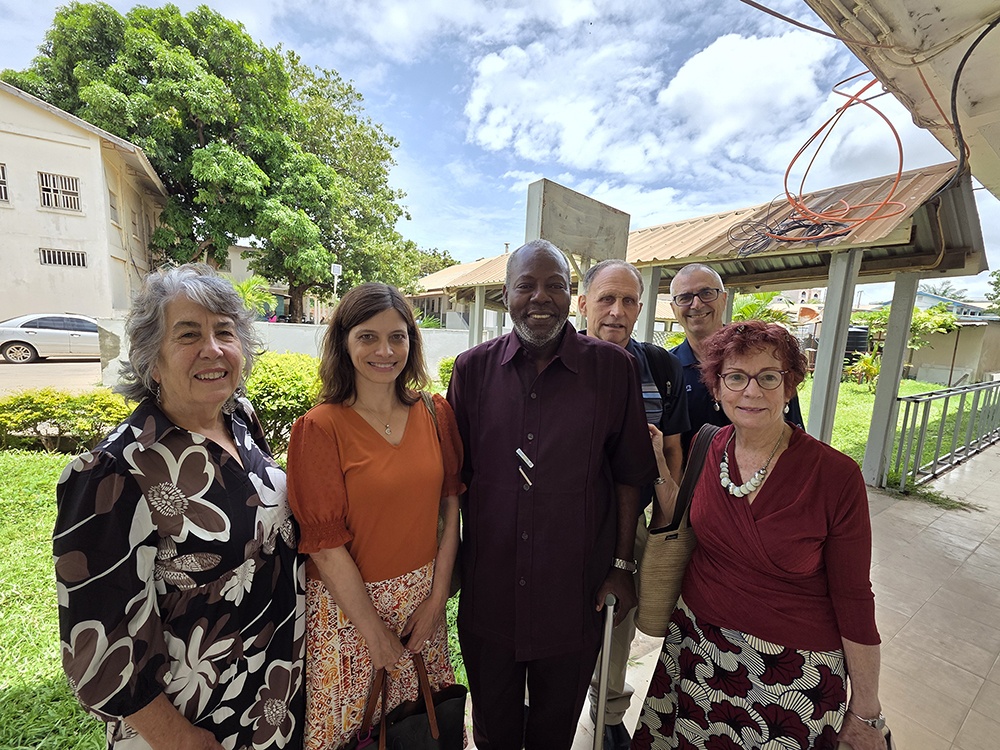
Read about how the team helped develop a policy that provides a blueprint to protect health care workers from occupational hazards in the latest issue of “CATALYST” magazine.
When Melissa McDiarmid, MD, MPH, DABT, began her career in occupational and environmental medicine, she never imagined her path would take her from Baltimore classrooms and clinics to shaping national health policy in West Africa. Today, she and her colleague Joanna Gaitens, PhD, MSN, MPH, RN, both faculty members in the University of Maryland School of Medicine’s (UMSOM) Division of Occupational and Environmental Medicine, are demonstrating how academic medicine can drive real-world change in global health.
Their latest work — anchored by a project supported through the University of Maryland, Baltimore (UMB) President’s Global Impact Fund — is transforming how health care workers in The Gambia are protected from occupational hazards.
Protecting Those Who Protect Us
Health care workers are the backbone of any health system, yet in many parts of the world, their occupational risks — from exposure to bloodborne pathogens to unsafe medical waste — remain unaddressed. In The Gambia, McDiarmid and Gaitens partnered with the Ministry of Health and the University of The Gambia to tackle these challenges head-on.
Together, they identified three urgent priorities: prevention of bloodborne hazards, airborne infection control, and safe medical waste management. Through sustained collaboration and capacity building, this work culminated in the creation and validation of The Gambia’s National Occupational Health and Safety Policy for Healthcare Workers in 2020.
“This was not about parachuting in with a ready-made solution,” McDiarmid explains. “Our goal was to work side by side with Gambian colleagues to develop strategies that made sense in their context — anchored in their own laws, customs, and health system realities. That’s what true global health partnership looks like.”
The new policy, rooted in existing legislation such as The Gambia’s Public Health Act and National Environment Management Act, provides a blueprint for protecting health care workers while strengthening the nation’s health system as a whole.
Read more about the UMSOM team's work in The Gambia.
The latest issue of "CATALYST" magazine highlights the School of Nursing's work with HIV and mental health in Nigeria; a Maryland Carey Law fellowship honoring the legacy of graduate Eric Garvin; the new Master's in Trauma Sciences Program launched by the School of Medicine and School of Graduate Studies; UMB's health care pipeline for students from underserved rural areas such as the Eastern Shore; UMB's innovative policing; Five Questions with VP for Research Patrick O'Shea; and much more.