UMB is becoming a national leader in psychedelic education, uniting Pharmacy, Social Work, and Nursing to train current and future clinicians for safe, ethical psychedelic-assisted therapies.
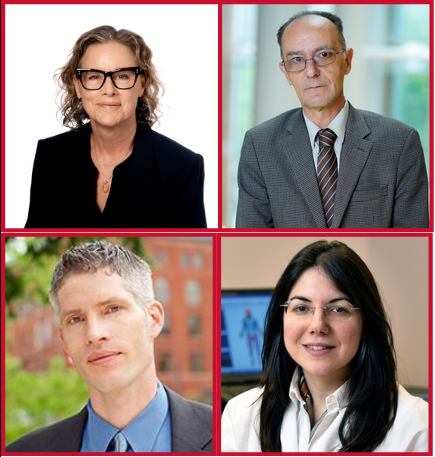
Photos, clockwise from top left: Megan Meyer, Andrew Coop, Luana Colloca, John Cagle.
The University of Maryland, Baltimore (UMB) is rapidly emerging as a national hub for psychedelic education and workforce training, powered by a unique collaboration across the University of Maryland Schools of Pharmacy, Social Work, and Nursing. Together, faculty leaders are building an integrated pathway that includes public education and policy, continuing education, and credit-bearing coursework to prepare health and mental health professionals for the evolving landscape of psychedelic-assisted therapies (PAT).
State Leadership and Andrew Coop
At the forefront of this work is Andrew Coop, PhD, professor and associate dean for students at the University of Maryland School of Pharmacy (UMSOP) and chair of the Maryland Task Force on the Use of Natural Psychedelic Substances. In this statewide role, Coop has testified before the legislature, guided task force deliberations, and participated in public listening sessions to help lawmakers and communities understand both the promise and the risks of natural psychedelics for therapeutic use. The task force’s interim report has begun to position Maryland as a cautious but forward-looking leader, emphasizing safe, evidence-based frameworks for any future psychedelic policy changes.
Megan Meyer Centering Social Work in the Psychedelic Renaissance
Megan Meyer, MSW, PhD, associate professor at the University of Maryland School of Social Work (UMSSW), emerged as a key architect of UMB’s psychedelic education strategy, ensuring that the values and workforce realities of social work are central to this rapidly evolving field. Meyer led the UMB Center for Addiction, Research, Education, and Service (CARES)-funded survey of social workers and nurses that documented both strong interest in PAT and significant gaps in training, helping to define the competencies needed for safe, ethical practice. Her leadership has gained growing public visibility through national and regional media coverage, including appearances on Elsevier’s “Raise the Line” podcast, interviews on WYPR’s “On the Record,” and features highlighting UMSSW's psychedelic work in outlets such as The Baltimore Sun. Meyer also presents widely at professional conferences and education forums, where she emphasizes the critical role of social workers in harm reduction, ethical practice, and equitable access as PAT moves from trials into real-world care settings.
Building Multidisciplinary Psychedelic Education
Within UMB, a multidisciplinary team launched in 2023 with a goal of developing accessible, affordable training in the science and practice of PAT for the health and mental health workforce. In response, the Schools of Social Work, Pharmacy, and Nursing co-developed a highly successful continuing interprofessional education series during the 2024-25 academic year, “Multidisciplinary Perspectives on the Science and Practice of Psychedelic Therapies,” which drew more than 200 students and licensed practitioners as audience members and covered topics ranging from psychopharmacology and clinical trials to ethics, access, and harm reduction.
U-PEP Fellows and National Recognition
UMB’s growing prominence is further enhanced by the selection of Meyer and John Cagle, MSW, PhD, professor at UMSSW, and Luana Colloca, MD, PhD, MS, professor and director of the Placebo Beyond Opinions Center at the University of Maryland School of Nursing (UMSON), as fellows in the University Psychedelic Education Program (U-PEP), a national initiative funded by the Joe and Sandy Samberg Foundation. As part of a U-PEP cohort of 60 fellows from 30 universities, they are immersed in advanced education and networking with leading scholars and clinicians to support integration of evidence-based psychedelic content into master’s-level curricula in social work and nursing. Colloca has also brought national attention to methodological questions in psychedelic science by convening a panel on placebo effects in psychedelic trials as part of UMSON’s “Placebo Beyond Opinions” lecture series.
UMB IPE Center Sustaining Grant
Building on this momentum, the team secured a two-year sustaining grant from the UMB Center for Interprofessional Education (IPE) to design a shared interprofessional curricular infrastructure in psychedelic science and therapeutics. The grant supports the creation of two interdisciplinary, credit-bearing courses in psychedelic science and PAT foundations, hosted by UMSSW and UMSOP and to be offered as electives to students across UMB. These courses will offer students core knowledge in psychedelic history, pharmacology, clinical research, harm reduction, social justice, and the legal landscape and will prepare them for advanced training through an interdisciplinary PAT certificate delivered via continuing professional education. The team is also developing continuing interprofessional education workshops that dive deeper into PAT for conditions such as PTSD, depression, anxiety, addiction, and palliative care. This work was recently highlighted at the annual UMB Center for IPE symposium on Nov. 19, where Meyer and Coop presented an overview of this three-year effort.
Positioning UMB for a Changing Policy Landscape
As Maryland considers potential legalization of PAT, UMB’s integrated strategy aims to serve two primary audiences — graduate students and licensed health and mental health professionals — with two tiers of preparation: foundational education and advanced, practice-oriented training. By combining state-level leadership with U-PEP-supported curriculum development, UMB is positioning itself as a key education provider in the emerging psychedelic ecosystem of care, capable of supporting safe, ethical, and equitable access to these therapies in the years ahead.