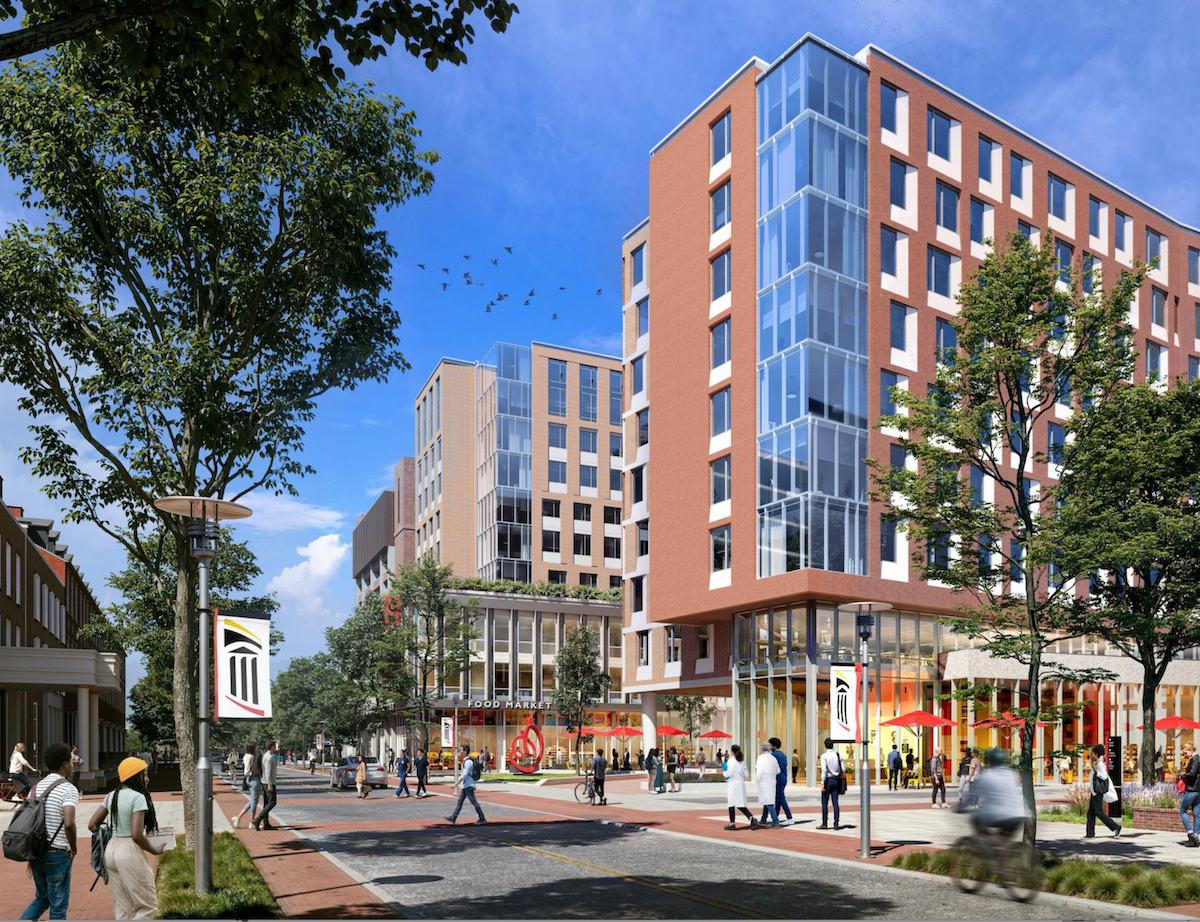
The plan would transform the north end of UMB’s campus into a bustling “Collegetown” with housing, retail, and outdoor entertainment and recreation space.
The University System of Maryland Board of Regents gave the green light Feb. 13 to a plan that will transform the sparsely used north end of the University of Maryland, Baltimore (UMB) campus into a bustling “Collegetown,” with housing, retail, and even outdoor entertainment and recreation space. The West Lexington Corridor project, as it’s called, is a significant part of UMB’s overall Vibrancy Initiative, something University leadership has been bringing into focus over the last two years.
“We think it benefits the University. It benefits the students that come here. It benefits the faculty, staff, and, as importantly, it benefits the city,” UMB Provost and Executive Vice President Roger J. Ward, EdD, JD, MSL, MPA, said at a UMB Staff Senate meeting last February. “And we think that with some of the experiences that we’ve had with the BioPark and some of the assets that we have, we could, together with the city and other developers, take the lead in creating what Baltimore so badly is missing.”
“Where can you live where you’ve got a Broadway theater?” UMB President Bruce E. Jarrell, MD, FACS, added. “You've got a Major League Baseball team, a major football team. You’re going to have a rejuvenated Inner Harbor and a vibrant downtown.”
The ultimate goal, summed up clearly by Chief Enterprise and Economic Development Officer and Senior Vice President James L. Hughes, MBA, the architect of so many new developments on and near campus, is to “create the type of environment that everybody says, ‘Wow, that’s a great university. I want to go to school there. I want to work there. And it’s one of the best places in Baltimore, and really the region, to live.’”
The West Lexington Corridor project will redevelop key parcels along the 600 block of W. Lexington St., just west of Greene Street, between Pearl and Pine streets. By transitioning land-banked parcels into productive development sites, UMB is helping return long-underutilized property to the city’s tax rolls, creating a powerful win for the University, the city, local businesses, and the surrounding community.
“This project is a once-in-a-generation opportunity to transform a critical avenue of our campus and strengthen our connection to the neighborhood,” Jarrell said. “We are excited to take this next step toward creating a more vibrant, inclusive, and welcoming district that supports our students, faculty, staff, and the broader Baltimore community.”