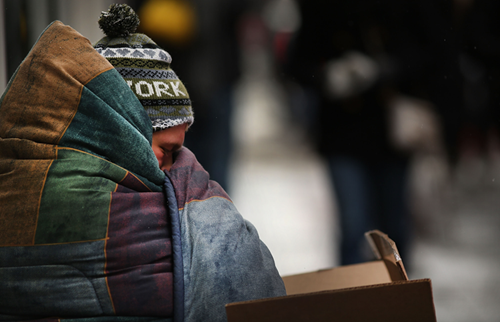
Community members can leverage community resources to make a difference for those in need.
Plummeting temperatures are particularly dangerous for vulnerable and at-risk populations, including unhoused persons. Below is helpful guidance for members of the University of Maryland, Baltimore (UMB) community hoping to make an impact.
The Challenges and the Solutions
Limited resources, growing need
Kind and well-meaning individuals who provide resources to one (or more) unhoused persons may inadvertently attract a large and/or returning group of vulnerable persons.
While the intent is good, this creates challenges for the individual who was trying to help and now faces unachievable expectations. It also increases the number of unhoused persons seeking resources at UMB, which is not equipped to offer long-term care.
UMB Police and Public Safety can connect those in need with ongoing, wraparound services to create a lasting impact.
Scams and crime
Police are seeing an increase in payment app scams. Here’s how it works:
An individual offers to send digital payment to a panhandler (e.g., unhoused person, squeegee worker). Once the app is open (e.g., CashApp, Apple Pay, Venmo, Paypal), the panhandler is given the phone to enter their payment information. Instead, they send themselves a large sum of money through the app.
Though rare, aggressive panhandling and physical theft may also occur.
- Never give a stranger your phone.
- Do not send payment to a stranger through a payment app. If you choose to give, consider small change from your pocket or care items (e.g., granola bar, bottle of water).
- Do not take out your wallet to give a stranger money.
- Never go with a stranger to an ATM.
- Keep vehicle windows up and doors locked. Do not get out of your vehicle. If you need immediate help, call 911.
Mental health and substance use challenges
Many unhoused persons suffer from mental illness and/or substance use challenges. Their behavior may be unusual or unpredictable.
Call 988 for behavioral health resources. Trained professionals can meet the person where they are and provide support.
Cold-related health concerns
Prolonged exposure to cold temperatures can lead to frostbite and hypothermia.
Look for symptoms such as:
- Shivering
- Redness or pain
- Numbness
- Exhaustion or drowsiness
- Confusion or difficulty speaking
Call 911 if you notice someone who is experiencing symptoms of hypothermia or frostbite.
Resources
Resources are available through UMB, Baltimore City, and community nonprofit organizations. These groups’ training and resources can create a larger, lasting impact for our community members in need. If you see someone who needs help, consider connecting with one of these resources.
UMB EMBRACE Initiative
The EMBRACE Initiative provides violence prevention programs, youth leadership and development programs, system transformation, training, and technical assistance.
https://www.umaryland.edu/embrace/
UMB Police and Public Safety Community Outreach and Support Team (COAST)
COAST connects vulnerable populations with resources and support through community partners.
Each winter, COAST gives out dozens of cold weather kits to vulnerable persons. These kits include gloves and a hat, personal hygiene items, food, and resource information.
410-706-6882
Baltimore City Mayor’s Office of Homeless Services (MOHS)
MOHS coordinates shelter, street outreach, and services through Baltimore City.
Call 311 or email HomelessOutreach@baltimorecity.gov to submit a homeless outreach request.
Crisis, Information, & Referral Line
Local behavioral health services resource. Available 24/7.
410-433-5175
MOHS Warming Shelters
When warming shelters are activated, the closest shelter to UMB is the Weinberg Housing & Resource Center at 620 Fallsway, 21202. It provides food and hot beverages and is open from 9 a.m. to 4 p.m.
Baltimore City Shelter Hotline: 443-984-9540
https://homeless.baltimorecity.gov/winter-shelter
Paul’s Place
Paul's Place provides:
- Meals (Monday to Friday, 11 a.m. to 12:30 p.m.)
- A weekly nurse’s clinic on Wednesdays during lunch
- Shower and laundry services
- One-on-one peer recovery support (Monday to Friday, 8 a.m. to 3 p.m.)
- After-school mentoring, tutoring, and enrichment programs for children and families
- Workforce development (Monday to Friday, 10 a.m. to 2 p.m.)
- Eight-week culinary training program
- Walk-in case management and community resources
Located steps from UMB at 1118 Ward St.
https://paulsplaceoutreach.org/
410-625-0775
Downtown Partnership of Baltimore (DPOB)
The DPOB Homeless Outreach team connects individuals to housing, addiction treatment, mental health services, career development resources, and more.
DPOB also cleans up trash and debris that is left once a unhoused person has moved on.
https://godowntownbaltimore.com/service-request/
Baltimore Crisis Response, Inc. (BCRI)
Provides behavioral health services and emotional support to individuals and communities navigating mental health and substance use challenges. A BCRI team member will meet you on the street to provide assistance.
988 (Suicide and Crisis Lifeline)