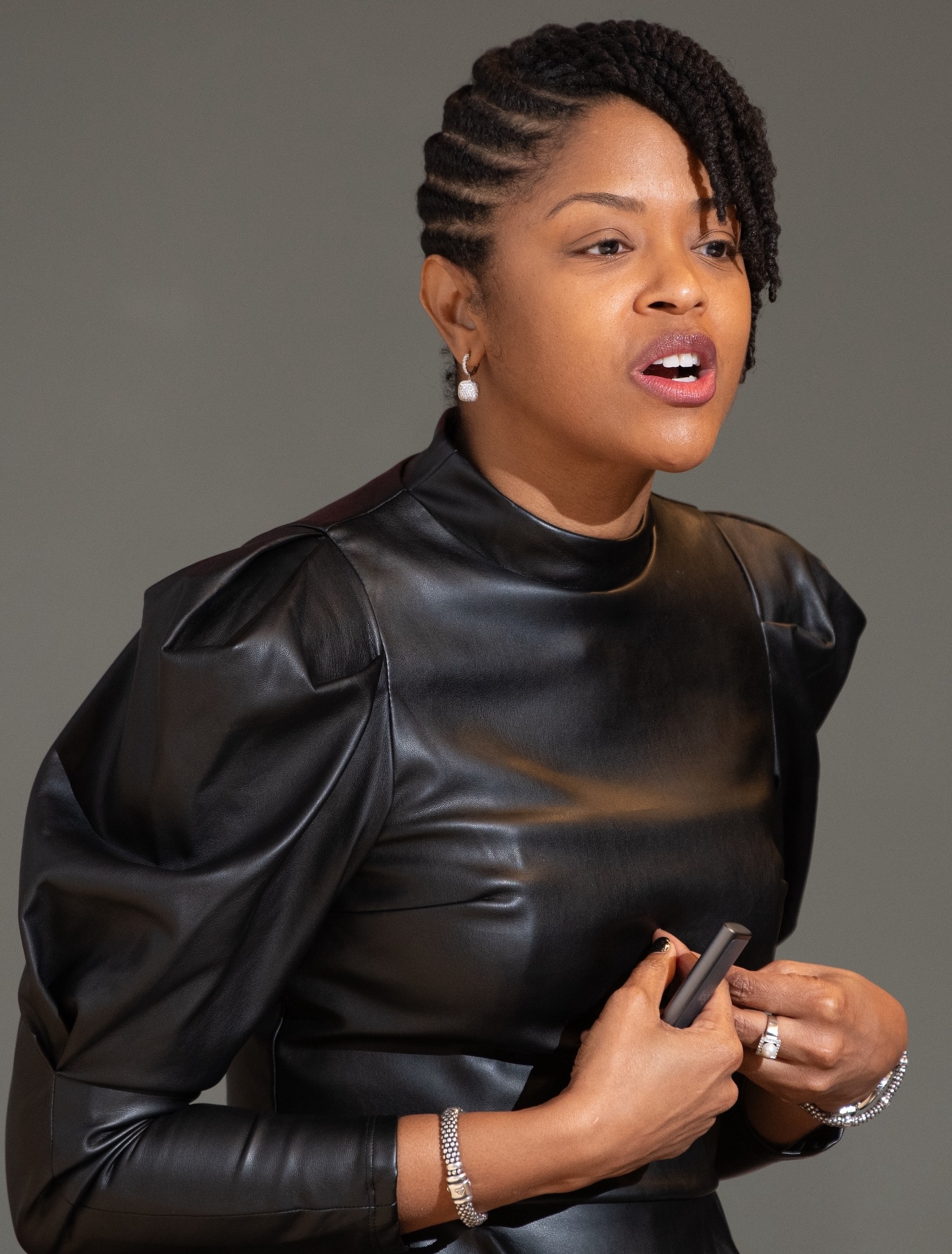
The University’s celebration of Black History Month includes recognition of leadership and community award winners and a spoken-word performance.
During the keynote speech at the University of Maryland, Baltimore’s (UMB) Rev. Dr. Martin Luther King Jr. and Black History Month Celebration on Feb. 5, Chris T. Pernell, MD, MPH, FACPM, interweaved stories about her relatives’ medical experiences into a call for health justice in the United States.
“If we are not uplifting the stories of those who are the most harmed, the most abused, the most disenfranchised, those who consistently are pushed off of the ‘Cliff of Good Health,’ then we are doing a detriment to the population as a whole,” Pernell, who is known as “Dr. Chris,” told the crowd of about 300 during her speech titled “The Clarion Call for Health Justice: No Retreat, No Surrender.” “Because the population as a whole can’t thrive and flourish as long as a half is not thriving and flourishing.”
Dr. Chris, a physician leader, social change agent, and director of the NAACP Center for Health Equity, where she provides strategic leadership on public health and community health initiatives with a focus on health equity and racial justice, said she was grateful to be addressing faculty, staff, and students at UMB, where Equity and Justice is one of the core values sets.
“I’ve sat across from heroes who have told me that work that centers on health care disparities or racism is not credible work. So to be in the midst of those who understand and have a commitment for the whole of humanity is not lost on me,” she said. “But still we must challenge ourselves in these specific times to understand the weight of the work that we do.”
Dr. Chris discussed the differences between equity and justice by showing a graphic of two people under a bent apple tree. Equity was giving the person on the one side a taller ladder to reach the apples, but justice shows the tree being straightened by a system redesign so that both people can pick the apples from ladders of the same height.
“Justice is difficult work,” she said. “In honor of the man, the pantheon, the leader, the legend in whose name we gather today, justice is necessary work.”
Dr. Chris, who was working as the first chief strategic integration and health equity officer at University Hospital in Newark, N.J., when the COVID-19 pandemic started, went on to define health justice as the assurance of the conditions for optimal health for all people. She talked about her father’s death from COVID and working at a safety net hospital that was ground zero for the pandemic.
“I find myself the daughter of a man who loses his life to the COVID pandemic,” she said. “I find myself the cousin of two men who lose their lives to the COVID pandemic. I find myself the sister of a woman who’s struggling through breast cancer, gets COVID working at a large retailer, and is fighting both COVID and breast cancer at the same time. I find too many people still silent about why certain groups and populations are disproportionately being impacted.”
She said offering telehealth visits, free COVID tests, and vaccines whether you had insurance or not during the pandemic are examples of health justice.
Dr. Chris also said half of the power dynamics from a health perspective can be traced to your ZIP code and pointed out that her mother, who had Parkinson’s disease, was dismissed from an emergency room and told there was nothing wrong with her when she was later found to have a splenic artery aneurysm leaking blood into her belly. When her mother thought she was having a stroke, it took an ambulance 15 minutes to arrive.
“ZIP code is determining outcomes because of political, social, economic, and cultural forces and pressures that group certain resources in certain locations, systems that stratify access and opportunity according to certain privileges, leading to the outcomes that we see,” she said. “Collectively I know that as a nation, maybe you live in a different community than me, maybe you have a different history than me, but if I’m falling off the cliff, you’re falling off the cliff, too. And we’re experiencing that right now.”
Core Values
UMB President Bruce E. Jarrell, MD, FACS, kicked off the program by acknowledging the challenges that the University faces but emphasizing that UMB is grounded in its core values, including Equity and Justice.
“Dr. King certainly reminds us that each of us has the power to create meaningful change in the lives of others, and I hope that we all keep that in mind because that’s what universities do — create change in the lives of others,” he said. “We stand for serving the public good and improving the human condition, and we stand by our core values.
“At UMB, our hope is to continue to create and further a community of inclusion, that we advocate for all members of our community, and that our actions speak louder than our words.”
The program also included music by the Scott Strother Jazz Combo, which led the audience in singing the Black national anthem, “Lift Every Voice and Sing,” and a spoken-word performance by Ephraim Nehemiah.
“I feel like every movement requires art, whether to imagine a world that does not yet exist to show us what we’re fighting for or to give us a strength to endure what we are currently existing in,” Nehemiah said before performing their work “Can’t Give Up Now,” which featured part of the Mary Mary song of the same name.
The winners of the MLK Leadership Awards were also honored during the celebration:
Outstanding Faculty Member Tonya J. Webb, PhD, of the School of Medicine; Outstanding Staff Member Det. Cpl. William Epperson of UMB’s Department of Police and Public Safety; and Outstanding Student Group, the student members of the School of Nursing’s Strategic Engagement and Impact Council.
UMB recognized two Community Champion of Equity and Justice Award winners: Rev. Franklin Lance, DMin, MDiv, senior pastor at Mount Lebanon Baptist Church; and the CASH Campaign of Maryland, represented by co-founders Robin McKinney, MSW ’01, and Sara Johnson, MSW ’02.