Read how the tool has been reshaped to address conditions that are more prevalent in Peru in the latest issue of “CATALYST” magazine.
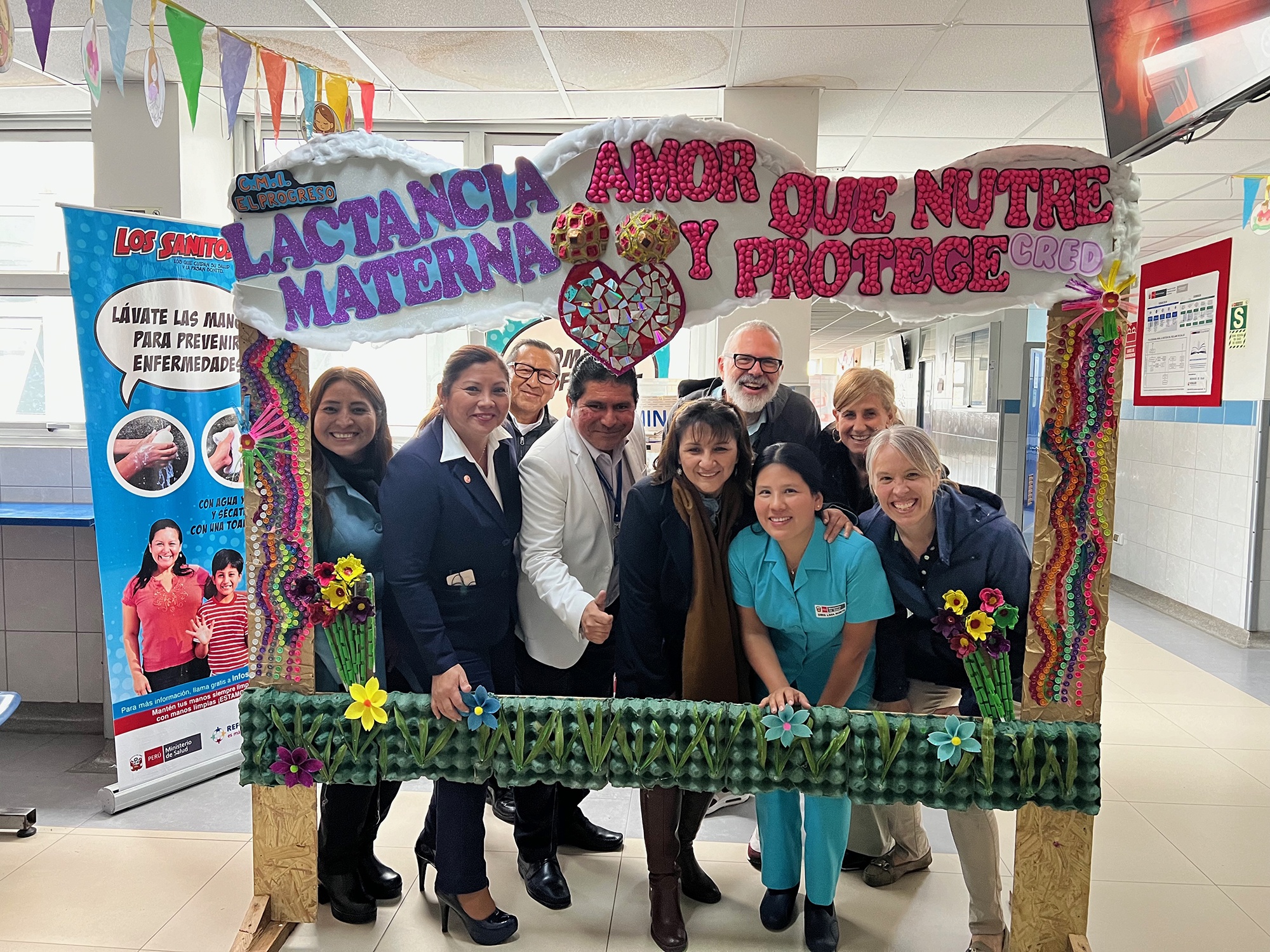
Photo: Jay Unick (back row, second from right) at a clinic in Peru. Photo courtesy of Jay Unick
When children in Peru enter the public health system, a nurse is expected to conduct a developmental screening for each child taking about 30 minutes. Given that there are more than 1 million children between the ages of 3 and 5 who need the screening, nurses face pressure to rush the screening or risk it being incomplete when the doctor sees the child.
A University of Maryland School of Social Work team, led by associate professor Jay Unick, PhD, believes a new digital screening can help. Partnering with Health Bridges International and Artemis Associates, and with support from the University of Maryland, Baltimore’s (UMB) President’s Global Impact Fund, they are adapting the Neurodevelopmental Ecological Screening Tool (NEST) for Peruvians.
The original NEST model, designed by psychologist Carmela de Caneda, provides a structured way for case managers with basic training to screen children. It was designed to be used in low-resource settings like homeless shelters, Unick explained. The scoring system and algorithm can help case managers determine the urgency and need of patients, signaling who needs further evaluation and who does not.
Parents can complete the screening on a tablet in the waiting room or at home before the appointment.
“What we really wanted to do was enable systems to operationalize and maximize resources in resource-constrained environments,” said Unick, who specializes in psychometrics.
In Peru, which has health systems and programs for different populations, Unick and his colleagues saw parallels of those challenges faced by U.S. shelters.
“We had a partner, Health Bridges International, that had worked with us domestically but has its primary presence in Peru,” he said. “They were like, ‘Hey, this sounds like a lot of the issues we’re facing in Peru.’ ”
Addressing Common Concerns in Peru
Adapting the tool has required more than a Spanish translation. NEST-Peru has been reshaped to address conditions more prevalent in the region.
“Anemia is a really big issue in Peru, which is not true in the United States,” Unick said. “So, we shifted some of those things, allowing the nurse to spend time assessing the child’s psychosocial development in a way that’s evidence-based.”
Parenting assessments also had to change, including assessing the mental health of the caregiver.
“There are different safety concerns, and there’s different parenting norms around how much freedom that you let your kids have,” Unick said.
Read more about the NEST project in CATALYST magazine.
The latest issue of "CATALYST" magazine highlights the School of Medicine's impact building safer health systems in The Gambia; the School of Nursing's work with HIV and mental health in Nigeria; a Maryland Carey Law fellowship honoring the legacy of graduate Eric Garvin; UMB's health care pipeline for students from underserved rural areas such as the Eastern Shore; UMB's innovative policing; Five Questions with VP for Research Patrick O'Shea; and much more.