The University’s Employee Pantry — a temporary initiative to fill the gap during the federal SNAP benefit lapse — will remain open into the spring.
Since Nov. 11, more than 550 bags with canned produce, cereal and shelf-stable milk, pasta, seasoning, personal hygiene items, baby formula, and more have been carefully packed for the University of Maryland, Baltimore (UMB) Employee Pantry. Now, UMB leaders are extending access to this free resource through April 2026.
The Pantry’s Quick Beginnings
The UMB Employee Pantry went from an idea to a reality in less than one week.
In late October, Maryland Gov. Wes Moore declared a state of emergency due to the funding halt for Supplemental Nutrition Assistance Program (SNAP) benefits as a result of the record-breaking government shutdown. At UMB, a team formed to develop a plan to support UMB employees who may have been impacted.
“With SNAP benefits being cut off, federal workers not getting paid and not knowing what was happening, and with many facing unemployment, we know people were going through a difficult time,” said Dawn Rhodes, DBA, chief business and finance officer and senior vice president. “Opening an employee pantry made so much sense. It not only gives us a way to help our own, but to lead by example and to live our core values.”
With a plan in place, a newly formed collaborative team leveraged expertise from the Division of Student Affairs (DSA) Office of Student Success, Leadership, and Engagement — who run the UMB Student Pantry — to expand inventory and sort through logistical challenges, such as how to receive, fill, and deliver orders.
“Developing the infrastructure for the UMB Student Pantry was an important opportunity to think systemically about food access. It has been an honor to help build a strong, sustainable, and scalable model that not only continues to meet students’ immediate needs, but also could be utilized for the quick and thoughtful launch of a pantry to support UMB employees,” said Courtney J. Jones Carney, DPA, MBA, assistant vice president of student affairs and assistant professor in the University of Maryland School of Graduate Studies.
With the UMB Office of Emergency Management (OEM) at the helm, additional employees from the Office of Public and Occupational Health, Human Resource Services, DSA Office of Facilities and Operations, and Center for Information Technology Services quickly set to work.
Spreading the Word
If you build it, will they come?
As OEM worked through logistical challenges related to coordinating and staffing the new temporary Employee Pantry, the Office of Communications and Public Affairs (OCPA) quickly got to work spreading the word.
On Friday, Nov. 7, OCPA’s team received the request to build an Employee Pantry webpage that included general information on the initiative, instructions on how to order food online and where to pick it up, and a list of other governmental, nonprofit, and UMB resources that employees could tap for further assistance. The team also worked on articles, newsletters, announcements, and a Universitywide letter from President Bruce E. Jarrell, MD, FACS. That letter came out on Tuesday, Nov. 11 — just two business days after receiving the original request.
“It was a team effort by our office, including web developers, marketing specialists, editors, and others,” said Laura Kozak, MA, chief marketing officer and senior associate vice president, OCPA. “We were happy to collaborate with other UMB staff to get the word out about the Employee Pantry in a timely manner so employees could access these resources during the federal shutdown.”
A Rise in Demand
Orders pour in at the UMB Employee Pantry.
The UMB Employee Pantry is open to all University employees; there are no income requirements. In its first day, the pantry filled 54 orders. The UMB Student Pantry received a surge of 24 orders.
As the operation grew, so did the number of partners. Volunteers from DSA, Environmental Health and Safety, Police and Public Safety, Office of the Fire Marshal, and Design and Construction helped with bulk purchases, inventory, packing bags, and distributing orders to employees. Employees from the Health Sciences and Human Services Library and the Thurgood Marshall Law Library assisted employees with placing orders.
By the end of December, 552 orders were placed by more than 250 employees. Canned tuna, soup, peanut butter, vegetable oil, ramen, soap, honey, and pancake mix topped the list of most-requested items.
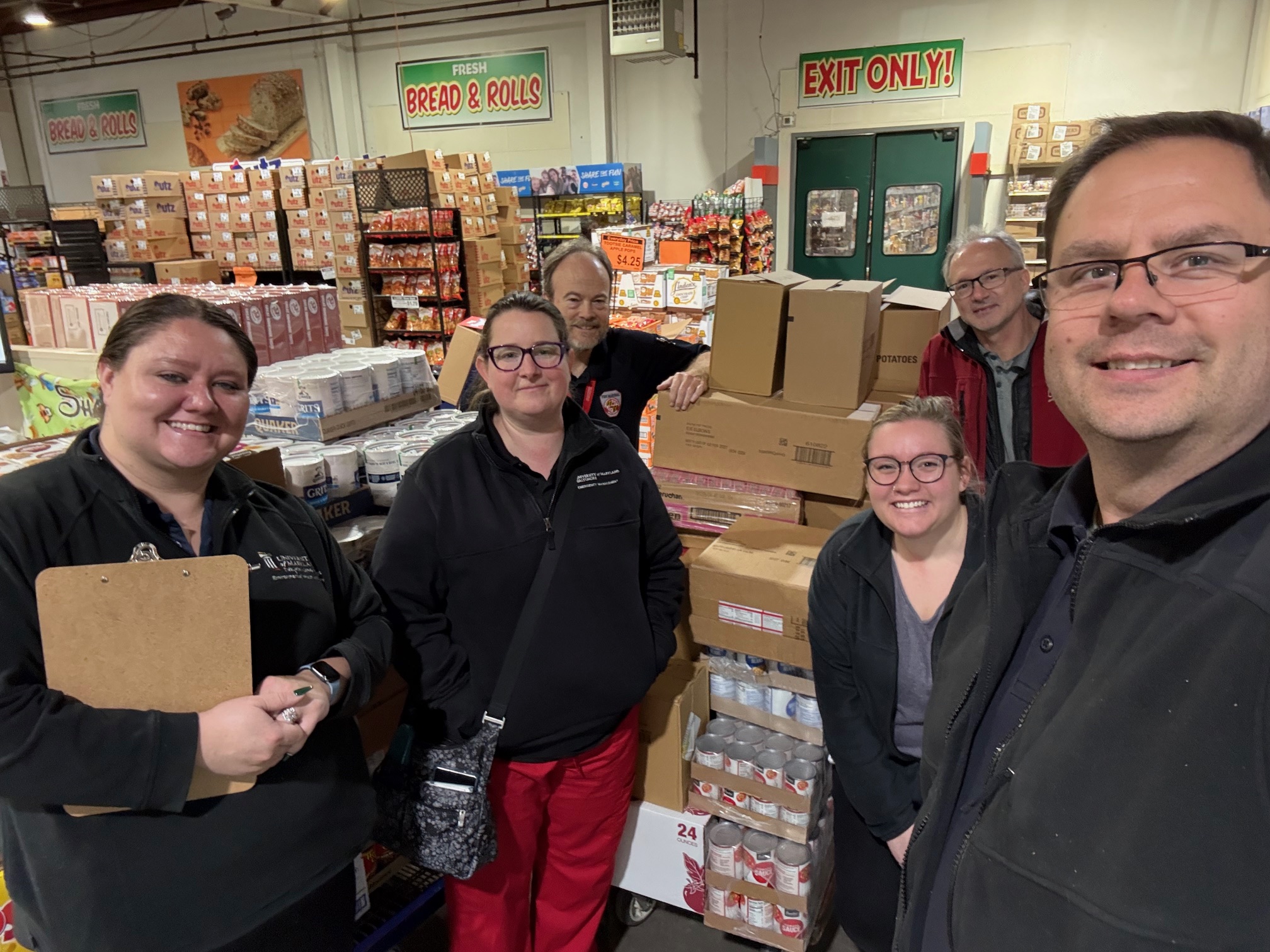
Stocking the pantry was a heavy lift — literally. Three tons of food comes from the Maryland Food Bank each month. OEM made two large trips to B Green Cash & Carry — a local wholesaler in the Camden Carroll neighborhood — filling an Environmental Services moving truck. And then there were orders from Amazon, which included personal hygiene items and special dietary items such as gluten-free, halal, kosher, vegan, and more.
“I have never seen such a large Amazon delivery,” said Laura Cathcart, PhD, OEM capability development manager. “The boxes just kept coming and coming. It took three of us over an hour to unpack them all.”
The logistics are mind-boggling. OEM and DSA manage the Maryland Food Bank’s fluctuating availability of items, then supplement from other vendors to keep a diverse array of items in stock. Teams of volunteers load and unload supplies, organize, and log the inventory.
UMB has spent more than $21,000 on inventory and supplies to get the Employee Pantry up and running. Financial donations through the UMB Food Security Fund also support the purchase of items for both the Employee and Student Pantries.
Understanding Food Access
Launching research to understand employee needs.
Research on food access within higher education has expanded in recent years, yet it has largely centered on student experiences. This presents an important opportunity for institutions to broaden the evidence base by examining food access and food-related experiences among University employees, strengthening understanding of how food insecurity affects the full campus community, and informing more inclusive, data-driven support strategies.
In late January or early February, UMB will launch a research study designed to better understand food access and food-related experiences among UMB employees. The study will begin with an online survey that explores employees’ experiences with food access, utilization of available resources (including the UMB Employee Pantry), and perceived barriers and supports related to meeting their food goals.
At the end of the survey, participants will have the option to indicate interest in a voluntary follow-up interview. The purpose of the optional interview is to gain deeper insight into employees’ food access experiences, patterns of pantry use, and perspectives on how UMB can continue to support food security across the campus community.
Together, the survey and interview data will provide a more comprehensive understanding of employee food access and potentially inform future institutional planning. If you would like to contact the principal investigator, Dr. Courtney J. Jones Carney, please email courtney.carney@umaryland.edu.
Well-Being In Action
“Thank you for being dedicated to the health and success of employees.”
Positive feedback came rolling in from employees who used the pantry, including from UMB employees married to furloughed federal employees who shared their thanks.
“My husband is a Federal employee and it has been a long 41 days,” wrote one employee. “Thank you for this.” Another employee echoed the sentiment: UMB’s support helped fill basic food needs while their partner went unpaid for more than a month.
The rising cost of groceries and bills contributed to the UMB Employee Pantry’s value. Staples from the pantry supplement family meals and lunches at work.
“The food pantry offered us essential items during a challenging time, allowing our family to prioritize more pressing bills and the needs of our children,” wrote another employee. “We are deeply grateful for this support and the relief it provided during such uncertainty.”
As the holiday season approached, the messages of thanks continued. Employees using the pantry shared that the food helped put Thanksgiving dinner on the table. Others shared that the pantry provided relief when family members experienced job layoffs.
“During a time when I was feeling stressed, the pantry offered not only nourishment but also a sense of comfort,” another pantry recipient wrote. “What meant the most was feeling welcomed as part of the UMB community. The kindness showed by the employee pantry reminded me that I’m not facing challenges alone — that I’m part of a caring and supportive community that looks out for one another. The understanding and support for UMB community members truly makes a difference.”
Dozens of UMB employees worked together over thousands of hours to successfully launch and run a complex pantry operation. Within its first 72 hours, orders poured in from Central Administration and most schools. In addition to the pantry’s current offerings, employees continue to request additional household essentials and fresh, healthy options.
Another employee wrote, “It truly makes a difference when an organization steps up to support its employees. Acts of care and assistance not only help during challenging times but also build a stronger, more connected community. Thank you for being an example of compassion and commitment.”
What began as an unprecedented disruption to critical resources became a Universitywide commitment to employee well-being. The headlines diminished. The need has not.