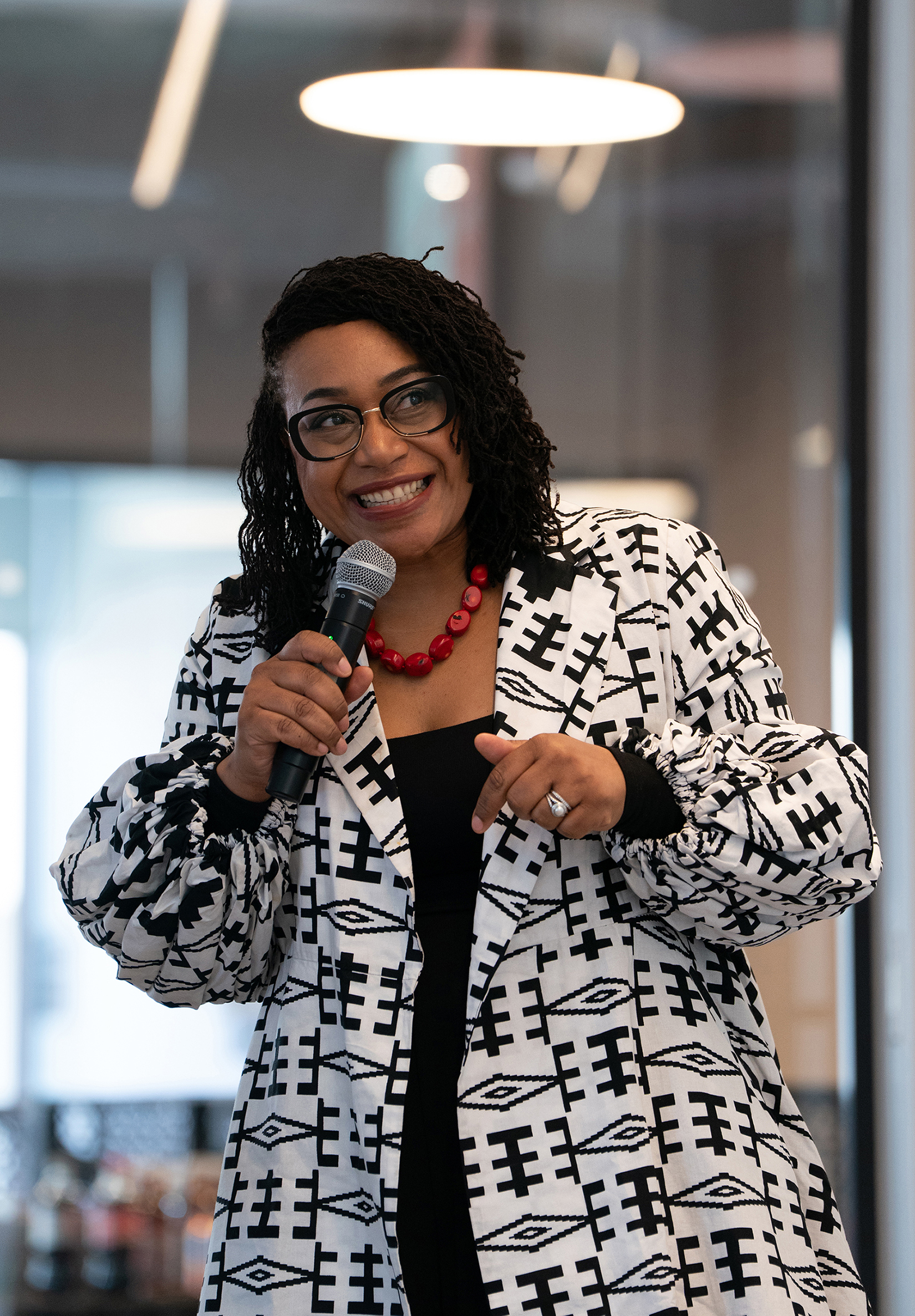
It’s important to study past inequities before moving forward to promote and advance the UMB core values set of Equity and Justice, Rhea Roper Nedd says during her presentation.
Photo: Rhea Roper Nedd delivers her presentation, titled “Sankofa: A Historical Reflection and Future Intention of Equity and Justice.” (Photo by Matthew D’Agostino)
Rhea Roper Nedd, PhD, MA, took a hybrid audience on a journey March 9 at the 4MLK building as the featured guest in the University of Maryland, Baltimore’s (UMB) Values in Action Speaker Series, delivering a presentation focused on the University’s core values set of Equity and Justice and how to ensure that UMB’s values are lived, challenged, and advanced across the University community.
Starting and ending in the West African country of Ghana, the trek included stops to discuss the “Door of No Return”; the Zong Massacre; and how equity and justice can be advanced through federal government laws, institutional policies and practices, and individuals’ actions and advocacy.
“This won’t be the easiest journey, because when we’re talking about equity and justice, there are some difficult historical and current day realities that need to be reflected on and acted on,” Roper Nedd, assistant vice president, Office of Inclusive Excellence and Institutional Effectiveness, said before beginning her presentation.
Her presentation, “Sankofa: A Historical Reflection and Future Intention of Equity and Justice,” began with a reflection on the meaning of the Sankofa Adinkra symbol. “The symbol is illustrated by a bird that has two feet placed forward, with its head turned backward,” Roper Nedd said. “What it represents is the belief that in order for us to truly move forward, we must reflect on the past.”
Roper Nedd — who as a faculty director at the University of Maryland, College Park developed and led multiple education abroad programs to Ghana — talked about her experience in visiting the Cape Coast Slave Castle, where enslaved people were once held and shipped away from their native lands, destined to be sold.
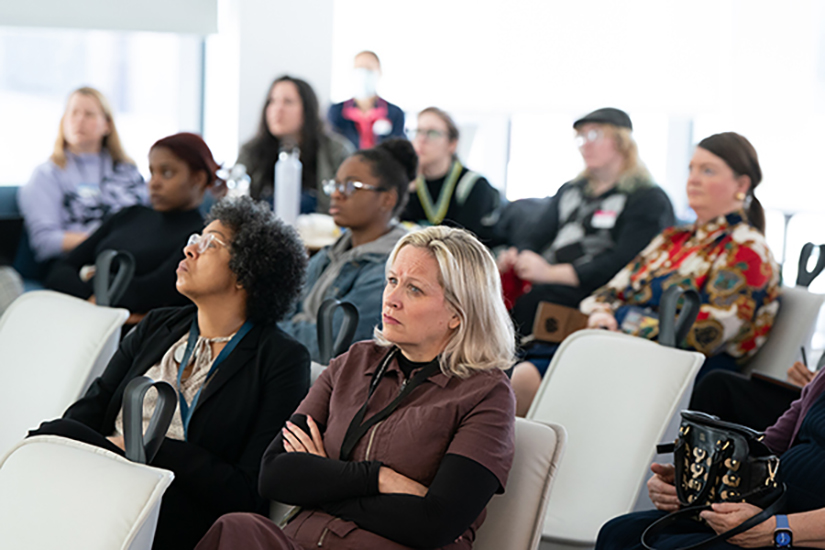 Attendees listen to Rhea Roper Nedd’s presentation March 9 at the 4MLK building. (Photo by Matthew D’Agostino)
The castle, she said, is “a massive structure — there are windows, doors, archways, and stairways, it’s white, and it looks grand on the surface, but what it represents is the physical environment of a story about global trade systems.”
She then took the audience down a flight of stairs where it was dark and showed photos of rooms with signs that read “Female Slave Dungeon” and “Male Slave Dungeon” over the entrances, as well as “The Door of No Return,” which was the final exit point for the enslaved people before they were sent across the Atlantic Ocean.
“The warmth of the sun that hit my body and the breeze that was on my face when I was above ground was a very different story below ground,” Roper Nedd said. “This is the Cape Coast Slave Castle. And seeing it forces us to confront how institutions, not just individuals, participated and benefited from the trade of human beings and enslaved people.
“It was an organized system. It was regulated. And it was permitted,” she added. “As we have these conversations, we should remember how these organized, regulated, and permitted systems can have unjust outcomes.”
With her reflections, Roper Nedd invited the audience to consider how systems — past and present — shape access, opportunity, and outcomes. Bringing this back to UMB, she asked the audience to question what is the responsibility of individuals and institutions to disrupt problematic patterns.
Historical Reflections Can Guide Future Intentions
Next, Roper Nedd took the audience across the Atlantic Ocean on the British slave ship Zong, which departed Accra, Ghana, in 1781 for Jamaica in the Caribbean and, due to countless navigational errors, bypassed its destination.
“There were several accounts as to why the crew murdered more than 130 enslaved people by throwing them overboard. Low water supplies was one account, and another account was the intent to file an insurance claim for lost ‘commodities.’ When taken to court, the law initially treated the deaths as a financial loss and the insurers were to compensate the ship’s owners. The dispute shifted, however, when testimony revealed that the enslaved people had been thrown overboard for the insurance claim.”
“So there was a dispute that it really was not lost commodities, but it was intentional, Roper Nedd said. “There was maritime law, there was insurance law, there was the court system. All of them reinforced this peril, the perils of the sea. They reinforced it. The system existed. But there were harmful outcomes that were normalized.”
Roper Nedd said the intent of this reflection and the reference to the Zong was intentional, designed to demonstrate how interconnected systems of maritime law, insurance law, and the courts collectively normalized injustice. This history underscores that systems can perpetuate injustice, yet systems also can be accountable to advance policies and practices that advance equity and justice.
Roper Nedd pivoted to contrast the terms “equity” and “equality,” noting the differences between the two concepts. Equality does not guarantee fairness in outcome based on the assumption that we all start from the same place, whereas with equity, resources are provided to each person based on what they need to succeed.
“We are human beings, and we are different,” she said. “People start from different positions, abilities, experiences, environments, and resources. In an equitable system, we have to adjust to those different characteristics of our human experience.”
Being a Catalyst for Equity and Justice
Roper Nedd described a number of ways to act as “catalysts for equity and justice” as individuals and institutions. People involved in higher education, she said, must confront historical and current inequities through polices, practices, and curricula; redress disparities and rebuild trust; redesign systems; and build and engage community.
For the UMB community, she suggested using inclusive language, affirming identity, engaging in dialogue, and promoting welcoming environments to create a sense of belonging and build community.
“Learning about others’ experiences is foundational to equity and justice,” Roper Nedd said. “No single perspective is sufficient; rather, it requires intentional reflection, action, dialogue, listening and learning, across differences.”
“Equity is an ongoing process,” she added. “Equity and justice extends beyond intention and input; it should also consider the outcomes. That is why we have to be intentional about the design and the intended impact of programs, policies, and systems with the aim of advancing more equitable and just outcomes.”
A Law Student’s Perspective
Before Roper Nedd’s presentation, Imani Vice, a Class of 2026 Juris Doctor student at the University of Maryland Francis King Carey School of Law, spoke about her work as a student attorney with the school’s Decarceration Initiative Clinic and representing prisoners who maintain their innocence. Vice (in photo, left) pointed to the Cardin Requirement — which mandates that Maryland Carey Law students provide legal services to people who are poor or otherwise lack access to justice as a prerequisite for graduation — as a reason for choosing the school, saying the experience prepares students to gain knowledge that goes beyond legal theory.
Vice presented hypothetical prison terms for second-degree murder, armed robbery, and participating in a carjacking that resulted in the paralysis of the victim, asking attendees if the 40-, 75-, and 90-year terms were just — nobody in the audience said “yes” — and whether their opinion would be affected when adding varying extenuating circumstances to each case.
“While I helped support those within my cohort as they juggled questions similar to these examples, these weren’t issues I had to grapple with,” she said. “I struggled with a different dilemma: How do you tell the court, respectfully, ‘Justice was never served. An innocent man has been imprisoned for 30 years for a crime he did not commit?’
“Representing my client who has maintained his innocence for longer than I’ve been alive has been the greatest challenge to my understanding of justice so far,” Vice added. “I wish I could conclude this portion of the talk with the amazing news that my client’s motion has been granted and he has a release date. Unfortunately, we’re still waiting to hear back from the court on what his future will be.”
She concluded by telling the audience that you don’t have to be a lawyer to confront injustice and praising UMB for its commitment to equity and justice.
“I don’t want to convey that fighting for justice, in a world where injustice is so prevalent, is futile,” Vice said. “Instead, I want to impress upon us all just how privileged we are to be a part of a community that has Equity and Justice as core values.”
She asked attendees to consider how those core values can be exemplified in their lives, urging them “to hold those around you accountable to ensure that these values are not just words but callings upheld throughout the UMB community and beyond.”
‘Intentional Action’ Required
Shani Fleming, PhD, MSHS, MPH, PA-C, associate professor and assistant dean of values and strategic initiatives, University of Maryland School of Graduate Studies (UMSGS), praised the talks by Roper Nedd and Vice.
“The two presentations challenged attendees to reflect not only on the historical roots of inequity but also on their role within UMB’s ongoing commitment to equity and justice,” Fleming said. “As both speakers emphasized, advancing these values requires more than awareness. It calls for intentional action in how we teach, lead, serve, and build community to improve the human condition.”
The Values in Action Speaker Series is a collaboration between the Core Values Program at UMB and the Office of Values and Strategic Initiatives at the University of Maryland School of Graduate Studies. The series was created to recognize the ways that all members of the UMB community bring to life the hallmarks of our community. Register for the next event in the series, which will be held May 11 from noon to 1 p.m.