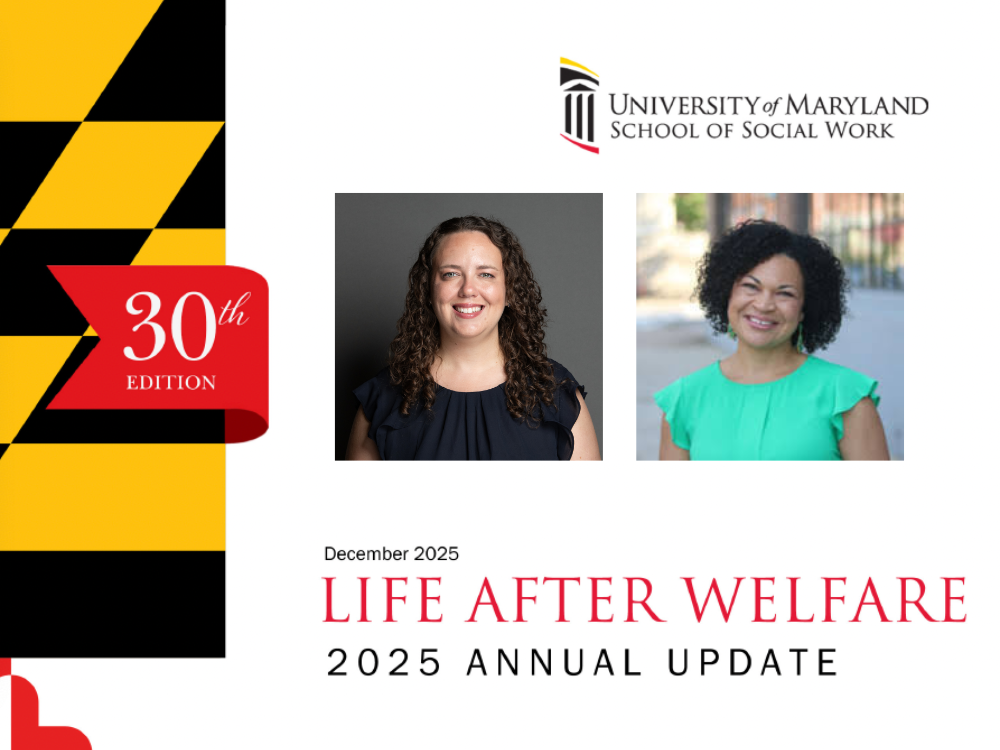
A new UMSSW report provides an in-depth state-level view of how people move through cash assistance programs before and after receiving support, going beyond traditional aggregate statistics.
A new report from the University of Maryland School of Social Work (UMSSW) provides an unprecedented look by any U.S. state at how the same people move through cash assistance programs before and after they receive help as opposed to aggregate-only data.
The “Life After Welfare: 2025 Annual Update” pdf follows more than 42,000 adults who exited Maryland’s Temporary Cash Assistance (TCA) — Maryland’s version of the federal Temporary Assistance for Needy Families (TANF) program — between state fiscal years 2020 and 2024. In addition to comparing different groups of people at different moments, researchers tracked changes within individuals. This shift reveals how employment and earnings evolve over time.
“It reveals the actual trajectories of those leaving cash assistance, showing how employment and earnings evolve for the same person before entry and after TCA exit,” said Lauren A. Schuyler, PhD, assistant research director of the UMSSW Family Welfare Research and Training Group, who is the lead author of the report. Individual progress can be masked through aggregated averages.
“We were able to see who had certain types of changes in employment — not just whether or not they were employed,” Schuyler said. “Did they move from having partial employment throughout the year to full employment? Did they have partial employment, and they then have no employment after they left?”
Maryland is the only state to have publicly tracked welfare leavers (recipients who leave TCA) for nearly three decades. The School of Social Work has partnered with the Maryland Department of Human Services (DHS) since 1997 for the “Life After Welfare” report, analyzing comprehensive administrative data sets on cash assistance. Using DHS administrative data, the report examines cases of 42,459 adult recipients.
“For 30 years, Maryland has shined on a light on what happens to families after leaving TCA,” said Letitia Logan Passarella, MPP, research director of the UMSSW Family Welfare Research and Training Group and co-author of the report. “This year’s report goes even further — tracking individual families to better understand those journeys. This insight is critical for shaping policies that support economic stability.”