Pamela Peeke and Michelle Singletary discuss health and wealth with 200 participants at the daylong event.
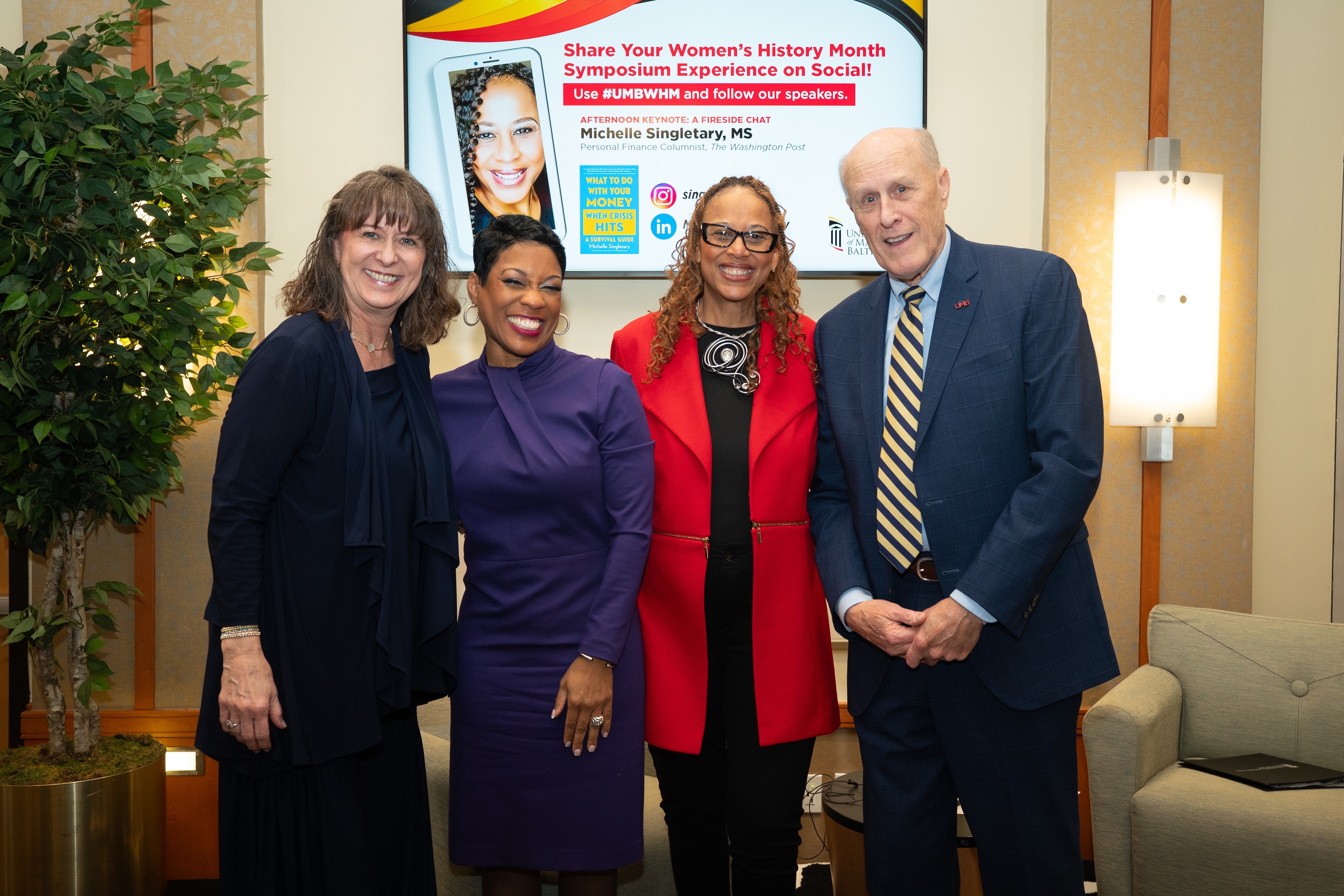
Photo: From left to right, Jennifer Litchman, Tisha Edwards, Michelle Singletary, and Bruce Jarrell (Photos by Matthew D'Agostino)
Thriving was the theme of the University of Maryland, Baltimore’s (UMB) Seventh Annual Women’s History Month Symposium on March 4, as the featured speakers and workshop presenters emphasized health, wealth, and resilience.
The daylong event kicked off with Jennifer B. Litchman, MA, chief external relations officer and senior vice president, highlighting the importance of celebrating women at the University.
“Today we will be talking about thriving: mental health, physical health, financial health, and emotional health, all the different kinds of health, that I think sometimes we, particularly as women, don’t pay enough attention to because we’re taking care of everyone else,” she told the 200 attendees before introducing the morning keynote speaker, Pamela Peeke, MD, MPH, FACP, FACSM, founder of the Peeke Performance Center for Healthy Living and adjunct assistant professor of family medicine at the University of Maryland School of Medicine.
Peeke, a physician-scientist and thought leader in the fields of integrative and lifestyle medicine who was speaking at the UMB event for the fourth time, compared life to a marathon.
“Every mile, every year in our lives are so special,” said Peeke, a marathoner who ran in the New York Marathon after the Sept. 11 terrorist attacks and in the Boston Marathon in 2012, the year before the bombing. “We have to kind of squeeze out of it what we can.”
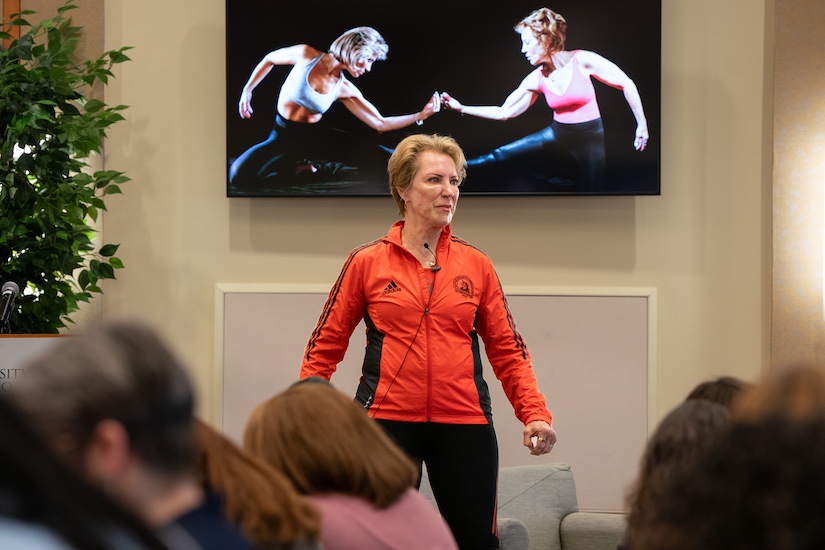
Photo: Pamela Peeke speaks at the UMB Women's History Month Symposium.
Peeke showed the audience a photo of herself from 40 years ago in which she posed for a photographer who was looking at the shadowing in women’s muscles, combined with a recent photo of herself in which she did the same pose. She said despite appearances, it was difficult to replicate.
“What would I tell my younger self?” she said before listing the 10 lessons she’s learned.
She talked about hormesis, the science behind the phrase “what doesn’t kill you makes you stronger.”
“Do hard things. Never be afraid,” Peeke said. “Your body and your brain, your mind and your spirit by definition are craving challenges. Boredom is a form of stress.”
She also emphasized adapting and adjusting and being resilient. “Run into the fire. Grab every single challenge you can,” she said. “You know why? Because you’re going to build up a very important muscle. And what is that muscle? Resilience. Resilience is the foundation, but it doesn’t come overnight. You get resilient. After finishing a marathon, you feel like you can do anything.”
Peeke told a story about running the Boston Marathon in the hottest temperature it had been in its history and coming upon a nurse who was 75 and listing as she ran. Peeke helped her by laughing with her along the way until she got her through the entire race.
“Be of service. Give of yourself,” Peeke said. “Science shows people live longer when they do. And plus, doesn’t it feel good?”
She also urged the participants to forgive.
“I have been blessed to be the part of many people’s journey with my patients in critical care,” she said. “And it was the people who never took the time to forgive who had the worst regrets. Just think for a second. Anyone really piss you off? Reverse it, reframe your brain. Turn it around. Forgive them, and then you’ll get rid of the 900 pounds you’ve been dragging around with you all this time.”
Her other lessons included: comfort is a cage (don’t be complacent); thank your body; reverse expectations (assume life is a problem until proven otherwise); have a license to chill; get your priorities straight; and play.
She closed her speech by quoting George Bernard Shaw: “Life is no brief candle to me. It is a sort of splendid torch, which I have got hold of it for just a moment. And I want to make it burn as brightly as possible before handing it on to the future generations.”
“Girlfriends, I’m handing it on,” Peeke said.
Financial Well-Being
UMB President Bruce E. Jarrell, MD, FACS, talked about the importance of inclusivity at the University as he introduced the afternoon session, a fireside chat moderated by Tisha Edwards, JD ’01, MSW ’00, president/CEO of the Maryland Bankers Association and member of the University System of Maryland Board of Regents, and featuring The Washington Post’s Michelle Singletary, MS, who writes “The Color of Money” personal finance column.
“We’re so pleased to celebrate Women’s History Month, to have a celebration like this and emphasize the importance of all of you,” he said.
Singletary, a Baltimore native, opened by talking about her upbringing: She was raised by her grandmother who was a good money manager but also worried about money all the time. Singletary said as a result she is a “money worrier.”
“Even though she’s really good at it, she writes about it, she understands it, she still stresses about it because of her upbringing,” Edwards said of Singletary. “So think about us, how we carry that trauma and that burden, and think about the clients we work with every day, that sometimes it doesn’t matter if you have money. You can still have that emotional baggage.”
They talked about how women are likely to be single, widowed, or divorced later in life and should be familiar with money so they aren’t taken advantage of.
“You have to be intimate with the numbers,” Singletary said. “You have to fight that fear so that you can handle it, because at some point, you will have to. We do a lot of things that we don’t want to do, and this is one of those things.”
Singletary sang Jennifer Hudson’s song “And I Am Telling You I’m Not Going” from “Dreamgirls,” changing the line "you’re gonna love me” to “you’re gonna love your budget” to emphasize that even if you don’t enjoy budgeting, it’s something you have to do. She said budgeting is powerful and used the example of being able to send all three of her children to college debt-free because of her budget: She told them this was what she and her husband could afford and stuck with that even when one of her children wanted to go out of state for college, which would have been a more expensive option.
“You have to fall in love with your budget,” Singletary said.
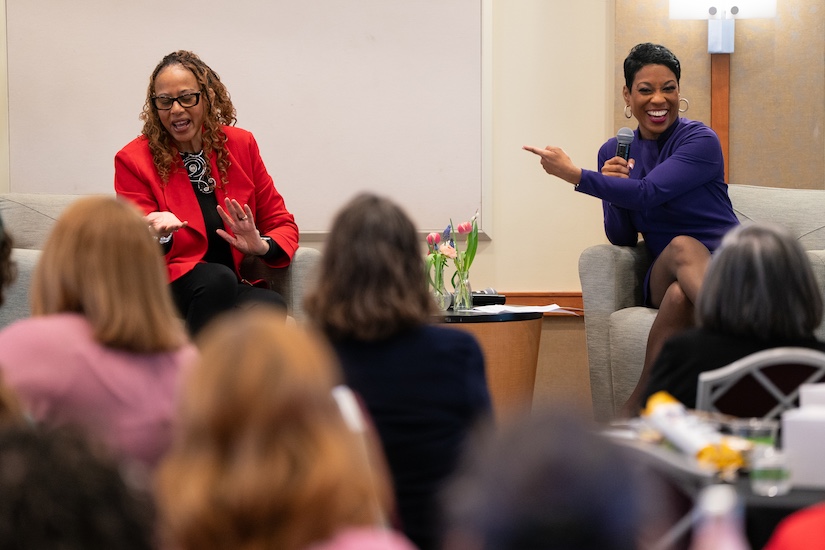
Photo: Michelle Singletary and Tisha Edwards speak at the Women's History Month Symposium.
She added that it’s never too late to budget for retirement.
“It means that you have to budget better now, so that you can put away more,” she said. “The later you wait, the more of the percentage of your check has to go to saving for retirement. But if I said it was too late, what does that mean? What does that do to your spirit, right? It’s just you have to make different decisions.”
Singletary’s advice included living by example for your children, owning your home debt-free, and completing a net worth statement.
“Your goal is to grow your net worth,” she said. “How do you know where you are going if you don’t know where you are?”
Singletary also — to some murmurs from the crowd — said there’s no line item for clothes shopping in a budget and told the story of how she wore the same outfit to counsel prisoners as she did for an appearance on "Meet the Press.” One of the prisoners approached her later and told her that made an impact on her, saying, “You must value me as much as you value the people who watch the show.”
“You have to care about things that are important,” Singletary said.
Edwards summed up Singletary’s advice: “No. 1, pay yourself first for your future. Taking control of your finances is a part of loving yourself.”
Attendee Nancy Schertzing, MS, director of the Restorative Approaches in Education Program for the Center for Dispute Resolution at the University of Maryland Francis King Carey School of Law, said the highlight of the event for her was learning with and from brilliant women.
“I believe females have a superpower for sharing wisdom and supporting each other,” she said. “That superpower was on full display in our opening speaker who inspired awe — and a little fear — advising us to ‘do hard things.’ Our afternoon speaker was equally awe-inspiring, but her wise advice was as nurturing as an heirloom quilt handed down through generations. The advice, food, and fellowship were delicious, nutritious, beautiful, and life-giving, just like the women who attended.”
Attendee Laurencia Hutton, DrPH, RN, CHES, school health officer and assistant professor, Department of Family and Community Health, University of Maryland School of Nursing, called the symposium “a day well spent.”
“I feel appreciated, knowing that the University values us and recognizes the importance of supporting our personal lives as there are many factors that influence how we show up at work,” she said. “When we’re supported in other areas of our lives, it helps us to be better employees.”
The day, which concluded with a social hour, also included impactful, insightful, and interactive morning and afternoon breakout workshops:
- “Empowered for a Healthy Midlife: A Conversation About Menopause,” presented by Madeline A. Dick-Biascoechea, MD
- “Health and Wellness for Career Women in Their 20s, 30s, and Beyond,” presented by May H. Blanchard, MD, FACOG
- “Beneath the Surface: Our Experiences, Assumptions, and Empathy in Healing from Grief,” presented by Rev. Meagan P. Downing, MDiv, BCC
- “Navigating Change with Hope and Humanity: Building Resilience in Times of Upheaval,” presented by Jill Wardell, MA
- “Sound Bath Therapy,” morning session, presented by Catarina De Sousa Henriques
- “Growth Mindset Flowerpots Workshop,” presented by Sofie Benson and Jamie Freed
- “The Sandwich Generation: Balancing Life While Caring for Aging Loved Ones,” presented by Katie Kecman, MS
- “Never Let Them See You Sweat: How Science Can Help Us Harness Stress for Success,” presented by Leigh Vinocur, MD, MS, FACEP
- “Sound Bath Therapy,” afternoon session, presented by Shabnam Khan, RN
- “Chair Yoga,” presented by Catarina De Sousa Henriques