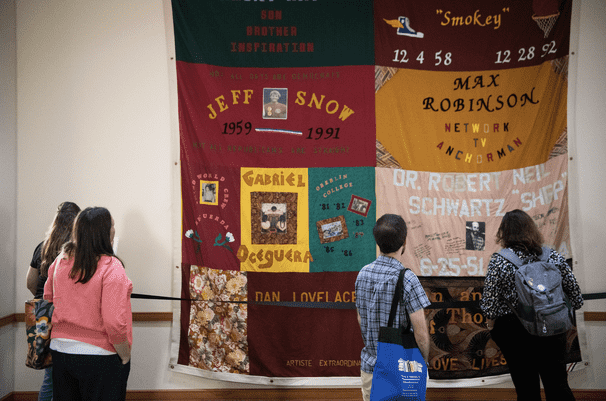
A Thursz Lecture panel brought together HIV advocates, AIDS Memorial Quilt co-founders, and a filmmaker to reflect on the epidemic’s history.
Amid the peak of the HIV/AIDS epidemic, Eric L. Anderson visited Washington, D.C., to view the AIDS Memorial Quilt as it stretched over 30 acres on the National Mall.
At that point in 1996, Anderson lived for five years with a HIV positive diagnosis. The 40,000 panels that laid in front of him represented lives lost to HIV/AIDS.
“I was looking at it, and wondering, who’s going to make a quilt for me?” an emotional Anderson recalled during the University of Maryland School of Social Work’s (UMSSW) Daniel Thursz Social Justice Lecture on Sept. 17. “I’m blessed because everybody didn’t get to survive as I did.”
Anderson’s survivor journey today includes outreach and advocacy — both as a Ryan White HIV/AIDS Eligibility Specialist with the University of Maryland School of Medicine (UMSOM) Institute for Human Virology’s (IHV) Together, Healing, Reaching, Inspiring to achieve Victory over illness and Embrace life (THRIVE) Program, and as a president of the Coalition of Baltimore HIV Providers.
His experience was part of a panel during the Thursz Lecture, “Past, Present, and Future: HIV, Gert’s Boys, and The AIDS Memorial Quilt,” which brought together HIV advocates, Quilt co-founders, and a filmmaker to reflect on the epidemic’s history and the work that continues today.
Advocacy can take many forms. During the Thursz Lecture, a conversation about the AIDS Memorial Quilt examined how an artistic movement helped turn grief into action to amplify the voices of people living with HIV and AIDS, while bringing that history to life for generations of health professions and law students.
The event featured a screening of an award-winning documentary short, “Gert’s Boys,” that tells the story behind the AIDS Memorial Quilt and its first volunteer, Cindy “Gert” McMullin, who is considered the mother of the quilt that was conceived by activist Cleve Jones in 1987. The panels, the film explained, are considered her boys.
In addition to Anderson, McMullin was joined by quilt co-founder Mike Smith, and the film’s director Sara L. Schwartz, PhD, MSW, MA, associate professor of Teaching at the University of Southern California Suzanne Dworak-Peck School of Social Work. Schwartz also serves on the National AIDS Memorial board of directors.
“We are so deeply honored to have people here who represent caring and empathy,” said Corey S. Shdamiah, PhD, LLM, LLB, the Daniel Thursz Distinguished Professor of Social Justice at UMSSW, highlighting the panelists as models for the UMB community to learn how to help people in ways that are meaningful.