Read about how the communications center’s technology is integral to the UMB community’s safety in the latest issue of “CATALYST.”
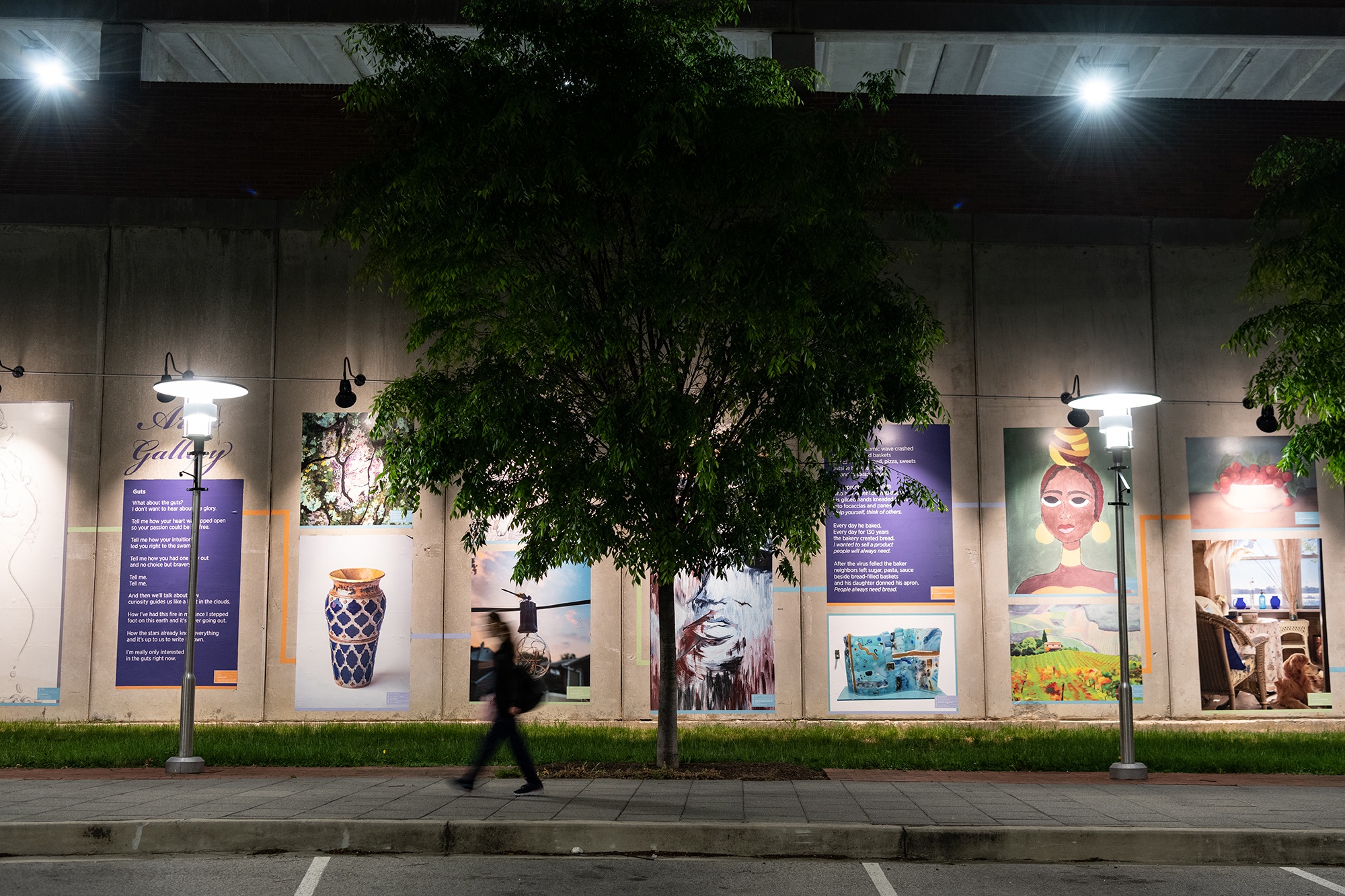
Photo: Among the upgrades, “the lighting on campus is better and brighter than ever. All these pieces work together to keep our community safe,” says Thomas Leone, MLS, assistant vice president for public safety and chief of police. Photo by Matthew D’Agostino
The room is dark, but inside it hums with activity: the crackle of a radio, the trill of a phone. Dozens of monitors line the walls displaying databases, camera feeds, and call logs. In the midst of this technological marvel sit two police communication operators (PCOs). Their calm demeanor pervades among the blinking lights and barrage of sound.
The University of Maryland, Baltimore (UMB) Department of Police and Public Safety’s communications center is the department’s nerve center. From here, PCOs manage several systems: phone calls, computer-aided dispatch, panic alarms, fire alarms, multiple camera networks, radios (including UMB police, security, maintenance, and parking, as well as local and state law enforcement partners), and more.
PCOs work hand-in-glove with the department’s sworn police officers and civilian security officers to deploy the right resources to the right people at the right time. The communications center’s technology is integral to the UMB community’s safety — which is why the department is investing in cutting-edge upgrades.
“Our leadership recognized the need to not only replace outdated systems, but to lead the way in collegiate communications,” said acting Major Todd Ring, MSL, who oversees the department’s camera project. So far, the department has replaced 350 internal and external cameras on UMB’s campus, including in University-owned parking garages. Ring says the number of cameras will double over the next year.
The vast number of cameras on campus provides better visibility and enhances community safety. The cameras can resolve conflicts or even prevent crime. Ring describes one situation in which an employee was thought to have broken a loading dock door.
“I knew exactly which camera showed the door. When we pulled the footage, we could prove that the employee didn’t break the door — there was a mechanical failure. That footage prevented a significant conflict,” Ring said.
In another instance, UMB Police received a complaint about a contractor who was being rude to UMB employees. Before canceling the contract, the department pulled the footage to find supporting evidence and identify witnesses to the bad behavior.
700 Cameras
PCOs always monitor a core group of cameras. After all, it’s impossible to watch 700 cameras at once. In the future, analytics will be able to alert PCOs to situations that are “out of the ordinary” — such as an unattended bag or a person who has been still for a long period of time and may need medical attention. The cameras do not use facial recognition.
Beyond the University’s static cameras, all UMB police officers on patrol wear a body-worn camera, in compliance with Maryland state law. Officers activate their cameras any time they respond to a call for service or during many other interactions and responses. When possible, the officer will tell you they’re recording.
“During an emergency, everything happens so fast. It can be hard to remember what happened and what was said,” Ring said. “Body-worn cameras show the facts. They can help clarify exactly what happened.”
All UMB police officers’ body-worn cameras are in “Ready Mode.” The cameras continuously record the past 60 seconds without sound. Once they activate the camera, the previous 60 seconds are captured as part of the recording. This means that, even in rapidly escalating situations in which an officer might not immediately begin recording, the entire interaction will likely still be captured.
UMB patrol cars also include dash cams, which record what happens inside and outside the police car.
“All of these cameras work together as a force multiplier,” Ring said. “When we get a report that a laptop was taken from the library, we now have all these options at our disposal to identify who took it and recover the stolen property.”
Read more about police technology upgrades in the spring issue of CATALYST.
The latest issue of "CATALYST" magazine celebrates the students and alumni who represent the future of Maryland’s health, law, and social work professions. Read about a School of Nursing alumna who turned her 2023 Grid Pitch idea into Ryan’s Place, a health care center in Gaithersburg, Md.; how Maryland Carey Law’s Law and Health Care Program prepares students to serve; a School of Dentistry graduate who studies gene therapies to prevent and treat cleft lip; a School of Social Work graduate who has been appointed to Maryland’s Commission on LGBTQIA+ Affairs; the School of Pharmacy’s newly launched, one-of-a-kind MS in Artificial Intelligence for Drug Development program; and what’s on the desk of Courtney Jones Carney, assistant vice president of student success, leadership, and engagement.