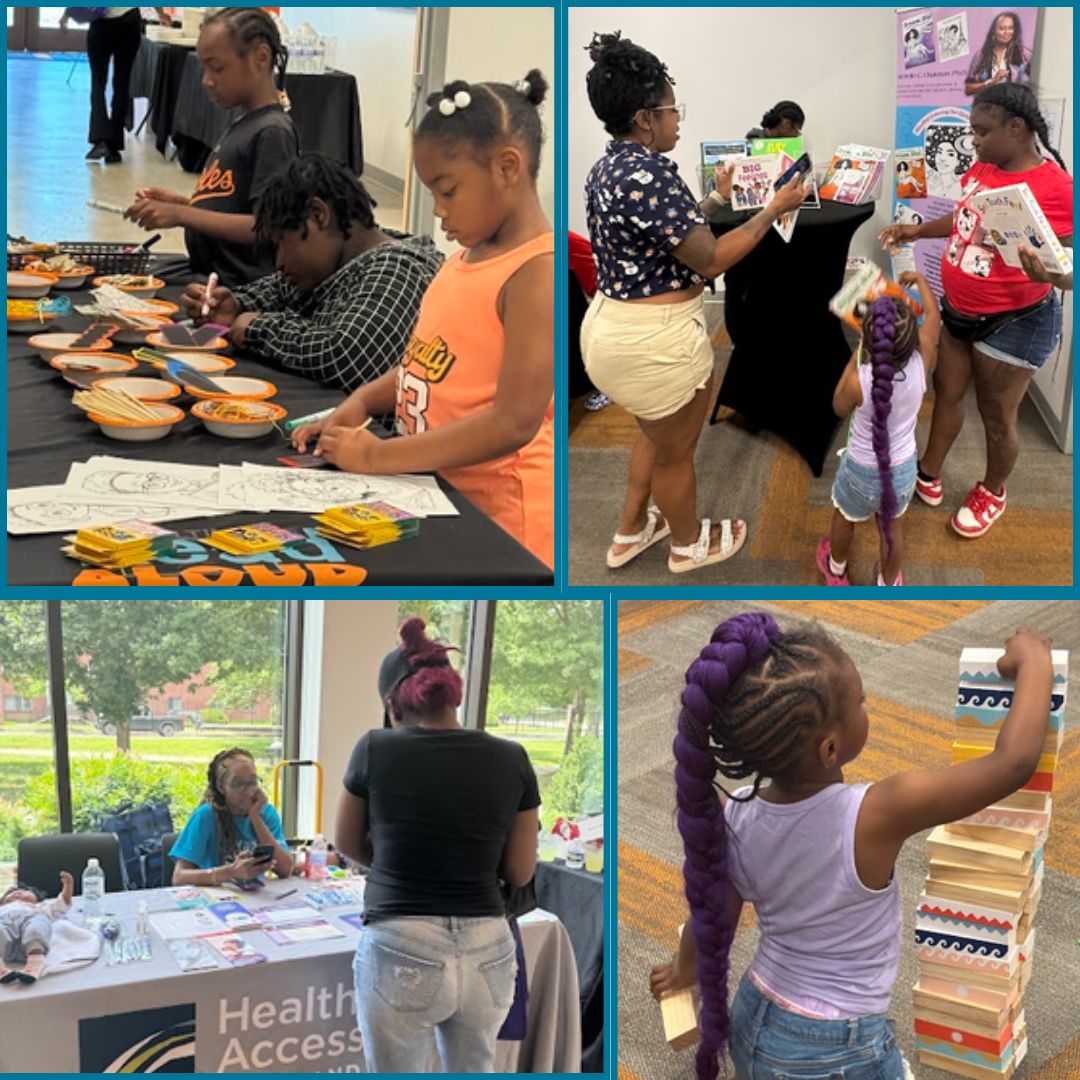
Parents in Upton/Druid Heights used a mini-grant to fund and host a community advocacy project that promoted early literacy, family connections, and health resources.
B’more for Healthy Babies (BHB) at the University of Maryland School of Social Work’s Center for Restorative Change, in partnership with Baltimore Read Aloud, turned this year’s Community Achiever’s advocacy project into a powerful demonstration of what community-led, mini-grant-funded events can accomplish in Upton/Druid Heights.
On June 6, 2026, families gathered at Baltimore Unity Hall for the Family Read-In and Resource Fair, a parent-led event designed to promote early literacy, strengthen family connections, and link caregivers to essential supports from pregnancy through early childhood.
Guided by social worker Blair Davis, MSW, LMSW, the BHB Upton/Druid Heights Community Achiever’s group used a BHB mini-grant to bring their vision to life — from planning activities and securing partners to ensuring that the event reflected the neighborhood’s priorities.
The mini-grant program began under the Promise Heights Initiative and continued through the Center for Restorative Change (CRC). Each year, B’more for Healthy Babies at the CRC dedicates a portion of its funding to resident- and community-led neighborhood improvement projects.
In the past, community members applied for funding to implement initiatives they believed would make a meaningful difference in their neighborhoods. For the past three years, however, the B’more for Healthy Babies Upton/Druid Heights Community Achievers Advocacy Group (CAAG)—a group of parents from the community—has determined how the funding will be used to improve the neighborhood and support residents’ well-being. The CAAG then collaborates with other residents to implement the selected project.
Each project funded through the program must incorporate BHB educational messaging — such as safe sleep, smoking cessation, and other maternal and child health topics — to promote healthier outcomes for families and children. Mini-grant funds can be used in one of three focus areas: beautification, increasing safety, or increasing social connection, recreation, or leisure. Three resident-led or community group projects are selected each cycle to receive $300 in funding per project.
The Family Read-In and Resource Fair is a clear example of how the community advocacy group continues to use micro-grants to support community-led events that foster social connection and family engagement. This year’s partners — Baltimore Read Aloud, the Baltimore Infants and Toddlers Program, The Family Tree, and HealthCare Access Maryland — joined BHB in offering literacy activities, developmental and parenting resources, and access to health navigation and supports. By combining meaningful financial support through the mini-grant with strong community leadership, the event created a welcoming space where children could enjoy reading and interactive activities while caregivers connected with trusted organizations.
Through efforts like the Family Read-In and Resource Fair, BHB and the Community Achiever’s advocacy group are showing how small, targeted investments can help residents design and lead events that strengthen neighborhood ties and promote healthy beginnings for Baltimore’s youngest residents.
Visit the BHB website for more information.