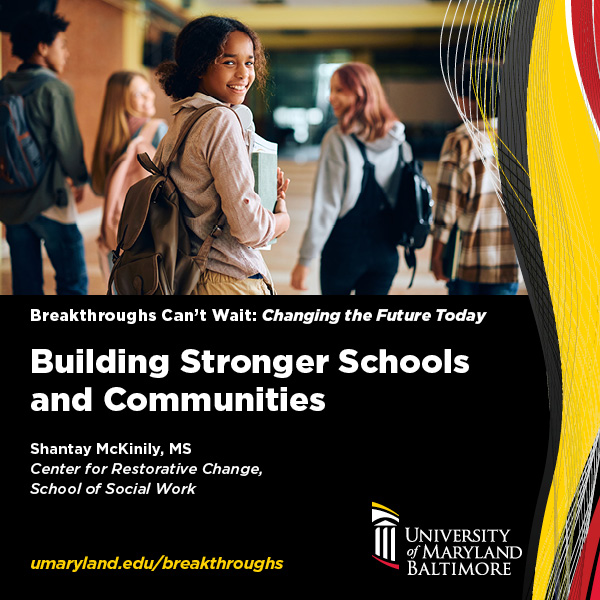
At the School of Social Work’s Positive Schools Center, Shantay McKinily, MS, is working to strengthen communities by helping schools serve as hubs of support for students and their families.
At the University of Maryland, Baltimore (UMB), groundbreaking discoveries happen every day — transforming medicine, improving health, and shaping the future. From changing legal policy to pioneering treatments to cutting-edge scientific breakthroughs, UMB researchers are tackling real-world challenges and making a lasting impact on lives everywhere.
In our “Breakthroughs Can’t Wait: Changing the Future Today” series of videos, we will dive into inspiring stories of innovation from across UMB’s seven schools. See how scientists, doctors, and experts are addressing today’s most pressing issues — fueled by the critical support of government funding that drives progress forward.
At the University of Maryland School of Social Work (UMSSW), Shantay McKinily, MS, is working to strengthen communities by helping schools serve as hubs of support for students and their families.
Supported by a Full-Service Community Schools Grant from the U.S. Department of Education, the Center for Restorative Change's Positive Schools Center — which McKinily directs — is helping Renaissance Academy and Augusta Fells Savage Institute of Visual Arts in West Baltimore expand services that address both educational and basic needs for students and their families.
McKinily said she hopes this work allows students to “leave schools feeling like they were truly, truly supported during their high school experience.”
The grant allows the schools to connect students and families with a wide range of practical supports that can remove barriers to learning. Through partnerships with community organizations, the program helps provide food distributions for families and snacks for students during the school day. It also connects families with assistance for housing and utilities, helps students obtain identification through the Motor Vehicle Administration, and offers academic support such as tutoring, mentoring, and guidance with college applications. Together, these services are designed to ensure that students’ basic needs are met so they can focus on learning and long-term success.
"Schools should be a hub for resources for families. Families should know that they have a place that they can come to if they need support,” she explained, and added, “A full-service community school is going to be a way that you shift the relationship between the school and the community, and also how you shift how kids actually experience school on a daily basis.”
Watch the video to see McKinily share more about how the community schools model supports students, families, and neighborhoods.