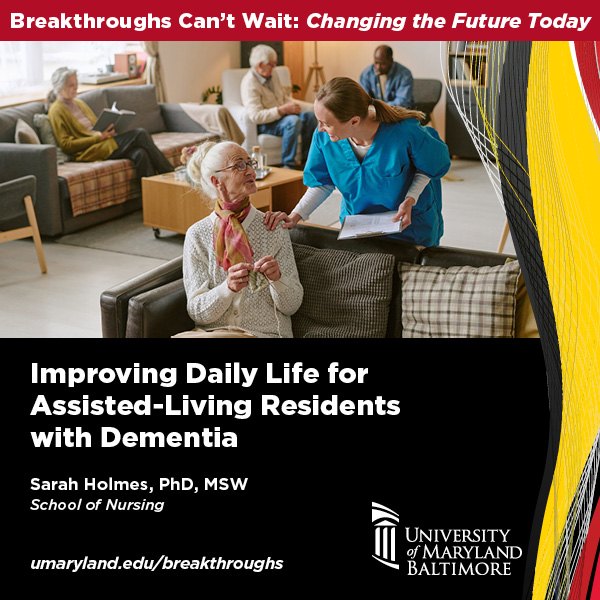
Sarah Holmes, PhD, MSW, of the School of Nursing is exploring how meaningful activity can improve quality of life while also reducing agitation, aggression, and other behavioral symptoms.
At the University of Maryland, Baltimore (UMB), groundbreaking discoveries happen every day — transforming medicine, improving health, and shaping the future. From changing legal policy to pioneering treatments to cutting-edge scientific breakthroughs, UMB researchers are tackling real-world challenges and making a lasting impact on lives everywhere.
In our “Breakthroughs Can’t Wait: Changing the Future Today” series of videos, we will dive into inspiring stories of innovation from across UMB’s seven schools. See how scientists, doctors, and experts are addressing today’s most pressing issues — fueled by the critical support of government funding that drives progress forward.
At the University of Maryland School of Nursing (UMSON), Sarah Holmes, PhD, MSW, associate professor, is exploring how meaningful activity can improve quality of life for residents with dementia in assisted-living communities — while also reducing agitation, aggression, and other behavioral symptoms.
Holmes noted that many residents with dementia spend large portions of the day disengaged, often because activity programming is not tailored to individual interests or abilities. “When residents — particularly those with dementia — become disengaged and bored, we often see an increase in agitation and other behavioral symptoms,” she explained. “This can be aggression, resistiveness during care interactions — and it can be really distressing and challenging for the staff to manage.”
To address this issue, Holmes and her team — which includes UMSON professors Barbara Resnick PhD, RN, CRNP, FAAN, FAANP, and Elizabeth “Beth” Galik, PhD, CRNP, FAAN, FAANP — developed “Meaningful Activities for Assisted Living,” a four-step, evidence-based approach that helps communities integrate personalized engagement into routine care. The process includes partnering with community stakeholders to evaluate the environment and policies, educate staff, identify residents' interests and preferences, and motivate care teams to incorporate meaningful moments throughout the day.
For some residents, that may mean playing the piano again, helping set the table at mealtimes, or participating in activities connected to past careers or hobbies. Holmes said this work has shown promising results: “We found that residents who were exposed to this meaningful activity approach had decreased behavioral symptoms and improved quality of life after about four months.”
To learn more about how Holmes’ research is helping residents with dementia live more engaged, connected lives, watch her full Q&A.