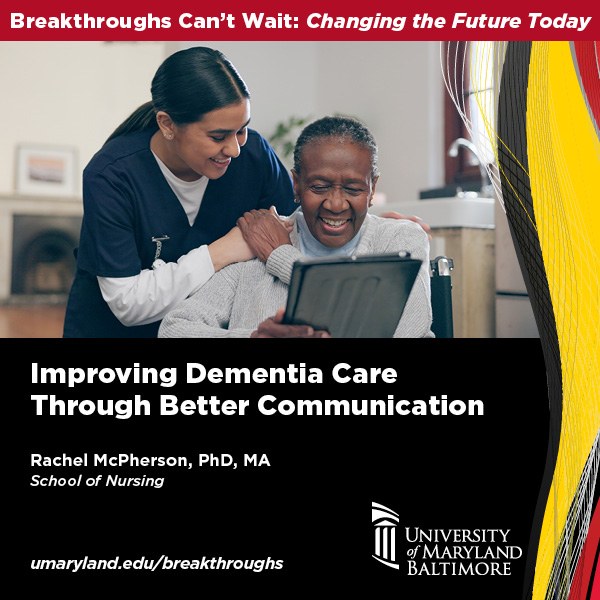
Rachel McPherson, PhD, MA, of the School of Nursing is researching how to help caregivers build more supportive and meaningful connections into daily care routines.
At the University of Maryland, Baltimore (UMB), groundbreaking discoveries happen every day — transforming medicine, improving health, and shaping the future. From changing legal policy to pioneering treatments to cutting-edge scientific breakthroughs, UMB researchers are tackling real-world challenges and making a lasting impact on lives everywhere.
In our “Breakthroughs Can’t Wait: Changing the Future Today” series of videos, we will dive into inspiring stories of innovation from across UMB’s seven schools. See how scientists, doctors, and experts are addressing today’s most pressing issues — fueled by the critical support of government funding that drives progress forward.
For residents living with dementia in assisted-living communities, even small interactions can make a big difference. At the University of Maryland School of Nursing, Rachel McPherson, PhD, MA, assistant professor, is researching how to enhance caregiving approaches to improve experiences for residents and staff alike.
To put those ideas into practice, McPherson developed the Fostering Positive Care Interactions in Assisted Living (FPCI-AL) intervention, which helps caregivers build more supportive and meaningful connections into daily care routines.
“The purpose of this intervention is to help staff improve how they interact with residents living with dementia,” McPherson said. She noted that residents can become distressed when care feels impersonal or abrupt — for example, when staff enter a room without greeting a resident, explaining what they are doing, or engaging the person in the process. Those experiences can contribute to behavioral symptoms such as resisting care, agitation, or withdrawal. Increasing positive interactions between caregivers and residents, she said, can improve well-being and reduce behaviors that make care more challenging.
The four-step intervention includes identifying barriers to positive interactions, educating staff about effective communication strategies, tailoring care plans to residents' individual needs and preferences, and providing ongoing coaching and support. McPherson hopes the approach not only will improve residents' well-being and participation in care but will also increase job satisfaction among caregivers and help reduce burnout.
While the project is currently underway in four assisted-living communities, McPherson believes its impact could extend far beyond those sites.
“If we do show that this is effective, we would look at dissemination across a larger number of assisted-living communities, and we could even look across other long-term care facilities as well, such as nursing homes,” McPherson said.
Watch McPherson's full Q&A in the video below to learn more about how positive care interactions could improve life for residents living with dementia.