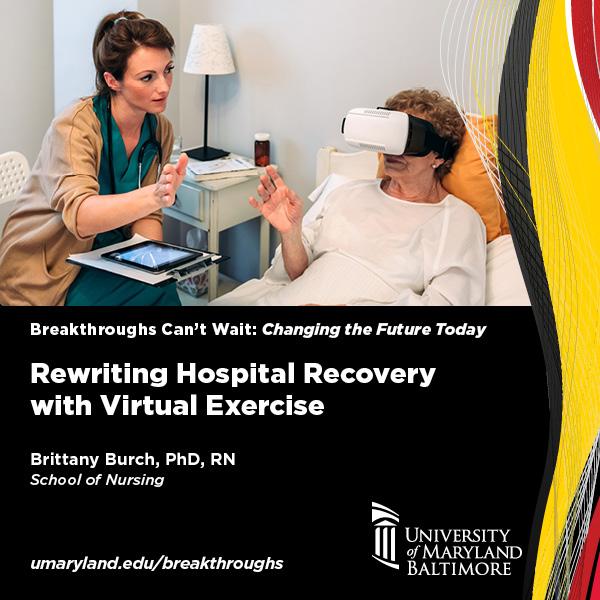
Brittany Burch, PhD, RN, of the School of Nursing and her colleagues developed Preserving Ability through Virtual Exercise, a virtual reality-based program designed to help patients stay active.
At the University of Maryland, Baltimore (UMB), groundbreaking discoveries happen every day — transforming medicine, improving health, and shaping the future. From changing legal policy to pioneering treatments to cutting-edge scientific breakthroughs, UMB researchers are tackling real-world challenges and making a lasting impact on lives everywhere.
In our “Breakthroughs Can’t Wait: Changing the Future Today” series of videos, we will dive into inspiring stories of innovation from across UMB’s seven schools. See how scientists, doctors, and experts are addressing today’s most pressing issues — fueled by the critical support of government funding that drives progress forward.
At the University of Maryland School of Nursing, Brittany Burch, PhD, RN, assistant professor, is helping older adults maintain their strength during hospital stays — a time when even a few days in bed can have lasting consequences.
“When you're in the hospital, there's a lot of barriers to getting out of bed,” she said, and explained that devices such as IV lines delivering continuous fluids, pulse oximeters, and telemetry monitors can act as “literal tethers to their bed.”
Those barriers, combined with illness, often keep patients inactive. But inactivity comes at a cost. “There's an assumption some people have that resting equals recovery, but it's actually the opposite,” Burch said. “Every day that a patient is in bed, they lose muscle mass.”
To address this, Burch and her colleagues developed Preserving Ability through Virtual Exercise (PAVE), a virtual reality-based program designed to help patients stay active. Patients can pick up a VR headset at their bedside whenever they feel up to it and follow guided exercises in an immersive environment.
“Behavior change is tough,” she said. “And from research, what do we know is a major motivator for exercise? Fun.”
By making exercise engaging and accessible, PAVE aims not only to preserve physical function, but also to support mood and recovery — helping hospitals better fulfill their role as places of healing.
Watch the video to learn more about how Burch's work could transform hospital recovery for older adults.