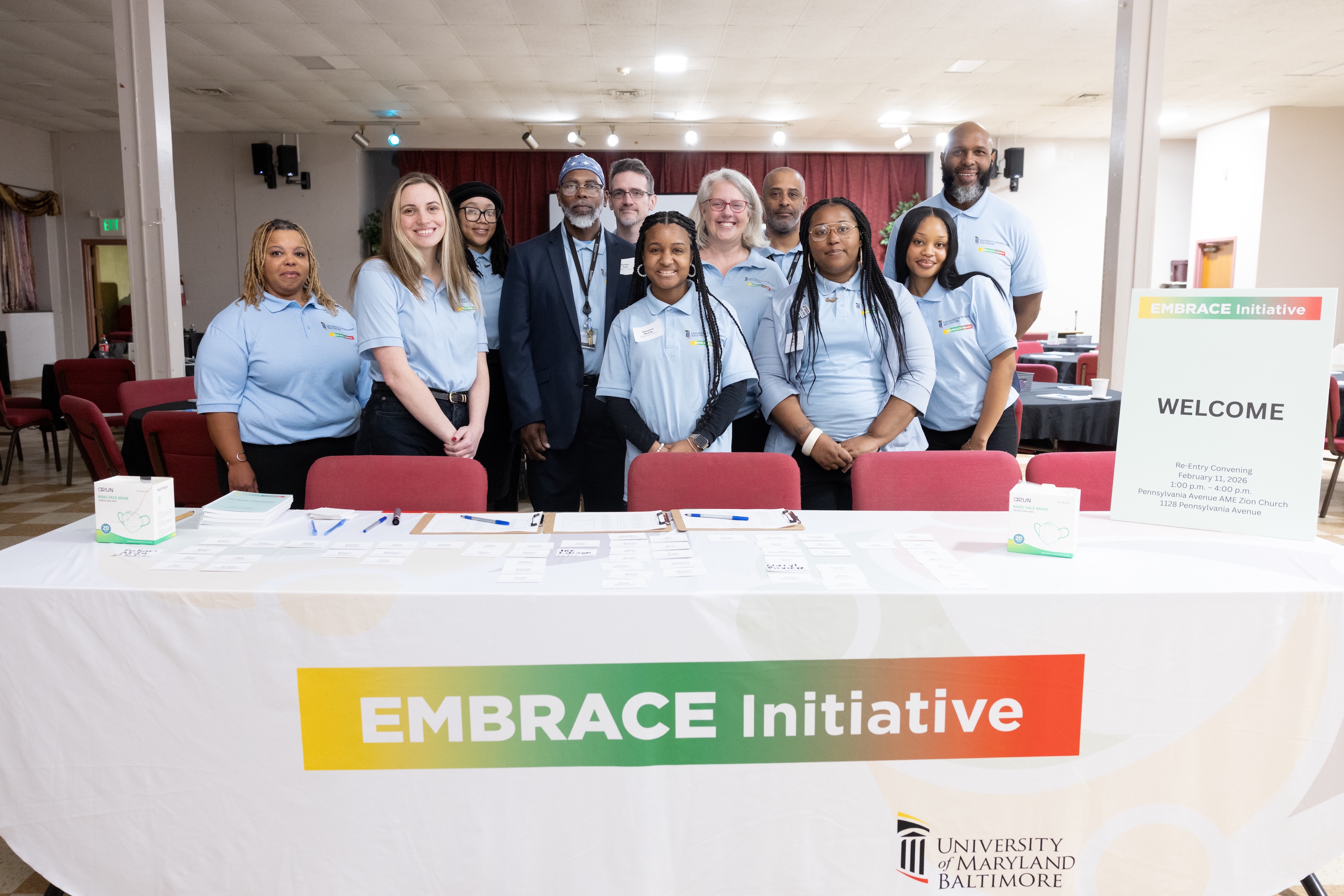
Service providers from across Baltimore came together to share actionable insights with funders, policymakers, and key stakeholders and explored how artificial intelligence could support reentry.
On Feb. 11, the University of Maryland, Baltimore's EMBRACE Initiative hosted its first reentry convening where 26 service providers from across Baltimore came together to share actionable insights with funders, policymakers, and key stakeholders. The event was a strong success, as participants explored how artificial intelligence (AI) could support reentry efforts, identified opportunities for collaborative data sharing, and began laying the foundation for a more connected and coordinated ecosystem.
Central to the convening was the development of an AI application that will assist returning citizens as they transition back into society. Ideas were exchanged as more than 60 participants offered their expertise for the AI application. Topics included finding and securing housing, obtaining employment and job training, and learning how to navigate public transportation to attend appointments. It was emphasized that the point of creating the AI assistant isn’t to replace human beings, but rather to connect human beings with other people and places.
Throughout the convening, there were numerous opportunities to network and gain a better understanding of the strengths and challenges of the current reentry ecosystem. From these interactions, a number of broad themes emerged, namely collaboration over competition, housing and employment as core stabilizers, and equity-centered and trauma-informed practices. This information, along with all that was learned during the numerous activities, was organized and then compiled into a report that will be disseminated among the service providers and other partners.
This convening marked the initial step toward building a more coordinated, equitable, and rehabilitative reentry ecosystem that produces measurable, long-term success for returning citizens and their families.
EMBRACE will host additional convenings in the future. For now, the focus is on Baltimore City, where a majority of citizens come home from incarceration. With the anticipated effectiveness of this endeavor, the Baltimore reentry ecosystem may serve as a model for the rest of Maryland — and possibly the nation.