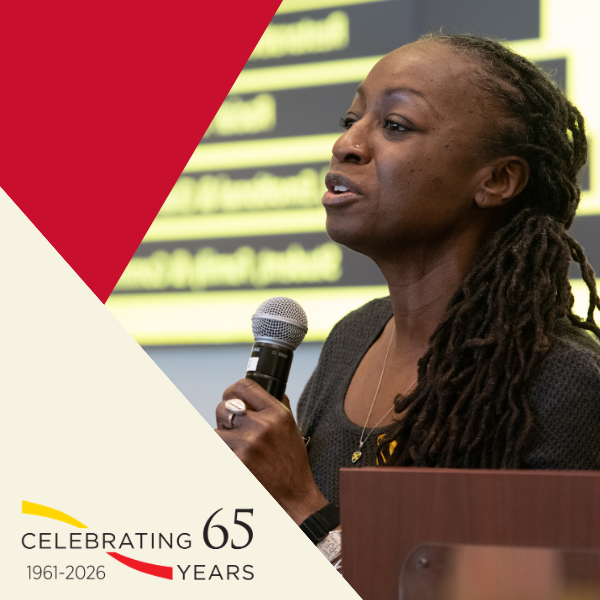
Wendy Shaia, who led the Center for Restorative Change for a decade and is a UMSSW alumna, discusses leadership, restorative change, and the future of social work.
As the University of Maryland School of Social Work celebrates six-and-a-half decades of advancing research, practice, and policy, Wendy Shaia, 2001 MSW alumna, reflects on the evolution of one of the school's most impactful community initiatives: the Social Work Community Outreach Service (SWCOS), now known as the Center for Restorative Change (CRC).
Founded in the early 1990s as the school's direct practice arm, SWCOS was created to connect social work students with meaningful community-based work in Baltimore while addressing critical social challenges alongside residents and community partners. Over time, that mission expanded beyond direct services to include systems change, restorative practices, leadership development, and community engagement.
"What they wanted to do was show that there was important work for social workers in urban settings," Shaia explained, noting that the original program began with a small cohort of students committed to community-based practice.
In 2022, SWCOS merged with Promise Heights and underwent a yearlong collaborative reimagining process that resulted in a new identity: the Center for Restorative Change. Through extensive collaboration, reflection, and dialogue, staff recognized that their work was fundamentally about building, repairing, and sustaining relationships grounded in trust, accountability, mutual respect, and collective action. For Shaia, the shift reflected a deeper commitment to relationship-building, shared accountability, and working with communities rather than for them.
"When you are restorative, you are doing things with people. When you are not restorative, you are doing things to and for people," she said.
Leadership Through Accountability
After more than a decade as executive director of the CRC, Shaia says the most important lesson she learned about leadership is accountability.
"My responsibility as a leader isn't simply to carry out the expectations of the institution. It's to remain accountable to the people doing the work and the communities our work is intended to serve," she said.
She believes effective leadership requires an understanding of history, power, and oppression, and that social workers are uniquely positioned to help organizations navigate complex human and systemic challenges.
The SHARP Framework Beyond Social Work
As Shaia transitions from her role as executive director to a greater focus on teaching, she continues to champion the SHARP Framework, a model that helps practitioners analyze Structural Oppression, Historical Context, Analysis of Role, Reciprocity and Mutuality, and Power.
According to Shaia, SHARP offers a lens for understanding social issues more completely and developing more effective solutions.
"How you see the problem is how you're going to structure the solution," she said.
While rooted in social work, SHARP is increasingly being applied across health care, education, nonprofit organizations, and other sectors seeking to build more equitable and restorative systems.
Advice for Students
Shaia encourages students to remain curious, reflective, and humble in their practice.
"Don't confuse professional expertise with knowing what is best for other people," she said.
She also urges future social workers to stay connected to the values that brought them to the profession, even when institutions present challenges.
Looking Forward
As CRC enters its next chapter, Shaia hopes the organization continues to evolve while remaining grounded in its core mission of restorative change.
"Focus on values over structure and people over processes," Shaia said.
Her message resonates not only with social workers, but with leaders across every field: Meaningful change begins with relationships, accountability, and a commitment to sharing power with the communities we serve.
Learn more about the Center for Restorative Change and the SHARP Framework.