Read about the innovation that ensures uninterrupted support for UMB’s groundbreaking research, teaching, and clinical care in the latest issue of “CATALYST.”
The University of Maryland, Baltimore (UMB) has some cool technology it utilizes in its sustainability efforts.
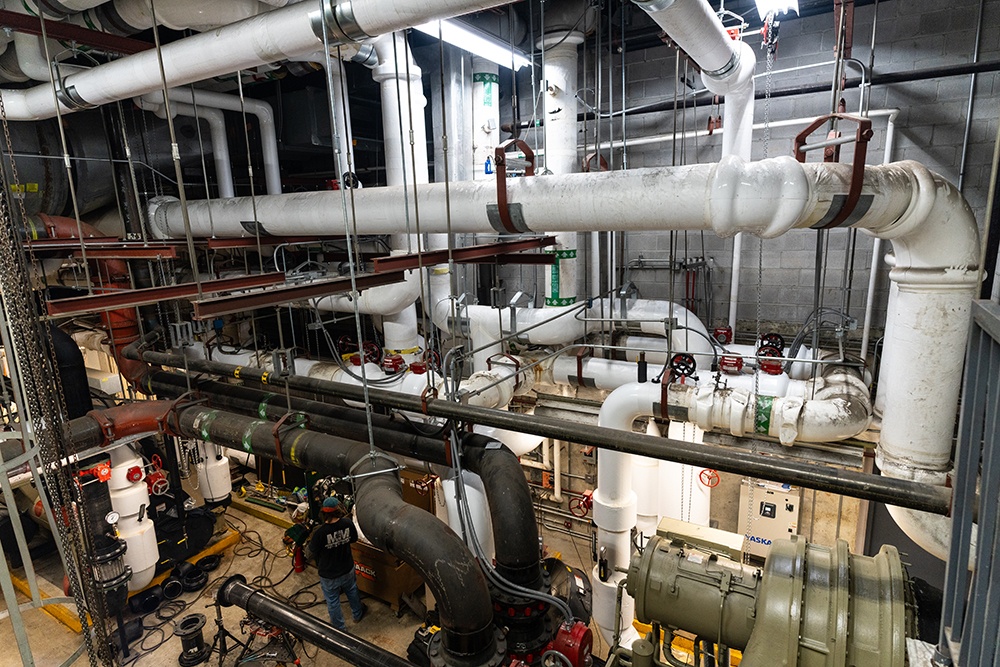
In a little-known part of the University of Maryland School of Nursing (UMSON) basement — underneath the grassy courtyard we all know and love — lies a facility that makes ice at night, when electricity usage in the grid is at its lowest. Typically, the system managed by Operations and Maintenance burns this ice in the daytime to cool the building during the peak heat of the day. A new chiller was recently installed that allows the ice to provide about eight to 10 hours of cooling, instead of the previous five hours, providing more system efficiencies.
The UMSON chiller, a machine that utilizes cool water to regulate the indoor temperature and humidity of buildings, is just one of several that was recently installed on the south side of campus to improve reliability and energy performance during the warm months when chilled water is utilized to cool buildings.
Chillers in the Health Sciences and Human Services Library and Institute of Human Virology also have been replaced over the last year. In each of these buildings and in UMSON, one new chiller now uses a variable frequency drive (VFD), which can adjust the motor speed based on both the building’s needs at the time and outside temperature conditions. Non-VFD chillers only have two modes — on and off — which does not allow any room for energy savings. The VFD chillers operate the system much more efficiently based on current conditions.
“This innovative solution strengthens the resiliency of our campus buildings, ensuring uninterrupted support for groundbreaking research, teaching, and clinical care,” says Anna Borgerding, PMP, assistant vice president, Facilities and Operations.
Chilled Water Loops
Combined with connective piping, these chiller upgrades are allowing UMB to create an efficient chilled water loop on the south side of campus, similar to the infrastructure on the north side of campus. This south chilled water loop, which also includes the SMC Campus Center and Graduate Research Building, provides more capacity than if each building operated separately. This shared loop allows equipment in one building to support another building if a piece of equipment fails, providing redundancy during unexpected outages.
The loop also makes it easier for Operations and Maintenance to perform maintenance on these buildings’ systems during regular business hours instead of during nights and weekends, without interruptions in cooling and ventilation to the building occupants.
“After years of work and with a lot of creative thinking, we have been able to build out a north and south chilled water loop project,” says Kevin Smith, associate director of mechanical and infrastructure, Facilities and Operations. While many other university campuses own and operate central utility plants, UMB’s location in downtown Baltimore makes it uniquely space-constrained, especially when it comes to building and operating large utility equipment. “This [project] has ultimately created a central plant within an urban environment and has improved our redundancy and reliability,” Smith says.
Read more about the chiller in the latest issue of CATALYST magazine.
The latest issue of "CATALYST" magazine highlights the School of Medicine's impact building safer health systems in The Gambia; the School of Nursing's work with HIV and mental health in Nigeria; a Maryland Carey Law fellowship honoring the legacy of graduate Eric Garvin; UMB's health care pipeline for students from underserved rural areas such as the Eastern Shore; UMB's innovative policing; Five Questions with VP for Research Patrick O'Shea; and much more.