Community engagement and technological improvements create a safer community.
The University of Maryland, Baltimore (UMB) is consistently one of the safest areas in downtown Baltimore. The data speaks for itself. As an urban campus, UMB does experience some crime. However, the data shows that overall crime on campus has been steadily declining since 2019 and remains consistently low on campus.
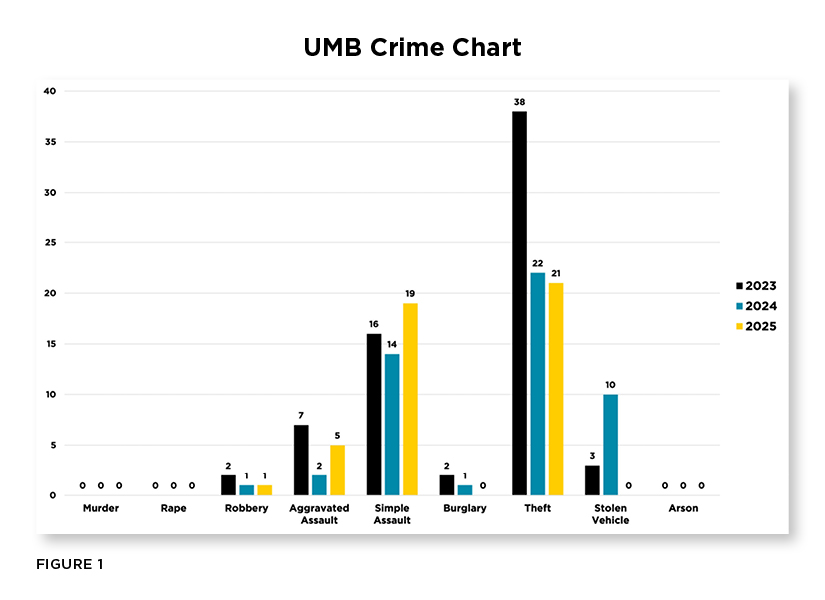
In an initial release of 2025 crime statistics, UMB Police and Public Safety reports that on-campus burglaries and stolen vehicles fell to zero. Murder, rape, and arson on campus also remained at zero. UMB police officers successfully arrested the person involved in the one robbery that occurred on campus in 2025. (See Figure 1 below)
Theft at UMB continues to decline. Theft is often a crime of opportunity. Small valuables left in plain sight can be quickly taken when the owner steps away. In many cases, the stolen items were left unattended and unsecured.
Stolen bicycles and electric scooters make up almost half of all thefts at UMB. Unfortunately, these sustainable micromobility devices can be lucrative targets for theft if they’re not locked properly. Students and employees who ride an electric scooter or bicycle are strongly encouraged to use the UMB bike cage in Pratt Street Garage or Bike Room in the Baltimore Grand Garage. If you choose to use a bike rack, always lock your device securely with a U-lock that goes through the rack and frame of your bike/scooter, as well as additional locks through the tires, if possible. Cable locks can be easily cut and should not be your only security measure.
The data does show a small increase in assaults on campus in 2025. Nine of the assaults occurred between people who knew one another. Two others occurred when UMB police officers were assaulted. Other incidents included road rage, a payment dispute, and phone/headphone distractions.
One of the Safest Areas in Baltimore
The Baltimore Police Department (BPD) divides the city into 138 posts. Generally, just one BPD police officer is assigned to each post at a time. UMB is approximately the size of one such post. However, because of UMB’s own Department of Police and Public Safety, eight to 10 UMB police officers patrol the University’s campus at any given time. This significantly increases visibility and reduces crime. Security officers, police communication operators (PCOs), fire marshals, and administrative staff all work together to support our community’s safety.
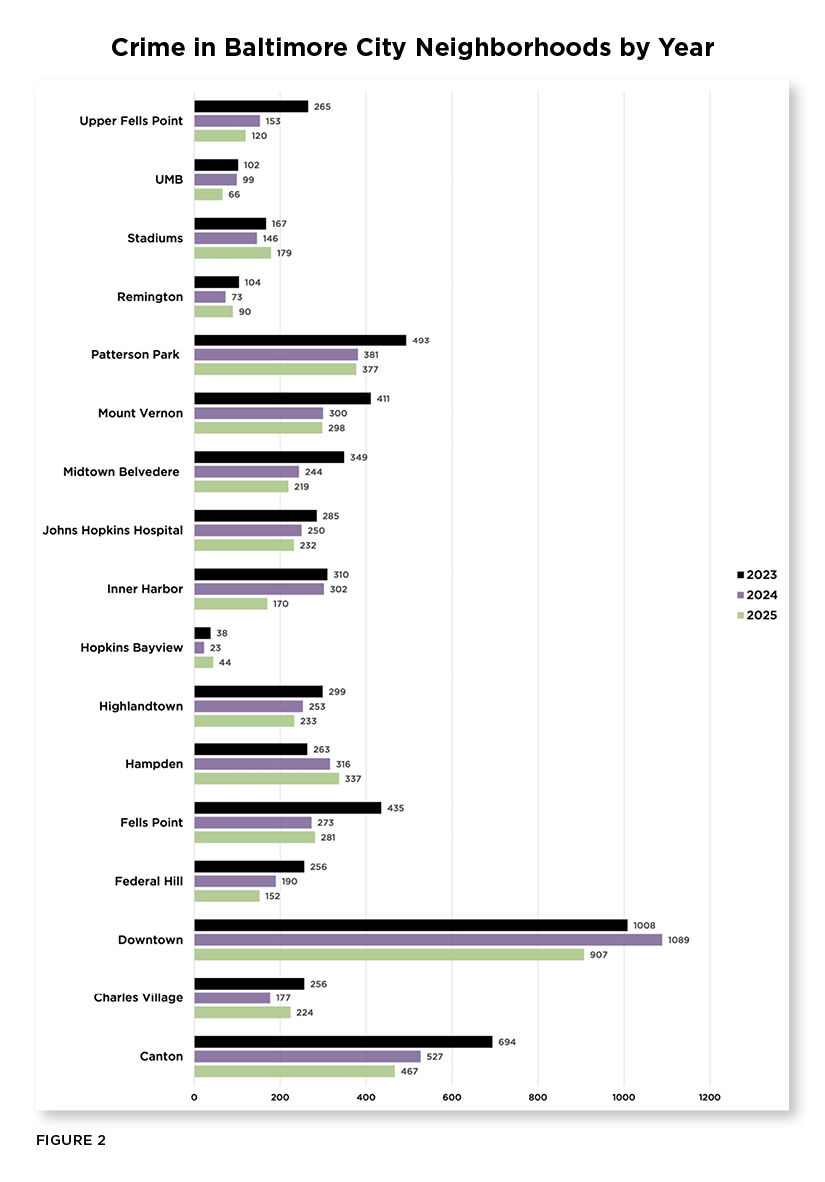
Among popular Baltimore City destinations for tourists and young professionals, UMB has the second-lowest crime. The only neighborhood with lower crime is the Johns Hopkins Bayview campus, an insulated campus that does not serve as a public thoroughfare the way that UMB does. (See Figure 2 below)
Serving the Public Good
UMB Police and Public Safety’s Community Outreach and Support Team (COAST) fosters positive relationships with the West Baltimore community, an area historically underserved and overpoliced. As part of their efforts, COAST works to change the stigma that police and the community have toward vulnerable populations. UMB police officers all take Crisis Intervention Training (CIT), which teaches first responders how to safely and effectively support those experiencing a mental health crisis. COAST members take an extended three-day CIT class and earn a certification.
UMB Police and Public Safety’s new and innovative approach to policing has made the department a national leader in community engagement. UMB served as a pilot agency for Law Enforcement Assisted Diversion, an initiative that redirects low-level drug users from incarceration to substance use and mental health resources; the program is still used today.
Officers have training but don’t always have the capacity to provide ongoing support to those in need. In 2021, Thomas Leone, MSL, assistant vice president for public safety and chief of police, and University of Maryland School of Social Work Dean Judy L. Postmus, PhD, ACSW, teamed up to expand the department’s work with vulnerable populations. UMB Police and Public Safety established the nation’s first partnership between a university police department and social work interns to provide case management and resources to the community.
Once social workers were onboard, the department went one step further: partnering with credible messengers. This innovative program uses returning citizens — members of the community who served time in prison — to encourage people engaging in crime to turn their lives around. The EMBRACE Initiative brings together COAST, social workers, and returning citizens to mitigate the negative impacts of homelessness, substance use, and other challenges on vulnerable people and the communities they live in.
These community-oriented strategies help UMB Police and Public Safety build positive relationships with the communities they serve. This is one key to the department’s success, but they also rely on data-driven policing strategies, visibility, and technology, which can help police officers identify and intercept criminal activity before it occurs.
Technological Upgrades Improve Community Safety
When asked in a 2022 Public Safety survey (which will be conducted again in 2026), 74 percent of respondents said they felt safe every day or almost every day. In response to some of those who say they do not feel safe, Leone worked with UMB Parking and Transportation Services to replace nearly 200 streetlights on campus. The result: brighter, safer streets and more energy-efficient lighting.
Speeding cars and construction created dangerous conditions for pedestrians. The department spearheaded a project to upgrade crosswalks to ensure safer conditions there as well.
Three-hundred and twenty-five outdated and malfunctioning cameras have been upgraded or replaced to improve officer safety, incident response time, and even prevent crime. The new cameras make it easier for PCOs to provide real-time monitoring during incidents. Once malfunctioning and outdated cameras are replaced, the department will add more cameras in previous blind spots and alleys.
In 2021, UMB Police and Public Safety partnered with the UMB Office of Emergency Management, UMB Center for Information Technology Services, and the Baltimore City 911 Center to establish an Aware Portal. The partnership allows UMB PCOs to see calls to Baltimore City 911 in real time for the UMB and University of Baltimore campuses. This means a faster response time to the correct location on campus.
Adding building access control software upgrades to the mix, the department’s commitment to making UMB dispatch a leader in collegiate communications center improves efficiency, communications, and reliability.
Baltimore City Getting Safer
In February, BPD Commissioner Richard Worley joined UMB President Bruce E. Jarrell, MD, FACS, to share updates on crime across Baltimore City. Homicides, nonfatal shootings, rapes, and carjackings all fell more than 25 percent citywide. Baltimore saw the lowest number of homicides in nearly 50 years.
The progress is a result of improved trust and collaboration with communities across Baltimore City, said Worley. Multiple agencies, including the Mayor’s Office of Neighborhood Safety and Engagement, law enforcement agencies, and community-based organizations, coordinate to provide wraparound services to vulnerable populations. These tactics echo many of the successful strategies used by UMB police for nearly a decade.