Read about the work of the college students and researchers in the latest issue of “CATALYST” magazine.
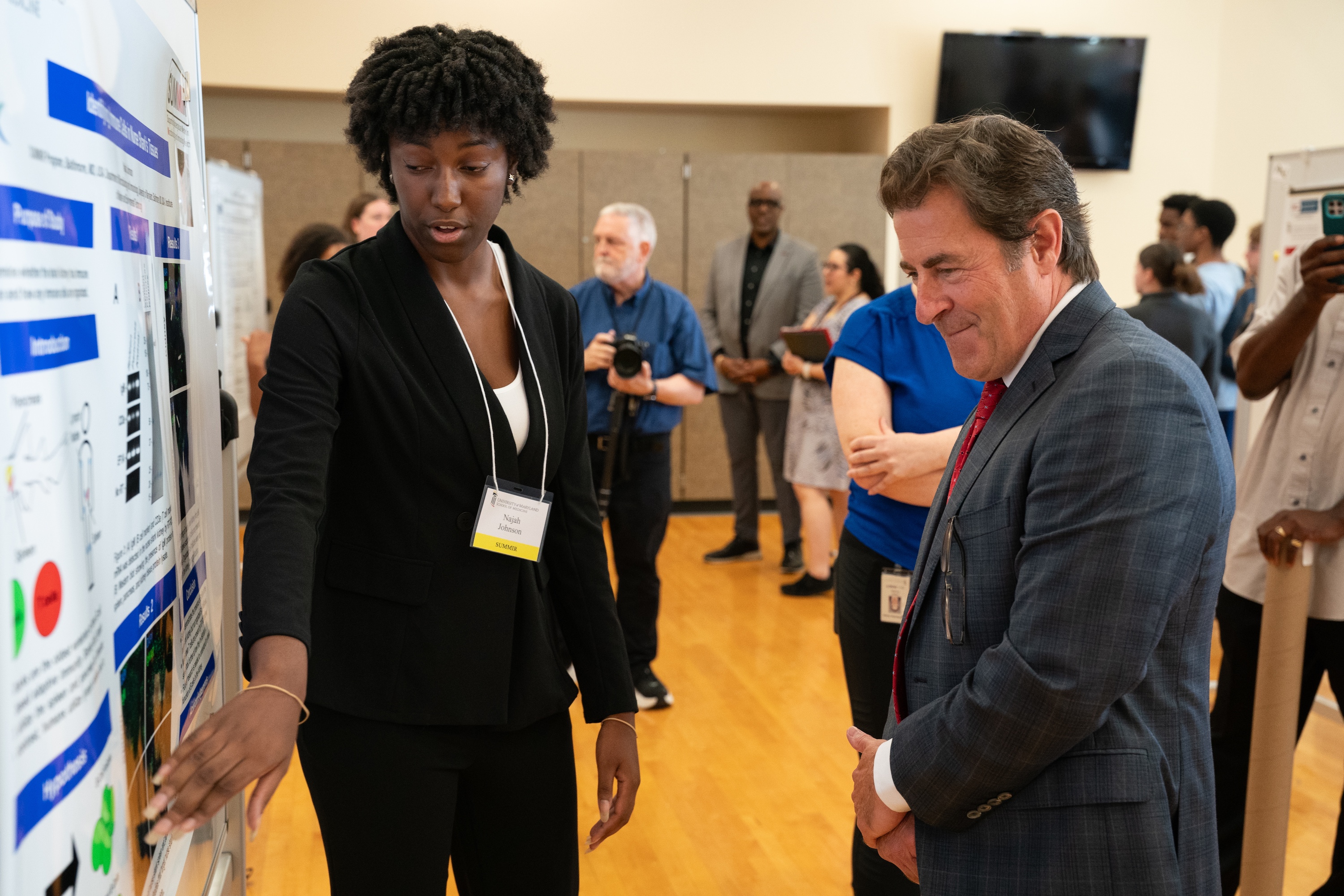
Photo: Najah Johnson, a student at Virginia Tech majoring in dairy science on the veterinary track, shows her research project “Sharks and the Science of Immunity” to School of Medicine Dean Mark Gladwin. Photo by Matthew D’Agostino
When she was in sixth grade, Najah Johnson sat in her classroom at Green Street Academy listening to a visitor describe a program that could change her life. She didn’t know then how research was conducted — or that one day she’d be studying sharks to fill in the evolutionary puzzle of immunity. But she signed up for the University of Maryland, Baltimore (UMB) CURE Scholars Program, and her path began to take shape.
Since its launch in 2015, CURE has opened doors for West Baltimore students as early as sixth grade, offering mentorship, lab experience, and academic support that change the trajectory of their lives. The program has now graduated four cohorts, and many of its alumni are thriving in college, where they’re turning early curiosity into discovery.
That was clear this summer at UMB’s Summer Research Forum, a two-day event hosted by the University of Maryland School of Medicine’s (UMSOM) Office of Student Research, that brought more than 150 students together to present their work investigating cancer, microbiology, immunology, and much more. Among them were four CURE alumni — Johnson, Lynijah Russell, Princaya Sanders, and Samiatu Yussuf — who had come full circle. Once middle schoolers just beginning to imagine what their future might look like, they now stood as college students and researchers, sharing their own work with faculty and peers.
That journey from curious middle schoolers to confident young scientists echoes what Greg Carey, PhD, associate professor of microbiology and immunology, associate dean for biomedical and health profession pathways and workforce development, assistant dean for student research and education, and director of PRISM and UM Scholars Student Research Programs, UMSOM, has observed across the many programs represented at the forum. Carey has seen how early exposure to research can change students’ lives.
“By immersing them in a rich variety of research, they see discovery, they see patient care, they see the populations impacted — and it helps them discover what they’re most passionate about. There is nothing more rewarding than watching that transformation,” he said.
Yolanda Langhorne, EdD, MS, executive director of the UMB CURE Scholars Program, said that transformation is exactly what CURE was designed to achieve. “For over 10 years, the CURE Scholars Program has been transforming the lives of scholars in West Baltimore by bridging the gap between potential and opportunity. Our mission is simple: to prepare sixth- through 12th-grade scholars for bright futures in STEM fields,” she said. “With a seven-year commitment from scholars and their families, we provide them with hands-on STEM learning, tutoring, and comprehensive support to help them gain the confidence, skills, and connections needed for college and beyond. As a result, our scholars are thriving — excelling in college, securing prestigious internships, and positioning themselves to lead in medicine, research, and technology.”
For the four CURE alumni who took part in the forum, the event was more than a chance to present research. It was a moment to demonstrate the power of opportunity, and to show how investment in Baltimore’s youth creates innovators ready to shape the future of science and medicine.
Read more about the CURE alumni and their work in CATALYST magazine.
The latest issue of "CATALYST" magazine highlights the School of Medicine's impact building safer health systems in The Gambia; the School of Nursing's work with HIV and mental health in Nigeria; a Maryland Carey Law fellowship honoring the legacy of graduate Eric Garvin; UMB's health care pipeline for students from underserved rural areas such as the Eastern Shore; UMB's innovative policing; Five Questions with VP for Research Patrick O'Shea; and much more.