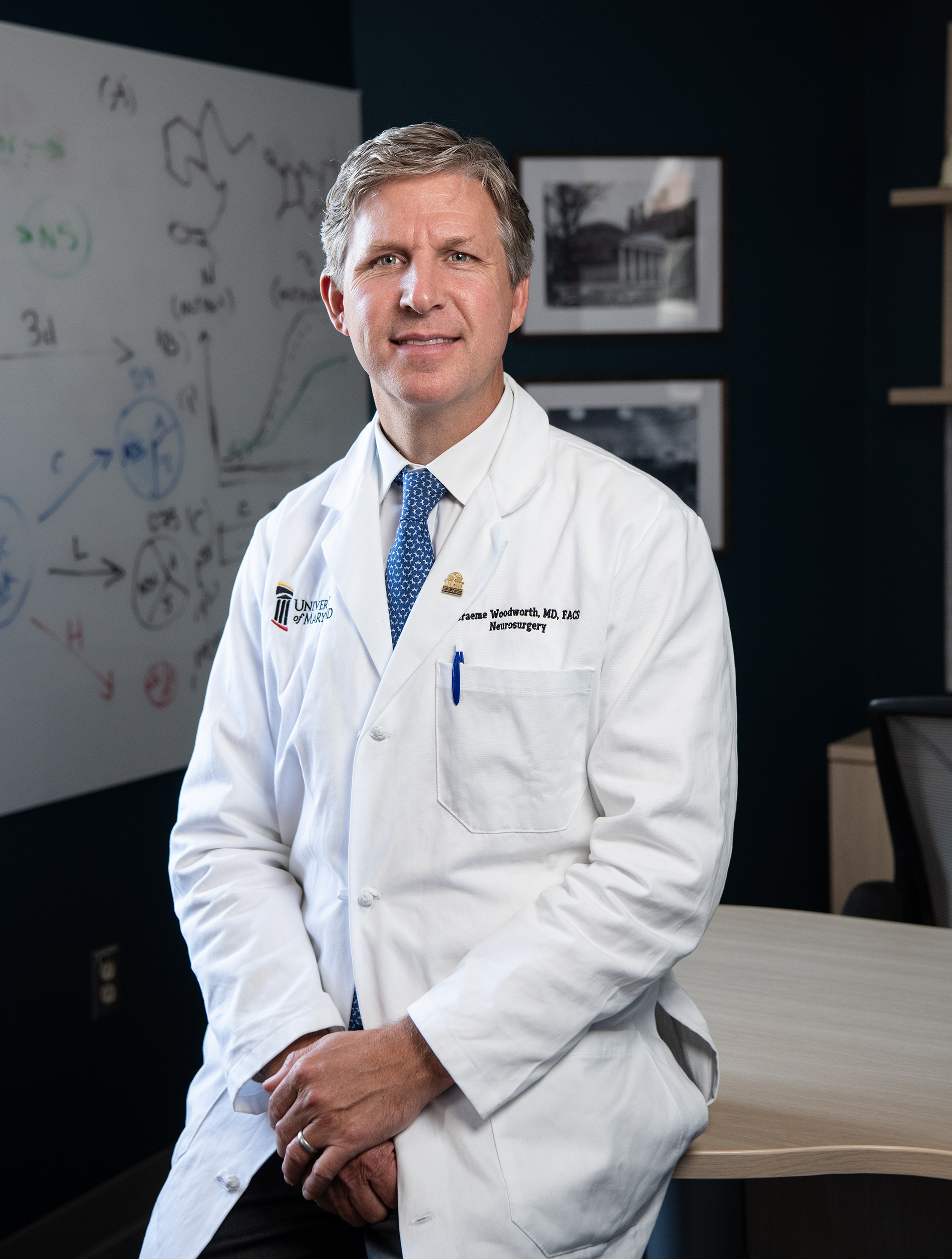
The School of Medicine neurosurgeon stands at the leading edge of innovation in treating brain cancer with focused ultrasound, extending lives and giving patients hope for better outcomes.
Every fall, the University of Maryland, Baltimore (UMB) commemorates our rich history and celebrates the future we’re building together during Founders Week, which this year runs Oct. 19-22. Among the highlights is recognizing the extraordinary work of UMB’s faculty, staff, and students with five awards, each signifying outstanding accomplishment in one facet of our mission. Leading up to Founders Week, we have highlighted the award winners each week on The Elm. For more information on UMB’s annual celebration and associated events, please check out the Founders Week website. (Photo by Matthew D’Agostino)
Graeme Woodworth’s parents are physicians, and surgeons run deep into his family tree. But when Woodworth was accepted into Tufts University in Boston, he took the family road less traveled, opting to major in chemistry with a minor in economics and no intention of pursuing a medical degree through a pre-med track.
“I was interested in working as soon as I finished college,” Woodworth said. “I picked a degree and course of study that I thought would give me the straightest path to a job right after college and one that would be interesting, impactful, and fun.
“So I focused on organic chemistry, and people said to me, ‘Why would you ever do that?’ But I liked it. It was really interesting, and I saw that I could do interesting things with it.”
After graduation, Woodworth worked as a scientist for pharmaceutical company Pfizer and then a research associate for the University of California, San Francisco’s Gladstone Institute of Virology and Immunology. But he realized that something was missing, something that the physicians in his family had enjoyed in their careers: a connection to patients.
“The direct impact of the work I was doing was too far away, too disconnected,” Woodworth said. “So as I started to think about getting a deeper connection to the work I was doing in chemistry and drug discovery, it led me to apply to medical school.”
Woodworth’s decision to attend the Johns Hopkins University School of Medicine — four years after earning his undergraduate degree — was the precursor to an exemplary career as a clinician-scientist, one who has made breakthroughs in brain cancer treatment and earned numerous accolades, including recognition as the University of Maryland, Baltimore’s (UMB) 2026 Founders Week David J. Ramsay Entrepreneur of the Year.
Woodworth, MD, FAANS, FACS, is the Howard M. Eisenberg, MD Distinguished Professor of Neurosurgery and Chair, Department of Neurosurgery, at the University of Maryland School of Medicine (UMSOM), which he joined in 2012 after seven years of neurosurgery training at Johns Hopkins Hospital in Baltimore.
He also is director of the Brain Tumor Program at the University of Maryland Marlene and Stewart Greenebaum Comprehensive Cancer Center, co-founder and co-director of the University of Maryland Medical System’s Neuroscience Network, and a member of the executive committee of the University of Maryland-Medicine Institute for Neuroscience Discovery (UM-MIND).
Margaret M. McCarthy, PhD, the James and Carolyn Frenkil Dean’s Professor and Chair, Department of Pharmacology and Physiology, UMSOM, and Distinguished University Professor, UMB, nominated Woodworth for the Founders Week Award.
“Dr. Woodworth’s transformative application of novel technologies, expansive scholarship, history of scientific leadership, and path-breaking research make him a deserving winner of this honor,” said McCarthy, who also is the director of UM-MIND, a multidisciplinary institute composed of faculty, postdoctoral fellows, students, and staff working to solve pressing problems in neuroscience. “His profile and contribution to science and technological development have furthered the frontiers of advanced neuro-interventions and intracranial drug delivery.”
Walking a ‘Tightrope’
Woodworth’s research aims to improve the outcomes of patients with brain cancer by developing innovative therapies and therapeutic delivery approaches in neuro-oncology that ultimately will be applied to malignancies in other human organs.
He designed and led the first U.S. clinical trials to test the safety and feasibility of using focused ultrasound to open the blood-brain barrier to treat brain tumors. This work set the foundation for Lotus Neuro, a company that is advancing focused ultrasound and drug combination therapies for brain diseases such as glioblastoma and Alzheimer’s disease.
The difficulty of treating brain cancer is high because surgery alone cannot remove all of the tumor due to what Woodworth called “invasive tentacles” woven into the fabric of the brain, where removing them would harm the patient’s brain functions.
“In neurosurgery, we walk that tightrope of getting as close as we can to taking out everything we possibly can but without causing a new functional deficit,” he said. “So that conundrum of trying to remove as much as possible yet knowing we’d never get all of it through surgery was the problem, but it was a problem I wanted to commit myself to solving.
“Therefore, getting drugs to reach those distant brain tumor cells that are so deeply connected with the brain, and to treat them successfully — again, without hurting the brain at the same time — became the challenge.”
A major factor in that challenge was getting the drugs past the blood-brain barrier, which Woodworth described as a critical interface in the human body between the bloodstream and the brain and tumor cells. “But it’s not just a single layer of cells like it might be elsewhere in the body. It’s multiple layers of cells, tightly regulated,” he said.
“So when this idea came along of using ultrasound energy — which could be delivered through the intact human skull and delivered in essentially any location within the brain, and done so on a time scale and a dosing scale that we could control — that became a fascinating opportunity to potentially deal with the blood-brain barrier.”
Woodworth and his team have been at the forefront of the research on using focused ultrasound to treat brain tumors for more than a decade, as the process has moved from conducting preclinical to clinical studies, to beginning the treatment of patients, to making advances in technology and the tools for clinical application.
‘Special Moments’
Woodworth said there are multiple key steps to go before the outcomes of patients with brain cancer improve — today, the average survival time is 12 to 18 months. But he is thankful for the progress that has been made — and for having the connection to patients he desired and found by becoming a doctor.
“One of the most special things in a physician’s life is to feel like you’ve not only improved that person’s life, but you’ve also potentially saved that person’s life,” Woodworth said. “I’m used to the unfortunate reality of giving people the diagnosis of brain cancer, especially glioblastoma, and having to be honest about a poor prognosis and that the median survival time is less than 18 months for most patients. And that’s a really hard thing to do day after day.
“So when we get one or two or a few patients with whom we don’t have to talk about that in the same way — especially when we’ve intervened in a new and exciting way that may be the future of brain cancer treatment — those are really special moments.”
Woodworth was grateful to be chosen for the Founders Week award, saying it reinforces the creative and innovative spirit of UMSOM’s Department of Neurosurgery, and he pointed to UMB’s culture of collaboration as a driving force in the University’s stellar record of medical innovation and discovery.
“We need to nurture that culture, because if we take it for granted, it will go away,” Woodworth said. “The people here at UMB genuinely want to help each other and work together. So we should see that as our special thing, our competitive advantage, our differentiator, because that’s what’s going to create more innovative discoveries that will change human health and how we can care for our patients.”