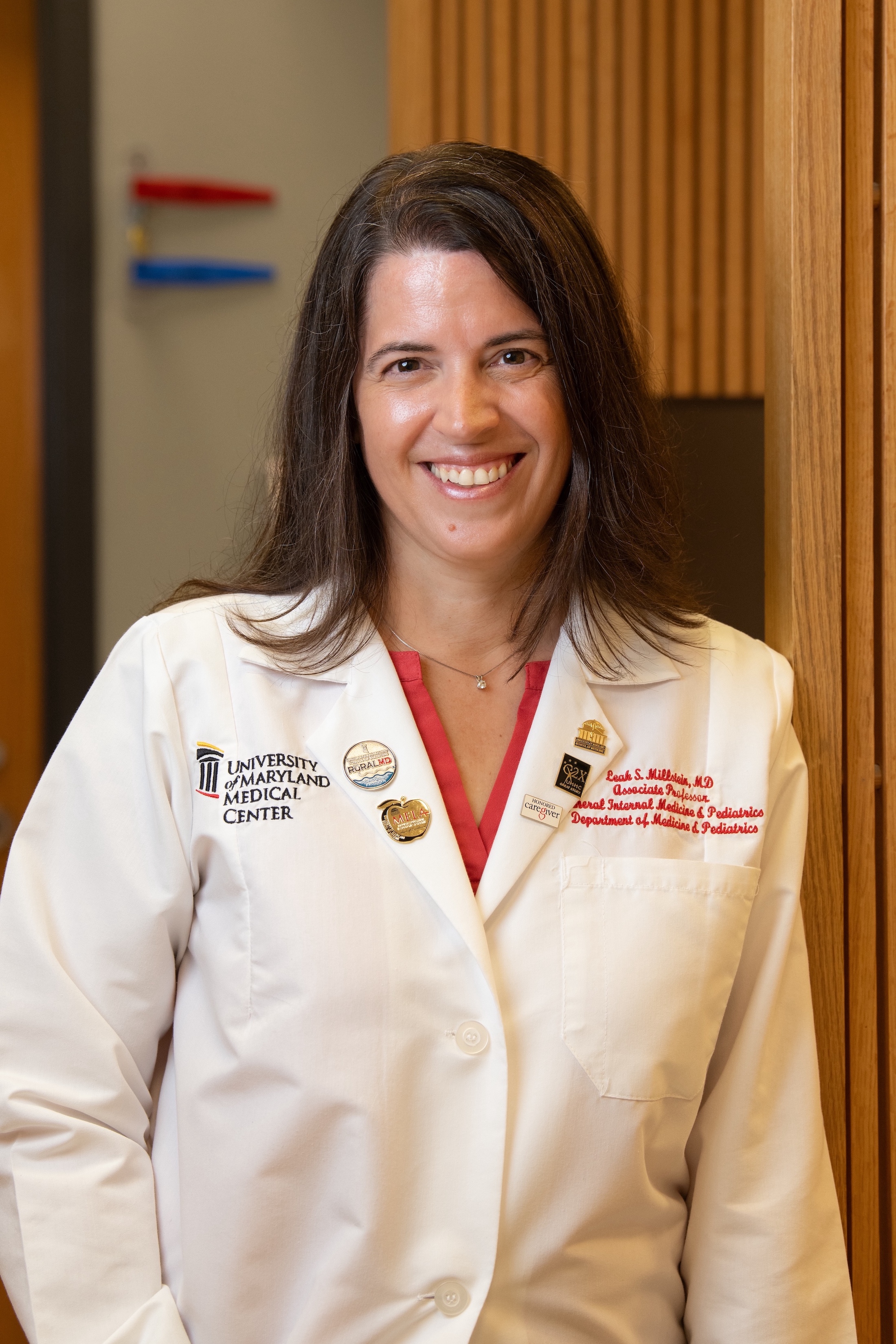
The UMSOM associate professor has transformed the Rural-MD Scholars initiative from a concept into a four-year academic scholarship program preparing physicians to work in underserved rural areas.
Every fall, the University of Maryland, Baltimore (UMB) commemorates our rich history and celebrates the future we’re building together during Founders Week, which this year runs Oct. 19-22. Among the highlights is recognizing the extraordinary work of UMB’s faculty, staff, and students with five awards, each signifying outstanding accomplishment in one facet of our mission. Leading up to Founders Week, we will highlight the award winners each week on The Elm. For more information on UMB’s annual celebration and associated events, please check out the Founders Week website. (Photo by Matthew D’Agostino)
In just two years, Leah S. Millstein, MD, has transformed the University of Maryland School of Medicine’s (UMSOM) Rural-MD Scholars initiative from a concept into a four-year academic scholarship program with the urgent mission of preparing physicians to work in underserved rural communities such as Maryland’s Eastern Shore.
The associate professor in UMSOM’s Department of Medicine has done so while distinguishing herself as an exceptional educator, who has been recognized as the University of Maryland, Baltimore’s (UMB) 2026 Founders Week Educator of the Year.
“Dr. Millstein creates learning environments in which students feel supported, challenged, and genuinely known,” said Donna L. Parker, MD, professor and senior associate dean for medical education, UMSOM. “She is an accessible and highly intentional mentor who invests in her trainees and follows their development over time. Students consistently describe her as someone who is deeply committed to their success and their growth as future physicians.
“I can say with complete confidence that she represents the very best of our institution and our profession.”
The Rural-MD Scholars Program offers immersive experiences including interactions with rural patients and practitioners, procedural and didactic learning, and a deep dive into the social determinants affecting rural health. Students are mentored by rural physicians, undertake clinical clerkships and rotations on the Eastern Shore, and commit to a minimum of four years of service in the community after medical school and residency training.
As director, Millstein has recruited the program’s third cohort and secured funding to ensure that all participants receive full tuition support, removing financial barriers and strengthening the program’s ability to attract committed students. In addition, she has designed and implemented a longitudinal curriculum that meaningfully integrates rural health across all phases of medical education and has built strong partnerships with physician-educators on the Shore.
Parker said the program reflects Millstein’s core strengths.
“It is intentional, longitudinal, and grounded in real-world clinical practice. It prioritizes mentorship and professional identity formation. It is built on meaningful community partnerships,” Parker said. “Most importantly, it is focused on outcomes that matter, specifically the preparation of physicians who are both capable of and committed to serving in rural and underserved settings.”
Millstein said the program is important because it addresses a critical workforce need in Maryland.
“By providing students with meaningful clinical experiences, mentorship, and community engagement opportunities, we hope to inspire and prepare future physicians to practice in rural and underserved communities,” she said. “At the same time, it strengthens UMSOM’s commitment to improving health equity and expanding access to care across the state.”
Millstein is evaluating every aspect of the program, including student outcomes, educational experiences, and workforce development goals, to better understand its impact and identify opportunities for improvement.
“Ultimately, we hope to contribute evidence that can inform rural workforce development efforts both within Maryland and beyond,” she said.
Work Brings Rewards, Awards
Millstein said her work is rewarding because the Rural-MD Scholars team is designing meaningful learning experiences for students.
And her students appreciate those efforts, with one of the Rural-MD Scholars calling her a caring mentor and leader who is invested in students’ personal and professional growth. Students praise Millstein for not only creating engaging learning experiences that are tailored to students’ unique goals but also for caring about their well-being.
Students and colleagues have previously recognized Millstein, who is also director of the Ambulatory course for fourth-year medical students, for her teaching excellence. She has been honored with UMSOM’s Ambulatory Medicine Teacher of the Year Award twice for her work with internal medicine residents and was selected as a fellow of the Pass and Susel Academy of Educational Excellence at UMSOM.
Millstein said one aspect of being an effective educator is to create a shared vision with students.
“When students understand how their learning connects to their future work and values, they become more engaged, motivated, and successful,” she said.
Millstein, who is board-certified in internal medicine and pediatrics and focuses her clinical time on patients with complex medical conditions in outpatient internal medicine, said she always thought she would become a doctor or a teacher.
“During medical school, I discovered the combined internal medicine-pediatrics specialty and was drawn to the physicians I worked with,” she said. “They were outstanding clinicians who also viewed teaching as a core part of their professional responsibility. Their example showed me that I could pursue both passions through a career in medicine and education.”
Millstein’s colleagues praise her skills in caring for patients and teaching others how to care for patients.
“Her deep knowledge of both pediatrics and internal medicine and her superb communications skills with all members of the health care team make her a favorite of many learners including medical students, residents, and junior faculty members,” said Erin L. Giudice, MD, associate professor, Department of Pediatrics, and associate program director, Pediatric Residency Program, who has worked with Millstein for more than 15 years.
“She has highly tuned skills in managing a health care team and seeing the big picture regarding the most important aspects of patients’ care. And she is particularly skilled at breaking down how to do this for more junior learners, making her an excellent clinician-educator role model.”
Millstein said she encourages students to always think about the patients they will care for.
“When they can connect what they are learning today to a real patient, the material becomes more meaningful and memorable,” she said. “That perspective helps students become lifelong learners and better physicians.”
Like Father, Like Daughter
Millstein, who holds a secondary appointment in the Department of Pediatrics, credits her father, a math teacher, with being her most influential educator.
“He was equally passionate about helping students who struggled and those who excelled,” she said. “Watching him taught me that great teaching is not about a single approach. It's about understanding each learner and helping them reach their potential. He instilled in me both a love of teaching and an appreciation for the many ways people learn.”
Millstein, who served as UMSOM’s assistant program director of the Internal Medicine and Pediatrics Residency from 2010 to 2024 and associate program director of the Pediatric Residency Program from 2011 to 2024, has used those observations from her father in her work developing curriculum. For example, she designed UMSOM’s Pediatric Board Support Program to help prepare residents to take the national pediatric board exams after graduation.
“Her new curriculum included a unique strategy for teaching test-taking skills to struggling learners and resulted in a drastic improvement in our residents’ rate of passing these national exams, forming the basis for the board review curriculum we still use several years later,” Giudice said.
Millstein called being named UMB’s Educator of the Year humbling and rewarding.
“Education is one of the most meaningful parts of my career, and I feel incredibly fortunate to work with such talented students and colleagues,” Millstein said.
Guidice called Millstein an “unsung hero.”
“She works tirelessly on educational innovations, never expecting accolades for her work,” Guidice said. “She lifts others up and often stands in the background to allow others to shine. She is warm, kind, and caring with patients, colleagues, and learners. She is creative in her approach to teaching. She is a humble servant-leader, fantastic physician, role model, mentor, and incredible educator.”