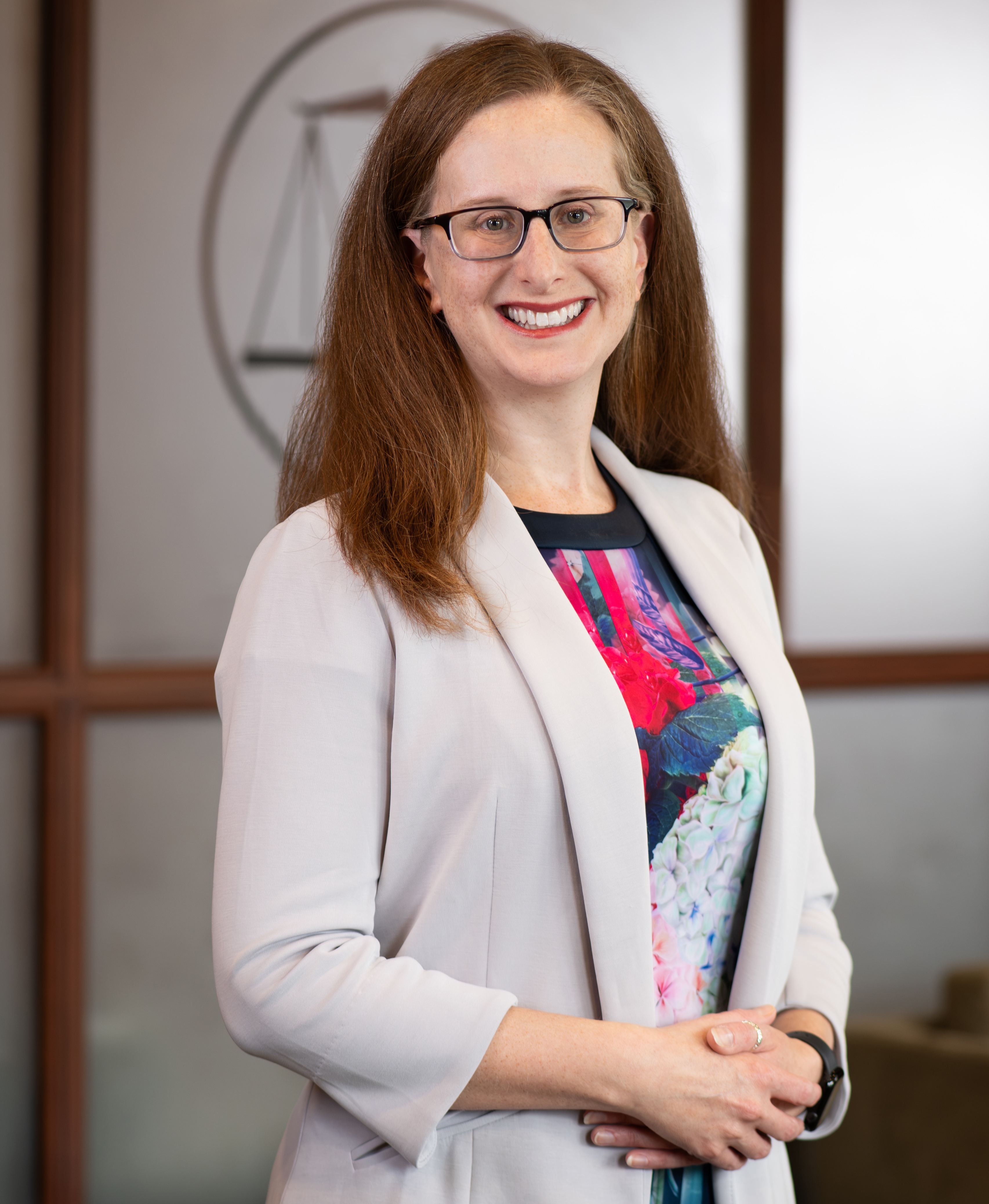
The Maryland Carey Law professor’s scholarship, which has led to law and policy changes, sits at the intersection of bioethics, surveillance technology, and constitutional law.
Every fall, the University of Maryland, Baltimore (UMB) commemorates our rich history and celebrates the future we’re building together during Founders Week, which this year runs Oct. 19-22. Among the highlights is recognizing the extraordinary work of UMB’s faculty, staff, and students with five awards, each signifying outstanding accomplishment in one facet of our mission. Leading up to Founders Week, we will highlight the award winners each week on The Elm. For more information on UMB’s annual celebration and associated events, please check out the Founders Week website. (Photo by Matthew D’Agostino)
After the Golden State Killer was identified using DNA profiles searchable in an online genetic genealogy database, University of Maryland Francis King Carey School of Law professor Natalie Ram, JD, not only published a scholarly article, she also raised questions that helped lead to Maryland’s first-in-the-nation law that comprehensively regulates law enforcement’s use of consumer genetic data.
It is just one example of Ram’s scholarship and influence regarding genetic privacy and the law. She has studied newborn screening, also informing policy changes in several states, and wastewater surveillance in the wake of the COVID-19 pandemic. Ram’s work has led her to be named the University of Maryland, Baltimore’s (UMB) 2026 Founders Week Researcher/Scholar of the Year.
David C. Gray, JD, PhD, MA, the Jacob A. France Professor of Law who has written several articles with Ram, called her a generational scholar who is highly respected among scholars and practitioners.
“Professor Ram is the leading scholar writing at the intersection of bioethics, surveillance technology, and constitutional law,” said Gray, a Fourth Amendment expert who was UMB’s Researcher of the Year in 2019. “Indeed, she is largely responsible for creating the field. She has been the first to identify and pursue important legal and policy questions around genetic privacy and the relationships between public health research and law enforcement. Her work is impactful among academics, scientists, lawyers, and policymakers working in fields ranging from cold case investigations to wastewater testing.”
Maryland Carey Law Dean Renée Laurent, JD, called Ram an exceptionally innovative and influential scholar.
“Her research is reshaping national conversations about privacy, science, and the law,” she said.
Ram said her work asks, “How should society govern our sensitive biological information?”
“I study genetic privacy in an age of big DNA databases, with a particular focus on law enforcement use of genetic data in new ways and from new places,” she said. “This work explores whether and how the government should be allowed to use genetic information, and how we can best protect people’s privacy when DNA can reveal information not just about one person, but about whole families.”
In her article “Genetic Privacy After Carpenter” published in the Virginia Law Review, Ram used the Golden State serial killer case to examine privacy concerns related to genealogy databases. Investigators had compared DNA recovered from victims and crime scenes to DNA profiles searchable in a free genealogical database, finding a distant relative of former police officer Joseph DeAngelo and leading to his arrest in the cold case. Ram examined this usage in light of the Supreme Court ruling in Carpenter v. United States, which held that a cellphone user maintains an expectation of privacy from the government trying to access cellphone location data.
“The Supreme Court’s recent decision in Carpenter opens the way for more robust and nuanced assessments of what constitutes a reasonable expectation of privacy for data in third-party hands,” Ram concluded in the article. “Genetic information is precisely the kind of data in which an individual ought to maintain an expectation of privacy after Carpenter — even when that data is shared with a third party.”
Ram served as a member of the Maryland Genetic Genealogy Working Group, which helped inform the state’s groundbreaking legislation that regulates law enforcement use of consumer genetic data and requires judicial oversight. She continues to serve on the forensic genealogical DNA panel that was created under that legislation.
Wastewater Surveillance, Newborn Screening
Ram has written more than 20 book chapters and law review articles, 17 peer-reviewed publications, and 23 shorter scholarly pieces. In 2026, she was recognized by the Privacy Law Scholars Conference with the Ian Kerr Best Paper Award for “Surveilling the Sewer,” co-written with Emory University’s Jessica Roberts, JD, and forthcoming in UCLA Law Review.
Ram said wastewater surveillance experienced rapid investment and expansion during the pandemic.
“From the start, I have been focused on what would happen with these programs once the pandemic subsided,” she said. “Given the hundreds of millions of dollars invested in infrastructure and human capital to build up wastewater surveillance capabilities, what would these efforts be used for other than the COVID-19 virus? In the last two years, we’ve started to see an answer emerge.
“In addition to monitoring for infectious diseases, several states have considered bills that focus on screening wastewater for signs of medication abortion. Using wastewater surveillance as a tool of abortion regulation is inconsistent with the public health rationale that justified these investments and risks undermining public health and public trust.”
Ram also has examined the newborn blood sample screening that every state does as part of a public health program to analyze for a wide range of metabolic, genetic, and other disorders. In her article “America’s Hidden National DNA Database,” published in the Texas Law Review, she pointed out that most states retain these blood spots and nearly one-third allow law enforcement to access them, related data, or both.
“In addition to concerns about undermining public trust or diminishing respect for persons — and thereby discouraging broad public support and participation in newborn screening — permitting law enforcement to access newborn screening resources without a warrant for crime-detection purposes is likely to run afoul of the Fourth Amendment to the U.S. Constitution,” she wrote.
Ram now is conducting grant-funded work answering legal and ethical questions associated with efforts to expand newborn screening to include genome-wide sequencing.
Real-World Impact
Laurent said Ram’s scholarship demonstrates a rare combination of intellectual rigor, interdisciplinary reach, and real-world impact.
“Her work on genetic privacy, biospecimen use and government access to sensitive biological data has fundamentally advanced understanding in both legal and scientific communities,” Laurent said. “Her recent publications illustrate her ability to engage deeply with complex scientific issues while producing rigorous, accessible legal analysis.”
She said Ram’s research is distinguished not only by its quality but also its reach.
“Her work appears in not just leading law reviews, but also in major scientific journals, reflecting its cross-disciplinary significance,” Laurent said.
Ram said her parents influenced her career: Her mother, Michal Ram, MSc, who earned her master's in oceanography, worked in labs at Wayne State University in Detroit, while her father, Jeffrey Ram, PhD, is a professor who runs a research lab at Wayne State University School of Medicine. Many of Ram’s articles on wastewater surveillance have been co-authored with her father.
“I credit my dad, in particular, with modeling a career that is a calling,” she said. “I am a lawyer by training and a bioethicist by trade. I grew up in a household of scientists, and while I spent some time in the lab, I fell in love with the law. Bioethics, including genetic privacy, offered the opportunity to bridge these interests in novel and interesting ways.”
Ram said her favorite part of being a researcher is digging deep on the hard questions.
“We want law enforcement to solve serious crimes,” she said. “But I think we also care deeply about privacy from the government and more broadly, especially of our most sensitive and intimate data. Figuring out how to safeguard both privacy and public safety, and how to do that while staying true to American legal values, is essential. That’s what my work is trying to do.”
Ram said she was surprised and grateful to be named UMB’s Researcher/Scholar of the Year.
“Our University has so many exceptional researchers doing highly impactful work across disciplines, and I’m honored to be named a leader in this community,” she said.