Innovation in aging starts with creating space to experiment, fail, and see new possibilities.
How do you catch lightning in a bottle?
My colleagues and I found ourselves returning to that question as we developed the ESCAAR program: Entrepreneurship and Science Communication for Aging and Aging-Related Research. We knew we had recruited eight promising early-career researchers studying aging (read who they are in this Elm article). The harder question was what would help them begin turning their research and expertise into ideas, that “lightning in the bottle,” that could make a difference beyond academia.
What Is ESCAAR?
ESCAAR is a professional development program funded by the National Institute on Aging for five years. We started building the program last fall and welcomed our first cohort (out of four) this July.
The program is a training pathway for aging researchers to think beyond discovery by adopting the perspectives of science communicators and social entrepreneurs to move their ideas into the world. Moving ideas into the world involves more than just conducting research. It's about communicating them in compelling ways, engaging the people who can use them, and transforming promising ideas into meaningful change that can positively impact individuals and communities as well as systems that serve older adults.
We all know, and have experienced, how research changes lives — but only when ideas move beyond journals and into the world. But are we doing enough to prepare researchers to move ideas into the world? My two co-PIs, Howard J. “Jim” Kucher and Diane Martin, who are associate professors, like me, in the School of Graduate Studies at the University of Maryland, Baltimore (UMB), felt we need to do a better job with that.
Currently, doctoral education prepares us to generate knowledge, and does so pretty well, but the focus is not always on moving knowledge into the world and breaking down our science for audiences outside of academia. In today’s complex world with complex problems, we must communicate across audiences, collaborate beyond academia, and learn how to recognize opportunities to move discoveries into practice.
Our solution? An interdisciplinary training program based on three simple ingredients, or, as we call them, the ESCAAR pillars:
- Reframing Aging
- Entrepreneurship
- Science Communication
Our goal? Preparing aging researchers to shape the future of aging, turn ideas into solutions, and make science accessible — to all of us. Jim Kucher, who is an associate professor of social innovation at UMB, describes the program as “a journey of discovery — to see if alternatives to traditional research paths might be viable.” And Jim, Diane, and I made a very strategic decision on how to get our fellows started on this “journey of discovery.”
Setting the Stage to Catch Some Lightning
To create an atmosphere conducive to discovery and innovation, we realized that we couldn’t rely just on the typical formats of teaching, like lectures, readings, and discussions. Most importantly, we needed to establish trust with our fellows and signal that this environment is one where creativity, outside-of-the-box thinking, and most importantly errors were not just acceptable, but welcome and, I would argue, essential.
So we started our 2.5-day Summer Institute with improv.
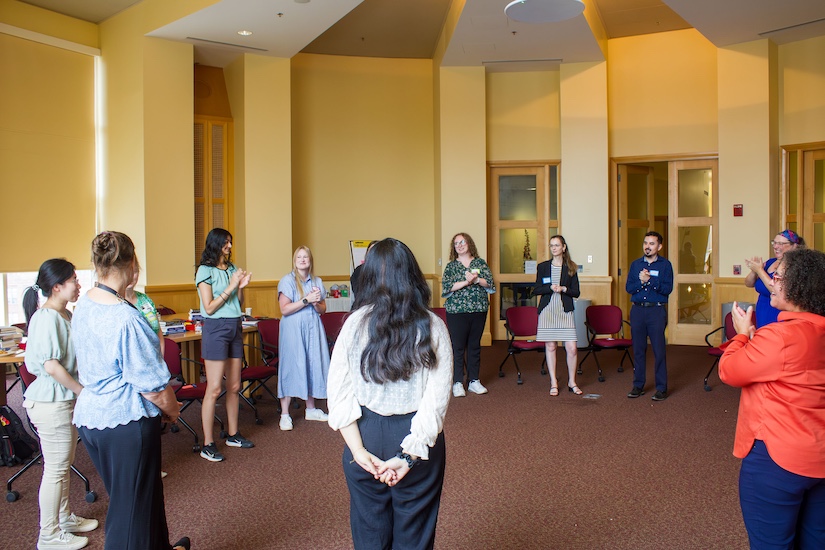
Photo: ESCAAR fellows, faculty, and the improvscience facilitator participate in the opening workshop of the ESCAAR Summer Institute 2026 inside the Gladhill Boardroom at UMB. Photo by University of Maryland School of Graduate Studies
Most of our eight fellows came to Baltimore from across the country. They did not know one another, and we were about to ask them to spend the next 10 months doing something that can feel surprisingly uncomfortable for researchers: playing with ideas before knowing whether those ideas are any good or will work.
The first thing that Raquell Holmes and Martha McCoy from improvscience did was to get us out of our chairs. They asked us to move around the room, use our bodies and voices, respond to one another, be a little silly, and — perhaps most difficult of all — not to spend too much time thinking before we responded to any of their prompts.
It felt very different from many of the academic spaces we knew, and it wasn’t easy for us. That was precisely the point.
As researchers, we are trained to be careful. We examine the evidence, critique arguments, qualify our claims, anticipate limitations, and design studies intended to reduce the possibility of error. Those practices are essential to good science.
But developing a new idea also requires something else. It requires being able to stay open to the unexpected and the possible derailment of our ideas. It means sharing an idea before it is completely formed, building on someone else’s suggestion rather than immediately identifying its limitations, and being willing to follow an idea even when you do not yet know where it will lead. And most importantly, realizing that many of our great ideas might actually not work, or not work the way we thought they would, and — here is the kicker — relish in, even celebrate, that “failure” and learn from it.
One of our fellows wrote this about their experience with the improvscience workshop: “I was skeptical at first, but I really enjoyed it! It emphasized that the way we will engage in this work is much more creative and collaborative than is often structured in traditional academia.”
Maybe catching lightning in a bottle isn't really about capturing one brilliant idea. Maybe it is about creating the conditions in which people feel free to see possibilities they couldn't see before, and setting the tone with the improvscience workshop was our way to make that happen. For our fellows, innovation in aging begins with that openness: seeing new possibilities in their research and exploring where those possibilities might lead.
PS: Read about the origins of the phrase “to catch lightning a bottle” on this blog.
PPS: Applications for the program open in January. Check our website to sign up for regular updates (such as information sessions for applicants and mentors) about the program and to apply once applications open.