Read about how medical student Austin Kim is working to improve the health care workforce and advocate for patients on the U.S. territory in the latest issue of “CATALYST.”
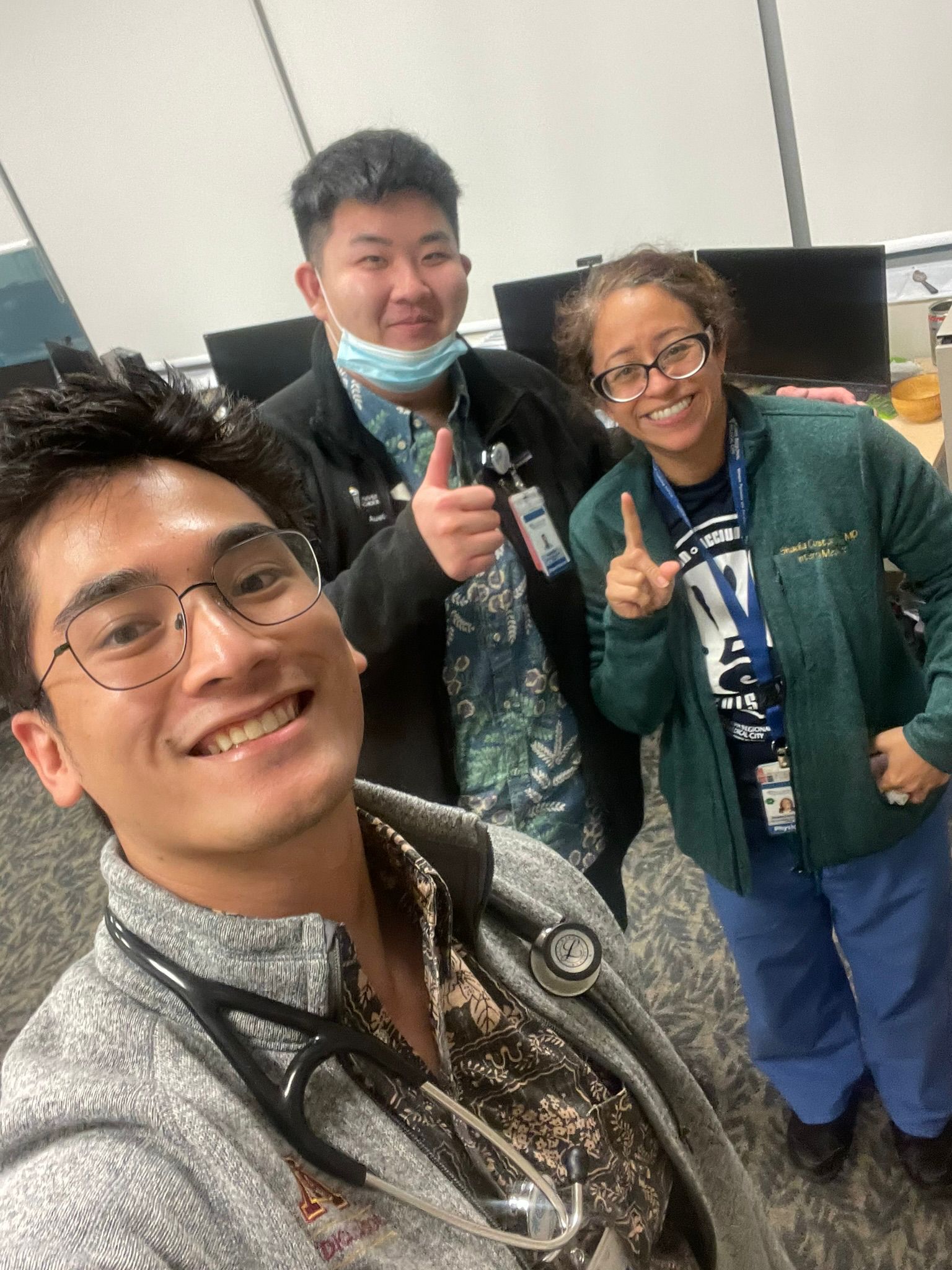
Photo: Austin Kim (center) with Kai Akimoto (left), co-founder of Chålan Åmte, and Shadia Constantine, MD, director of medical education at Guam Regional Medical Center, during Kim’s Area Health Education Center rotation at the medical center. Photos courtesy of Chålan Åmte
As a 16-year-old from Guam, Austin Kim watched his grandmother fight for her life in an intensive care unit after she suffered a severe heart attack and found his family caught in a devastating reality of island health care.
Doctors presented an impossible choice: keep her on Guam with limited care options or risk transferring her to the Philippines for surgery she might not survive the journey to receive.
“I realized there were probably many people on Guam facing similar situations,” Kim says. “It’s unfortunate that people have to make life-or-death decisions based solely on where they live.”
Ultimately, Kim’s grandmother remained on Guam and recovered. Now a third-year medical student at the University of Maryland School of Medicine (UMSOM), Kim, 25, carries that moment with him as he pursues a path that will eventually lead him back to his island home.
Kim has become involved with Chålan (CHUH-lan) Åmte (UHM-ti), an organization whose name translates to “road to healing” in Chamorro, the language of the Indigenous people of Guam. The group comprises about 50 members, mostly medical students from the U.S. territory who understand the island’s health care struggles.
“Our main focus is improving the health care workforce and advocating for patients on Guam and throughout the Pacific Islands,” he says.
With just two civilian hospitals plus Naval Hospital Guam for military personnel, Guam’s health care infrastructure struggles to meet the needs of its 170,000 residents. The island has slightly over one physician per 1,000 people, well below the U.S. average of three, leaving specialists particularly scarce. For many islanders like Kim’s grandmother, this shortage presents difficult choices between limited local care or risky medical evacuation to the Philippines or Hawaii.
“Austin represents a big part of our health care solution — islanders who understand our unique challenges, gain specialized training at the best medical schools, and return home with those skills,” says Vincent T. Akimoto, MD, Chålan Åmte advisor and family medical physician on Guam.
Kim helped develop Chålan Åmte’s website and high school initiative to inspire young people to pursue health care careers. The group also partners with the Area Health Education Center (AHEC), a U.S. program designed to improve the quality of health care in underserved areas, facilitate clinical rotations on Guam for medical students, and serve as interim pre-med advisors for University of Guam students.
“Without a dedicated pre-med advisor on island, students struggle with knowing which classes to take, how to prepare for the MCAT, or navigate the application process,” Kim says. “We’re able to provide guidance since many of us went through the process recently.”
Read more about Austin Kim's work in CATALYST magazine.
The latest issue of "CATALYST" magazine highlights the School of Medicine's impact building safer health systems in The Gambia; the School of Nursing's work with HIV and mental health in Nigeria; a Maryland Carey Law fellowship honoring the legacy of graduate Eric Garvin; UMB's health care pipeline for students from underserved rural areas such as the Eastern Shore; UMB's innovative policing; Five Questions with VP for Research Patrick O'Shea; and much more.