Read about the Ew Meds List, a comprehensive, evidence-based guide to the worst-tasting liquid medicines, along with proven strategies to make them taste better, in the latest issue of “CATALYST.”
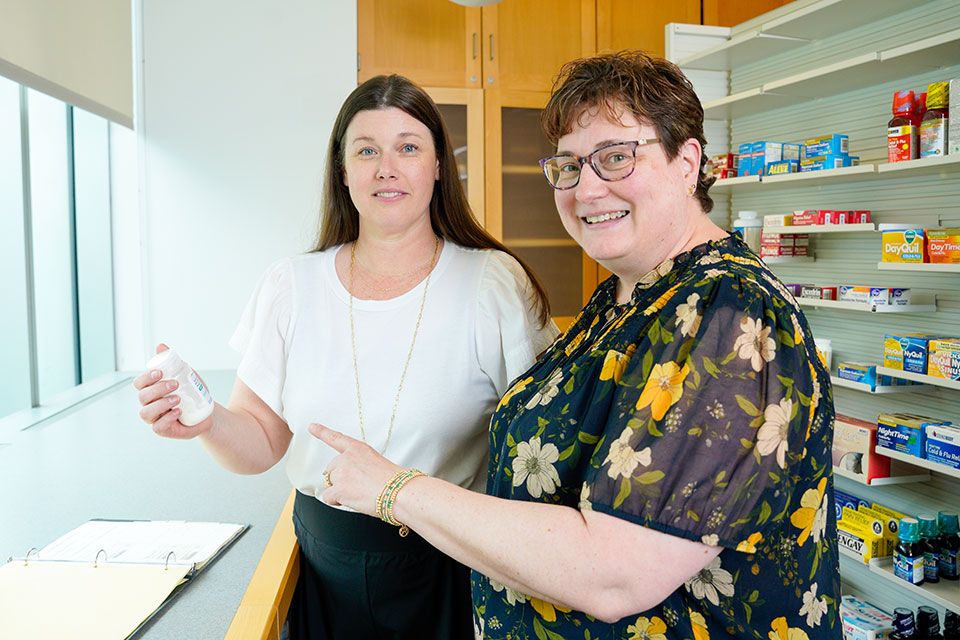
Photo: Amy Kruger Howard, PharmD ’17, MS ’21 (left), and Jill Morgan, PharmD, BCPS, BCPPS, FNAP. Photo courtesy of the School of Pharmacy
From mixing antibiotics with pudding to freezing cough syrup into Popsicles, parents will try just about anything to get their kids to take bad-tasting medicines.
And for years, the medical community wasn’t far behind. Health care practitioners and even hospitals were relying on the same tips and techniques, none of which were ever really proven to taste better. It was all based on anecdote and assumptions about what might work to help children better tolerate their medication.
Jill Morgan, PharmD, BCPS, BCPPS, FNAP, professor and chair of the Department of Practice, Sciences, and Health Outcomes Research and a pediatric pharmacist at the University of Maryland School of Pharmacy (UMSOP), and Amy Kruger Howard, PharmD ’17, MS ’21, a pediatric clinical pharmacist at UMSOP, knew there had to be a better way.
Nearly 75 percent of active pharmaceutical ingredients are bitter, and while capsules and tablets are designed to avoid taste issues, that doesn’t help infants and younger children who can’t swallow them. Liquid medicines are often the only option, but they taste awful. Worse still, many of the common tricks that are used to hide the flavor simply don’t disguise it.
The problem isn’t just children’s heightened perception of bitter taste. Poor palatability is directly linked to non-adherence, meaning children are more likely to skip or refuse doses altogether, which can be dangerous and even life-threatening.
So Morgan and Howard created the Ew Meds List — a comprehensive, evidence-based guide to the worst-tasting liquid medicines, along with proven strategies to make them taste better. Instead of relying on guesswork, the list provides pharmacists and providers with real tools that help — from better-tasting drug alternatives to pharmacy flavoring recommendations and home-based masking interventions. No more trial and error. No more bribery. Just science, with a little creativity on the side.
Now in the hands of pharmacists and providers, the Ew Meds List is helping caregivers make informed choices and getting kids the treatment they need.
“This is actually a huge problem, with the majority of medicines not tasting good,” Morgan said. “And it’s a big issue for kids with chronic health issues who have to take medication every day.”
Read more about the Ew Meds List in the spring issue of CATALYST.
The latest issue of "CATALYST" magazine celebrates the students and alumni who represent the future of Maryland’s health, law, and social work professions. Read about a School of Nursing alumna who turned her 2023 Grid Pitch idea into Ryan’s Place, a health care center in Gaithersburg, Md.; how Maryland Carey Law’s Law and Health Care Program prepares students to serve; a School of Dentistry graduate who studies gene therapies to prevent and treat cleft lip; a School of Social Work graduate who has been appointed to Maryland’s Commission on LGBTQIA+ Affairs; the School of Pharmacy’s newly launched, one-of-a-kind MS in Artificial Intelligence for Drug Development program; and what’s on the desk of Courtney Jones Carney, assistant vice president of student success, leadership, and engagement.