Read about the project, which has built on already established medical partnerships in Nigeria, working with roughly a dozen clinics in the latest issue of “CATALYST” magazine.
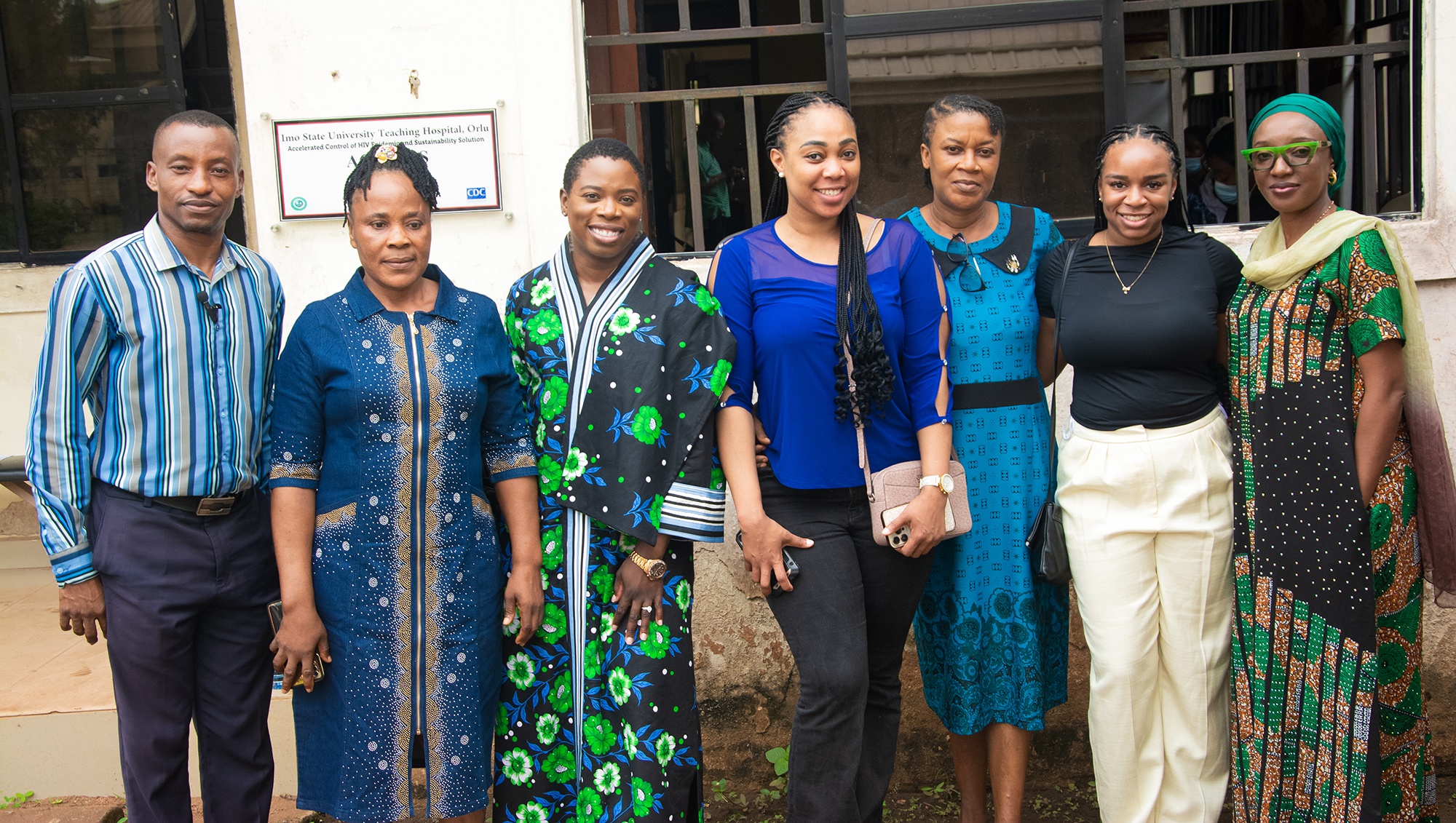
Photo: Charlotte Nwogwugwu (third from left) outside a clinic in Nigeria. Photo courtesy of Charlotte Nwogwugwu
At the end of 2024, 40.8 million people globally were living with HIV, according to the World Health Organization (WHO). In Nigeria alone, an estimated 2 million people were living with HIV as of last year, according to UNAIDS.org.
And while medication and treatment continue to help improve mortality outcomes, medical infections aren’t the only struggles patients diagnosed with HIV are facing. Those living with HIV, according to HIVinfo.NIH.gov, are twice as likely to struggle with depression.
In an effort to combat this compounding crisis, the University of Maryland School of Nursing (UMSON) is working to bring mental health care to Nigerians diagnosed with HIV. But in a region already plagued with a lack of access to medical resources, UMSON had to find a way to meet patients where they are.
“We understood the fact that the health care system in Nigeria is very fragmented,” said Charlotte Nwogwugwu, DrPH, BSN, RN, HIV PCP, CPH-BC, assistant professor and director of the Office of Global Health, UMSON.
“Now, there is no perfect health care system, but when you compare it to [the United States], there is a lot that needs to be done,” she added. “We understood that we were not necessarily trying to create a new health care system, but more primarily [trying] to strengthen what was already available.”
Building on Existing Rapport
Nwogwugwu launched The BRAVE (Building Resilience and AIDS Care Through Mental Health Valor and Empowerment) Project, which has built on already established medical partnerships in Nigeria, working with roughly a dozen clinics to build the capacity of doctors, nurses, and community health workers.
“In Nigeria, a lot of people who are living with HIV and AIDS don’t typically get access to mental health care,” Nwogwugwu said.
Across the globe and in Nigeria, especially, she added, there is so much stigma around seeking care. And, she added, there has been a concerning and still growing rise in suicide rates.
The training BRAVE provided was intensive and taught medical workers in HIV clinics in Nigeria’s Imo State how to assess, diagnose, and treat mental health conditions in patients seeking treatment for HIV. It also created a treatment referral pathway and includes a fund to help provide mental health medications at minimal or no cost.
Pairing mental health screenings and treatment with already established care from trusted professionals helped to remove some of the treatment barriers, she said.
“They’ve developed a rapport,” said Theddeus Iheanacho, MBBS, DTM&H, associate professor adjunct of psychiatry and director, Global Mental Health Promotion at Yale University School of Public Health who has worked with Nwogwugwu on the project. “It kind of made clinical sense to actually build on [the existing provider relationships]. Even if we’re going to bring in additional people — which we’ve done — it’s building it on top of that relationship they have with the clinicians that they’ve known for years.”
Read more about the BRAVE Project in CATALYST.
The latest issue of "CATALYST" magazine highlights the School of Medicine's impact building safer health systems in The Gambia; a Maryland Carey Law fellowship honoring the legacy of graduate Eric Garvin; UMB's health care pipeline for students from underserved rural areas such as the Eastern Shore; UMB's innovative policing; Five Questions with VP for Research Patrick O'Shea; and much more.