Read about how students can gain hands-on experience through a number of clinics and more than 30 externship placements at hospitals, agencies, and nonprofits in the latest issue of “CATALYST.”
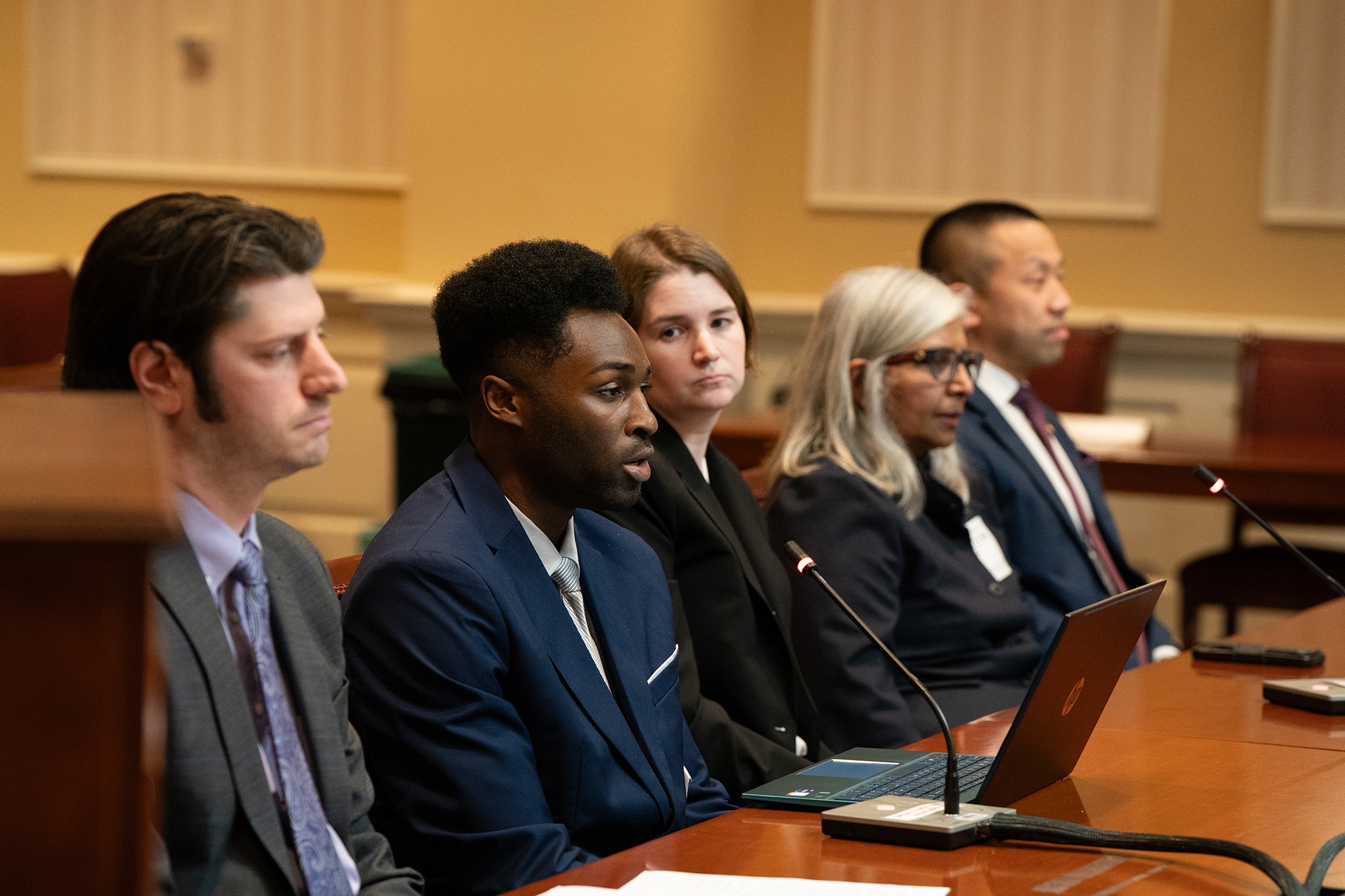
Davon Nixon (second from left) testified before a Senate committee on a tobacco cessation bill. Photo by Matthew D’Agostino
When Christopher Daffin, JD, enrolled at the University of Maryland Francis King Carey School of Law, he thought he was leaving medicine behind. As a biology major in college, he had planned to become a doctor. Then in 2020, the summer before his senior year, the murder of George Floyd shifted his trajectory and he decided he could make a greater impact as a lawyer, advocating for legislation that would improve people’s lives.
Today, Daffin, who graduated in 2024, calls his position as committee counsel for the Maryland House Health Committee his dream job. He manages a portfolio of bills covering public health, minority health disparities, and Medicaid, advising the committee chair and shepherding legislation from drafting through passage.
“It was really a full-circle moment,” Daffin said. “I thought I was leaving health and medicine, and then I ended up doing what I love in that same field I was already trained in through college.”
Daffin’s path from law student to legislative counsel was directly influenced by the Law and Health Care Program at Maryland Carey Law. Founded in 1984 by Professor Emeritus Karen Rothenberg, JD, MPA, the program was pioneering from the start, establishing the country’s first law school AIDS clinic. Consistently ranked in the top 10 health law programs in the nation, it has grown into one of the most comprehensive health law programs in the country.
The program offers more than 25 health law courses, covering everything from medical malpractice and food and drug law to bioethics, health care fraud, and the emerging legal challenges of artificial intelligence in health care. Students can gain hands-on experience through a number of clinics, including the Public Health Law Clinic, the Medical-Legal Partnership, and the new LGBTQI Equality Clinic, or through more than 30 externship placements at hospitals, federal and state agencies, and nonprofit organizations. The program also supports the student-led Journal of Health Care Law & Policy, works closely with the robust Student Health Law Organization, and sends student teams across the country to compete in health law competitions, including in its own Health Law Regulatory and Compliance Competition.
Students also can earn a Health Law Certificate, a formal designation approved by the Maryland Higher Education Commission that signals specialized expertise to future employers. About 750 graduates have earned this distinction in nearly 30 years.
Diane Hoffmann, JD, MS, who joined the faculty in 1987 and took over as program director in 2000, said the program’s national standing reflects decades of institutional investment.
“We just have so many resources devoted to it, and part of that is because it has such a rich history,” Hoffmann said. “We are on a health sciences campus. We have about 10 full-time faculty members and at least that many adjuncts who teach in this area, and they’re always writing about new and cutting-edge issues. Our clinical component has historically been strong, and our externship program, because we’re so close to so many hospitals as well as state and federal agencies, provides lots of opportunities for students.”
That proximity, she said, is central to how students learn to apply what they are taught.
“We’re close to the federal government agencies that address health care, but we also have Schools of Medicine, Pharmacy, Nursing, Dentistry, and Social Work right here,” Hoffmann said. “That gives students the opportunity to take interdisciplinary classes and learn about health law through the lens of students in the health care disciplines.”
Hoffmann said the breadth of the curriculum, combined with the program’s network of practitioners and experiential opportunities, is a major draw for prospective students and the reason graduates land in such a wide range of health law careers.
Read more about the program in the spring issue of CATALYST.
The latest issue of "CATALYST" magazine celebrates the students and alumni who represent the future of Maryland’s health, law, and social work professions. Read about a School of Nursing alumna who turned her 2023 Grid Pitch idea into Ryan’s Place, a health care center in Gaithersburg, Md.; a School of Dentistry graduate who studies gene therapies to prevent and treat cleft lip; a School of Social Work graduate who has been appointed to Maryland’s Commission on LGBTQIA+ Affairs; the School of Pharmacy’s newly launched, one-of-a-kind MS in Artificial Intelligence for Drug Development program; and what’s on the desk of Courtney Jones Carney, assistant vice president of student success, leadership, and engagement.