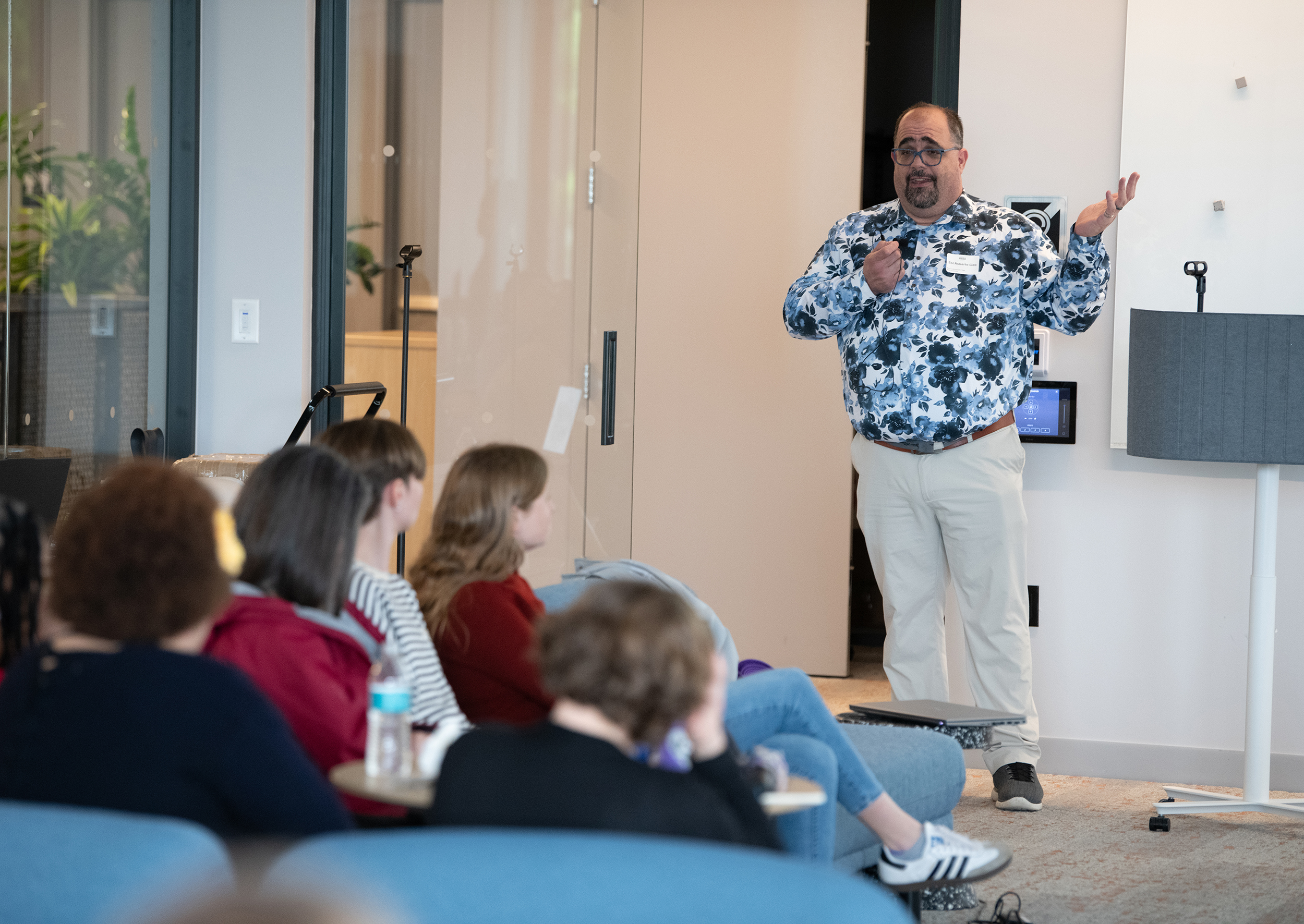
Values in Action speaker Sol Roberts-Lieb says the UMB core values set includes finding new ways to teach, research, and work as well as seeking out new and diverse perspectives and observations.
Photo: Sol Roberts-Lieb delivers his Values in Action Speaker Series presentation May at the 4MLK building. (Photos by Matthew D’Agostino)
A commitment to innovation and discovery can help you strive for lofty, world-changing goals — creating breakthrough vaccines, fighting cancer, ending world hunger — but it’s more likely to be impactful in ways that will change your world, says Sol Roberts-Lieb, EdD, director of the University of Maryland, Baltimore’s (UMB) Faculty Center for Teaching and Learning.
“How many of us are going to build that rocket that flies us to the moon? Probably not a lot of us, but we are going to be able to do significant things,” Roberts-Lieb said during his Values in Action Speaker Series hybrid presentation May 11 at the 4MLK building that focused on the UMB core values set of Innovation and Discovery.
He pointed to a PowerPoint slide showing a loaf of bread and the evolution of the wheel into a car tire. “We’ve heard the expression ‘the best thing since sliced bread,’ right? And I don’t know about you, but I’m not making a new wheel,” he said.
“But what we have is the opportunity in our everyday interactions to innovate and to discover,” added Roberts-Lieb, who also is an assistant professor of health professions education at the University of Maryland School of Graduate Studies. “And one of those ways could be just through regular hallway conversations. In this audience, we have three or four practicing clinicians, and they have patient interactions. But we’re not re-creating a patient interaction.”
The point, Roberts-Lieb said, is that innovation and discovery isn’t always about creating or finding something new.
“For our teachers in a classroom, can we do a lecture differently? Probably. Can we do a simulation differently? Yes,” he said. “What I’d like for you to take home today is this: Innovation is for everybody, innovation occurs all the time, and innovation doesn’t have to be new, but it can be new to you.
“When we’re discovering, we are figuring out: How does it work for us? What’s the better approach? Are we being more inclusive? Are we discovering a new way to connect? And as teachers, what works for your learners in your situation at your time?” Roberts-Lieb added.
As an example, he discussed a University of Maryland School of Nursing faculty member who, for the first time, used team-based learning (TBL), a teaching strategy in which students, rather than merely listening to a lecture, work in small teams to solve real-world problems and apply course concepts.
“TBL has been around for a while, 20 to 30 years,” he said. “And it worked great in her class, and it was new to her. It was discovering a way to better engage her students. And that’s what we’re really doing here at UMB.”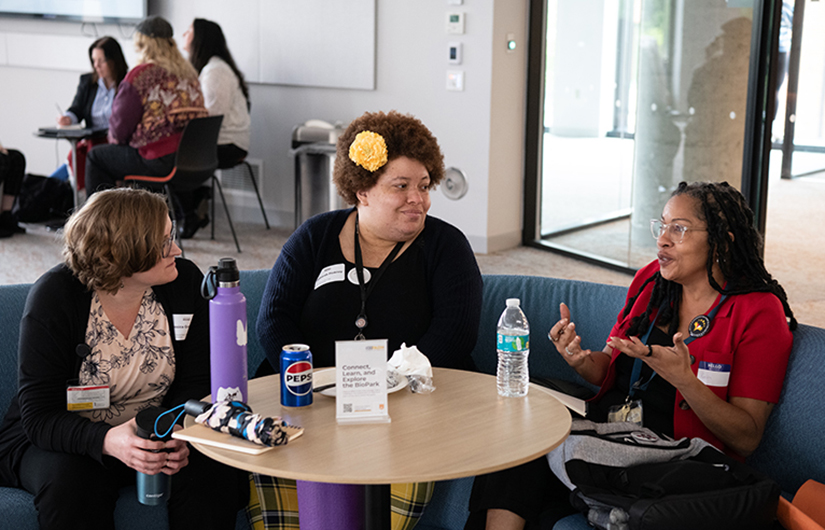
Photo: From left, Jessica Grabowski-Roop, Deborah Pinkney, and Reetta Gach chat at the Values in Action Speaker Series event May 11.
Giving UMB Its ‘Soul’
Roberts-Lieb noted that at UMB, research discoveries and large research grants are generally what get the most attention, but everyday innovations and discoveries are what give the University its “soul and keep us going.”
“To me, this is what UMB’s Innovation and Discovery core value is all about: improving access, supporting students, strengthening communication, redesigning learning experiences, and making systems more human-centered,” he said, pointing to a slide with a quote from Albert Szent-Györgyi, a Hungarian scientist who discovered vitamin C and won a Nobel Prize in 1937: “Innovation is seeing what everyone has seen and thinking what nobody has thought.”
“Had vitamin C always been there? Yes, but he looked at it through a different lens,” Roberts-Lieb said. “So what do we see when we take off our glasses, look outside of our perspectives, or look at somebody else’s practices? If I’m a law professor, am I going to look at a nursing class and pick something up? Absolutely.
“So innovation is intentional. Intentionality is the key,” he added. “You’re not going to discover that next thing without trying. So when we think about it, it’s all connected to the scholarship of teaching and learning.”
 Innovation, Curiosity, and Uncertainty
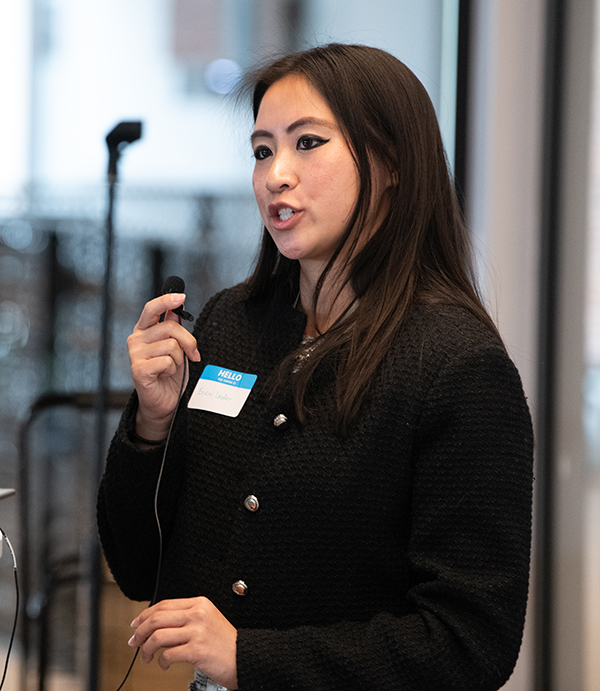
Erica Leyder, MSc (in photo, right), a third-year PhD candidate in the Molecular Microbiology and Immunology program at the University of Maryland School of Medicine (UMSOM), opened the event by talking about her research on viruses and how it intersects with discovery, education, and impact.
“For me, innovation doesn’t begin with an answer, it begins with curiosity, and often with uncertainty,” said Leyder, who works in the lab of Matthew B. Frieman, PhD, professor of microbiology and immunology, UMSOM.
“As scientists, we’re constantly stepping into the unknown, trying to make sense of systems that are designed to evade us,” she added. “And viruses, in particular, are masters of adaptation, but they are also considered nature’s best cell biologists. They evolve quickly, exploit our biology, and challenge us to think differently while we also are learning about our own cell biology.”
Leyder said the coronaviruses that caused the COVID-19 pandemic and two outbreaks — SARS in 2003 and MERS in 2012 — are among a large family of RNA viruses that typically cause upper-respiratory infections and include seasonal coronaviruses that can cause the common cold.
Her research is not focused on targeting the virus directly, but instead harnessing or strengthening the body’s cell structure to block the virus’ entry and prevent transmission.
“I focus on our own cells and ask, ‘What tools do we already have within us to fight back?’ ” Leyder said, adding that the current standard of care for treating high-risk patients with COVID-19 includes the drugs remdesivir, molnupiravir, and Paxlovid.
“All three can reduce disease severity, but their effectiveness depends on early administration and viral specificity, and they do not prevent transmission of the virus,” she said. “This has led me to study host-directed therapeutics, specifically identifying conserved cellular pathways that can limit viral entry.”
Leyder discussed her research with a gene called FAM46C, the role it plays in restricting viral pathogenesis, and how it can be strengthened with the drug norcantharidin, a small-molecule synthetic compound that has anti-cancer properties as well.
“Rather than designing a drug for one specific virus, this approach opens the door to something much larger: the potential for broad-spectrum antivirals that could help us respond more rapidly to future pandemics and have a potential prophylactic for the common cold,” she said.
As an adjunct lecturer at Johns Hopkins University and Coppin State, an HBCU (Historically Black Colleges and Universities), Leyder said she enjoys teaching and mentoring students who are from diverse backgrounds and underrepresented in the STEM fields.
“Teaching at an HBCU is meaningful because innovation isn’t just about new technologies or discoveries, it’s about expanding who gets to participate in them,” she said, recalling how a cheek swab experiment with Coppin State students seeing their cells under a microscope and hearing their observations reminded her of the importance of seeking out new perspectives.
“That moment reminded me how easily important details can be overlooked when you’re close to your own data, and how fresh perspectives, especially from students, can shift how we see familiar observations,” Leyder said. “It reinforced for me that innovation and discovery don’t happen in isolation. They’re often sparked in conversation, in teaching, and in simply paying closer attention together.”
The Values in Action Speaker Series is a collaboration between the Core Values Program at UMB and the Office of Values and Strategic Initiatives at the University of Maryland School of Graduate Studies. The series was created to recognize the ways that all members of the UMB community bring to life the hallmarks of our community.