Find out in the latest issue of “CATALYST” magazine why UMB Police and Public Safety’s community model works: UMB is one of the safest areas in downtown Baltimore.
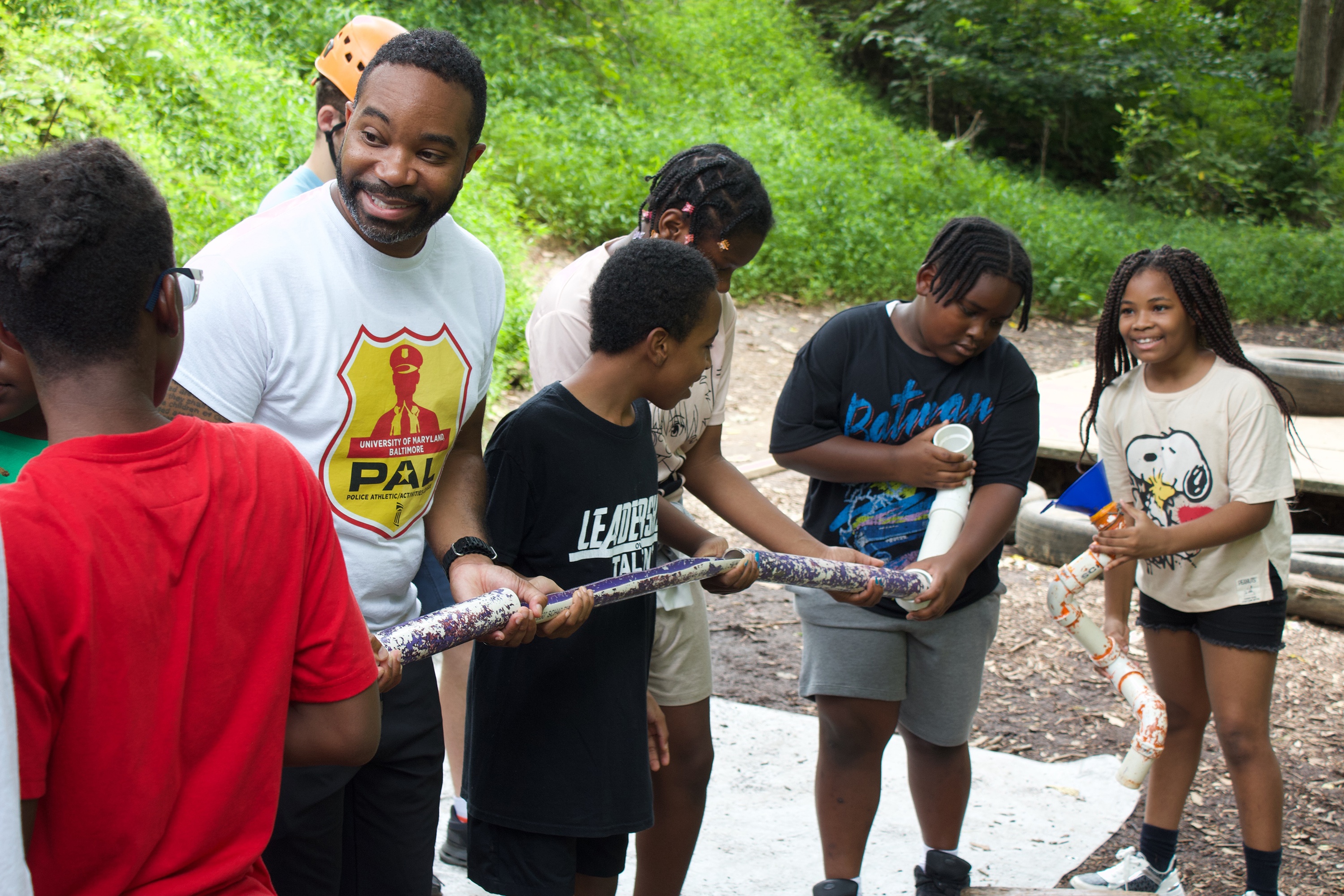
Photo: Lt. Matthew Johnson and PAL students take part in team-building activities at Terrapin Adventures in July 2025.
Ever since the first officers were sworn in 50 years ago, community engagement has been the bedrock of the University of Maryland, Baltimore (UMB) Department of Police and Public Safety.
On Christmas Eve in the 1970s and early 1980s, officers dressed up as Santa and his elves and visited children at the University of Maryland Medical Center and Ronald McDonald House.
“We used to sell coffee and donuts in Howard Hall,” says security officer William Groh, who has served the department since 1964. “We collected all that money together at Christmas and got the kids toys, and the teenagers, we’d give calculators.”
Now, the department joins first responders from across Maryland to donate and deliver toys to sick, needy, and homeless children during the holiday season through the Kindertime Toy Drive. It’s a magical sight: over a mile of twinkling lights from dozens of police cars and firetrucks slowly winding through the city to make their deliveries.
Around Thanksgiving, the department provides turkey dinners to local families in partnership with the Office of Community and Civic Engagement (OCCE). This past year, UMB Police and Public Safety gave away 65 backpacks full of school supplies to neighborhood kids at its National Night Out event.
A Shift in Outreach Strategy
Over the years, the department’s outreach has shifted from goodwill gestures to a structural model of community engagement. In 2018, then-Chief Alice Cary created the Community Outreach and Support Team (COAST), which formalized the department’s outreach programs.
As COAST expanded, UMB Police and Public Safety took a new and innovative approach to policing. This includes:
- Pilot agency for Law Enforcement Assisted Diversion (LEAD), an initiative that redirects low-level drug users from incarceration to substance use and mental health resources; the program is still used today
- First university police department to partner with social workers to provide case management and resources to the community
- Only university police department in the nation and only police department in Baltimore City with a Police Athletic/Activities League (PAL) program
- Third university police department with a comfort K9
Because UMB is a leader, the police are sharing their knowledge. Members of COAST have met with Johns Hopkins Public Safety and other Maryland police departments to show them the inner workings of UMB’s PAL program. The comfort K9 program has expanded to other regional university police departments, including University of Maryland, College Park; University of Maryland, Baltimore County; and Towson University. They’ve traveled to Washington, D.C., and Western Maryland and met in Baltimore with Philadelphia police to educate officers about the LEAD program and harm reduction strategies.
“Change is incremental,” says Lt. Matthew Johnson, who leads COAST. “It’s not like flipping a switch. But we are already seeing the difference these changes make to our community.”
Read more about community policing in the latest issue of CATALYST magazine.
The latest issue of "CATALYST" magazine highlights the School of Medicine's impact building safer health systems in The Gambia; the School of Nursing's work with HIV and mental health in Nigeria; a Maryland Carey Law fellowship honoring the legacy of graduate Eric Garvin; UMB's health care pipeline for students from underserved rural areas such as the Eastern Shore; Five Questions with VP for Research Patrick O'Shea; and much more.