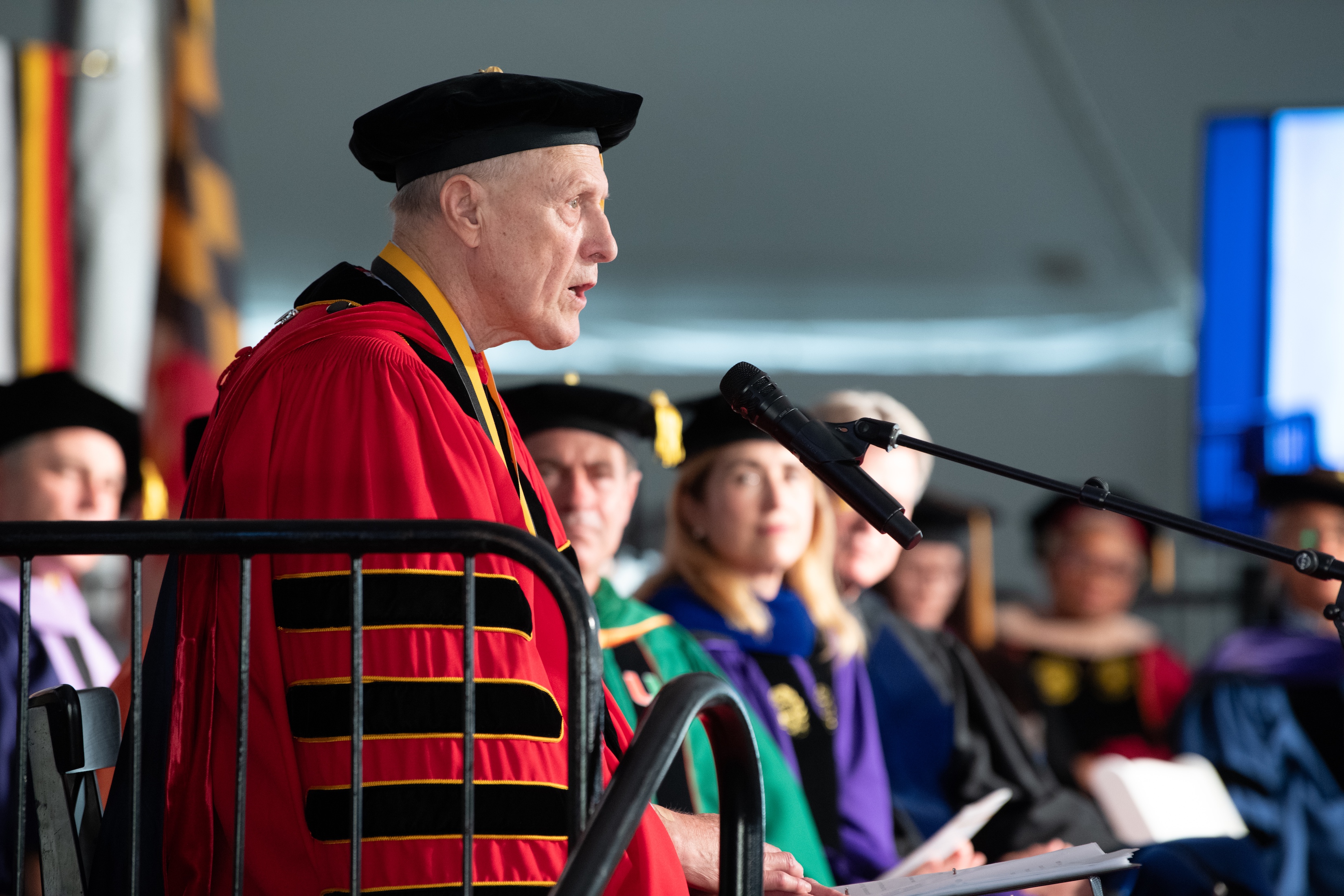
At Convocation, the University president talks about the people helped by UMB’s research and laments the “loud voices” in the country who are critical of higher education.
Photo: “Our measure of success ... will always be our impact on people’s lives,” UMB President Bruce Jarrell said at the Faculty Convocation. (Photo by Matthew D’Agostino)
During the University of Maryland, Baltimore’s (UMB) Faculty Convocation on Sept. 17, President Bruce E. Jarrell, MD, FACS, urged attendees to share the stories about the good work that the University is doing in research, patient care, health, law, and social work to drown out “the loud voices” who are attacking higher education.
He said if you listen to those people, you would believe that students don’t finish their degrees or get jobs, faculty are teaching their politics instead of their disciplines, and research is full of abuse and fraud.
“I hear loud voices in this country saying we universities have got it all wrong, that we have lost our way,” Jarrell told the 450 attendees. “I’ve got a beef with that.”
He said UMB’s faculty members are fully engaged in teaching, research, clinical care, and client advocacy, and almost all of UMB’s students graduate and go on to have highly productive careers.
“We have a state desperate for care providers and advocates, and UMB is delivering that workforce,” he said. “I see highly successful research scientists and scholars having an impact; discoveries changing the practice of medicine, dentistry, pharmacy, and nursing; opinions influencing high-court decisions; and new approaches to meeting the needs of communities in Baltimore and beyond.”
Watch a video of Jarrell’s remarks below or on YouTube.) School of Nursing faculty members Fernandez-Dizon and Bindon share their stories at Faculty Convocation.
Jarrell went on to outline the stories of three patients who have benefited from the research and patient care provided by UMB.
The first was Becca Valle, who was diagnosed five years ago with glioblastoma, a malignant brain cancer that kills most patients within 12 to 18 months of diagnosis. She enrolled in the clinical trial of Graeme Woodworth, MD, the Howard M. Eisenberg, MD Distinguished Professor of Neurosurgery at the University of Maryland School of Medicine (UMSOM), who developed an innovative approach to make chemotherapy more effective using a technique called focused ultrasound. Of the 34 trial participants, 40 percent have lived three years or more, including Valle, who is now 42 and doing well.
“Think how valuable those five years have been to her,” Jarrell said. “Think about the hope in her mind for the next five years. Put yourself in her shoes. Suppose you had died when you were 40? What would you have missed in your life?
“Do you mean to tell me that this is not a good use of federal research or faculty time? That this has no bearing on the future, the hopes of everyday Americans?”
Worthy Research Investments
Jarrell also spoke of two patients with sickle cell disease, a painful condition that leads to vital organ failure and death, who entered the sickle cell gene therapy program at the University of Maryland Greenebaum Comprehensive Cancer Center. Jessica Ceja and Ese Sifo are the first two adult patients with sickle cell anemia to undergo gene therapy in Maryland to cure them of the debilitating disease. Jarrell also pointed out that the program is run by Jean Yared, MD, and Jennie Law, MD, who is a UMSOM graduate.
“Research like this took decades to develop, with success and failure, requiring university and medical center partnerships,” Jarrell said. “It is expensive, slow work. But do you mean to tell me that this research isn’t worth that big investment? That it has been a waste of federal dollars? I bet these patients would say very differently. So would I. This is the best it gets.”
He also emphasized work being done by faculty at the University of Maryland Francis King Carey School of Law and the University of Maryland School of Social Work with the Unger group, 237 individuals who were incarcerated for violent crimes before 1981. It later was determined that they had been wrongfully convicted, and many were released from prison.
“How could individuals in prison for 30 years be expected to return to society and lead productive lives as opposed to winding back in prison?” Jarrell asked.
Seeing a need for social and legal services, law professor emeritus Michael Millemann, JD, and Rebecca Bowman-Rivas, MSW, Law & Social Work Service Program manager at Maryland Carey Law, developed a program to help them return to society.
“In Maryland, 40 percent of individuals released from prison return to prison within three years,” Jarrell said. “But with this program, the return rate was 3 percent. Individuals who faced a life sentence, literally, were now returning home.”
Telling the University’s Story
Jarrell emphasized, however, that it’s not enough to do good work, saying that the UMB community needs to tell the University’s story.
“We need to take the microphone back. We need our voices heard. The loud voices have had it for too long,” he said. “We need to tell the human side of the story, and we need to tell it better. We need to talk about the value of the lives we touch, not by shouting louder but by telling the whole story. Let us define who we are.”
He outlined some of the steps UMB has taken to do so, such as its “Breakthroughs Can’t Wait” campaign; connecting with legislative teams in Annapolis and Washington, D.C., when new federal policies are announced; partnering with Maryland’s attorney general; and committing $33 million to support the University’s research enterprise.
“We all see what’s possible,” he said. “We all see what’s at stake. That’s our story.”
He concluded by emphasizing that UMB’s purpose is to improve lives.
“We’ve been here for over 200 years, and we’re going to be here for another 200 years,” Jarrell said. “Our measure of success is not going to change. It will always be our impact on people’s lives.”