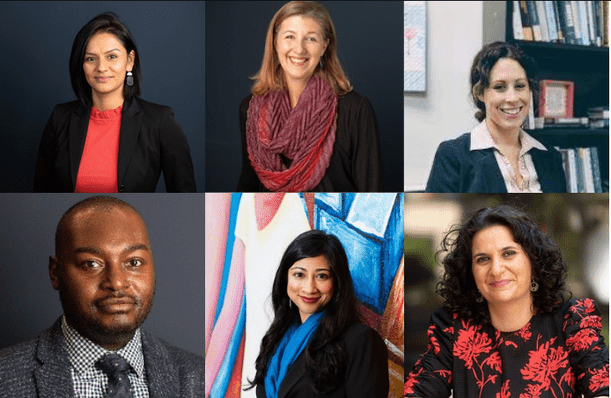
UMSSW faculty use LEAPS grants to advance innovative teaching in transnational Latine practice and AI, preparing students for complex real-world social work.
Innovation in teaching often begins with a question: How can students be better prepared for the complex realities they will face in practice? At the University of Maryland School of Social Work (UMSSW), that question is driving a new wave of instructional innovation led by Iris Cardenas, PhD; Angela Jachelski, MSW; Mary Hodorowicz, PhD, LCSW-C; Darren Whitfield, PhD, MSW; Nalini Negi, PhD, MSW; and Sarah Dababnah, PhD, MPH, MSW.
Advancing Innovation Through LEAPS
Through the University of Maryland, Baltimore’s Leaders in Education: Academy of Presidential Scholars (LEAPS) 2026-27 Instructional Innovation Seed Grant program, this interdisciplinary UMSSW team is expanding the scope and visibility of their work in ways that directly benefit students, practitioners, and communities. The LEAPS grant supports faculty as they experiment with, test, and implement new pedagogical approaches that require time, equipment, materials, and assessment support to enhance teaching quality and student learning.
By investing in early-stage instructional ideas and giving them room to grow, the seed grant program helps transform promising concepts into concrete classroom and field learning experiences that foster student success.
Transnational Teaching for Latine Communities
At the center of one funded effort is “Developing a Transnational Co-Instruction Framework for Social Work Practice with Latine Immigrant Communities,” led by assistant professor Iris Cardenas, PhD, in collaboration with assistant professor and practicum coordinator Angela Jachelski, MSW, and associate professors Darren Whitfield, PhD, MSW; Nalini Negi, PhD, MSW; and Sarah Dababnah, PhD, MPH, MSW.
The project focuses on preparing students for culturally responsive, globally informed practice with Latine immigrant communities by developing a transnational co-instruction model that intentionally incorporates voices, perspectives, and expertise across borders. By designing collaborative teaching strategies that connect classroom learning with the lived realities of Latine communities, the team aims to equip future social workers with the knowledge and skills needed to effectively support immigrants and their families in diverse settings.
Using AI To Teach AI
A second UMSSW project funded through the LEAPS seed grant program, “Using AI to Teach AI in Health Science and Human Services,” is led by Mary Hodorowicz, PhD, LCSW-C. As artificial intelligence (AI) becomes increasingly embedded in health and human services, social work students must be prepared not only to use these tools but also to examine them critically.
Hodorowicz’s project integrates AI tools directly into the learning environment so students can explore how these technologies work, evaluate their benefits and limitations, and consider the ethical questions that arise when AI is applied in practice. By “using AI to teach AI,” the project encourages students to develop a more nuanced understanding of emerging technologies and their implications for equity, access, and professional responsibility.
“AI is both opening new doors and creating new challenges and concerns for instructors, students, and patients. It’s essential to explore and educate on the ongoing ethical implications related to the use of AI tools within health science and human service education.” — Mary Hodorowicz
Interdisciplinary Work With Real-World Impact
Together, these LEAPS-funded efforts illustrate the breadth of UMSSW’s portfolio — spanning transnational collaboration, community-engaged practice, and technology-enhanced instruction across research, practice, and education. The projects are grounded in evidence-informed practice and equity-driven solutions, reflecting the school’s commitment to preparing students to navigate complex social, behavioral health, and human service systems.
By leveraging interdisciplinary expertise and University-level support for educational innovation, Cardenas, Jachelski, Dababnah, Whitfield, Negi, and Hodorowicz are creating learning experiences that resonate far beyond the classroom, strengthening the next generation of social workers and the communities they serve.