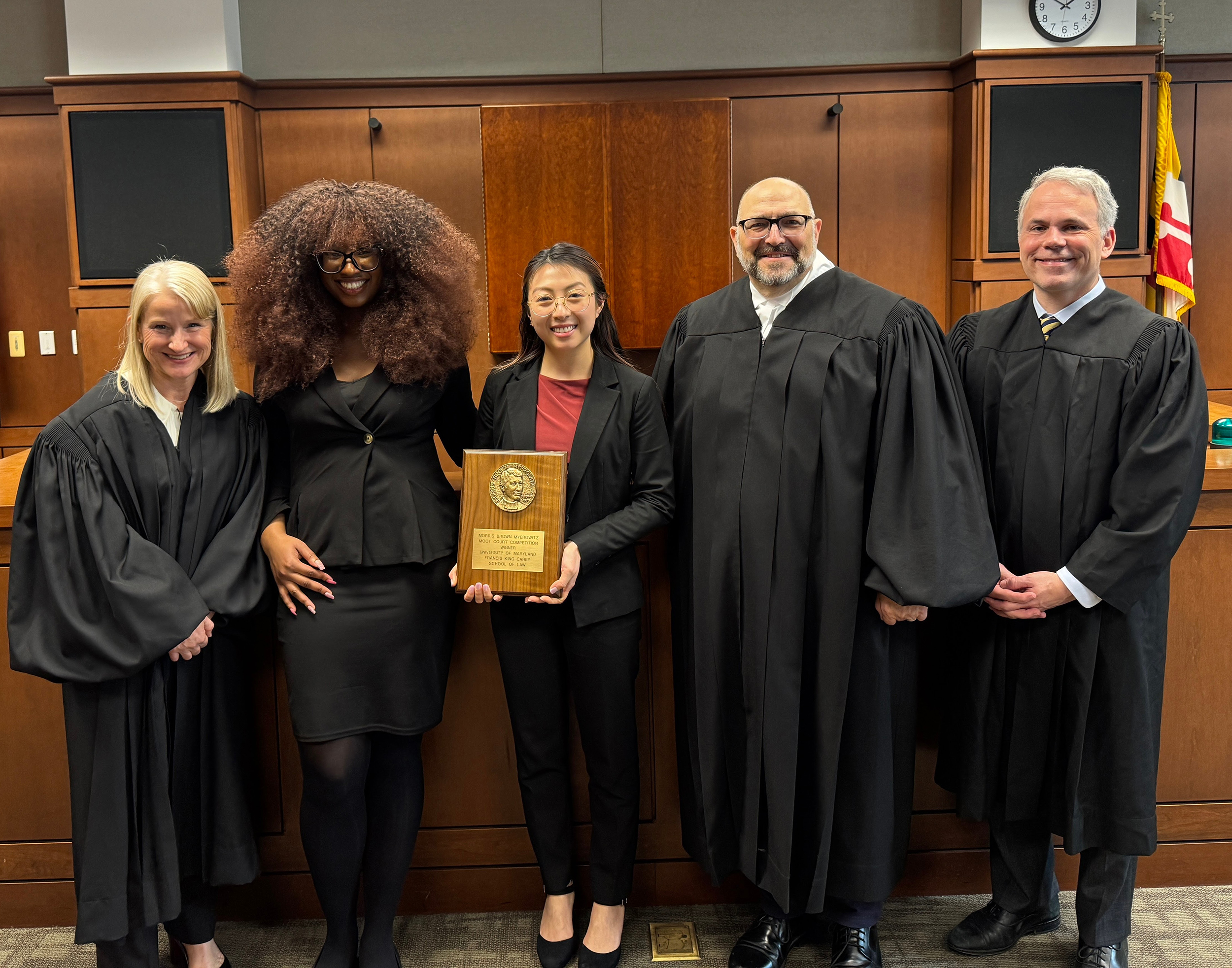
Maryland Carey Law student advocates argue “Hunger Games” scenarios, address issues around probable cause and Miranda requirements in the 55th annual event.
Photo, from left: Brynja Booth, judge; Ghenaé Ford and Erika Kim, students; and Daniel Friedman and Matthew Fader, judges.
The University of Maryland Francis King Carey School of Law held the final round of the 55th annual Morris Brown Myerowitz Moot Court Competition on March 11.
Four finalists — Carly Cohen, Ghenaé Ford, Kyle Korte, and Sarah Moore, all JD students in the Class of 2027 — presented oral arguments in the fictional case United States v. Katniss Everdeen, addressing issues around probable cause and Miranda requirements.
With deep knowledge of case law reflecting intense preparation, students argued for the petitioner (United States) and respondent (Katniss Everdeen). From the popular “Hunger Games” trilogy by Suzanne Collins, Katniss Everdeen is the resourceful and fiercely loyal teenager who illegally hunts to feed her impoverished family. Did peacekeepers enter the Everdeen home illegally? Should Katniss have been read her Miranda rights by a case worker who knew information from the interview might be used in a criminal case against Katniss?
Students were fortunate to wrestle with these questions before a panel of highly distinguished members of the Maryland Judiciary. They included Matthew Fader, JD, chief justice, Supreme Court of Maryland; Hon. Brynja Booth, JD, justice, Supreme Court of Maryland; and Daniel Friedman, JD ’94, judge, Appellate Court of Maryland.
In her welcome remarks, Maryland Carey Law Dean Renée Laurent, JD, introduced the judges, pointing out that Friedman was a finalist and best brief writer in the 1993 Myerowitz competition.
Before announcing the winners, the judicial panel praised the competitors for their preparation and nimble responses to questions during their arguments. “We look forward to seeing you in our courtrooms after you graduate,” Fader said. “You all did a great job.”
The coveted best oralist award went to Ford, with Korte as runner-up. Erika Kim received the best brief award, with Ann Kelly as runner-up. Kim and Kelly are both from the JD Class of 2027.
Ford, who will spend the summer working with the Center for Reproductive Rights, appreciated the opportunity that the Myerowitz competition gave her to develop important skills.
“Being named best oralist is deeply meaningful because I know how rare it is for someone with my background to stand in spaces like this,” Ford said. “As a Black woman and a low-income, first-generation law student, I was always aware that students who look like me are not guaranteed these opportunities— even when we work twice as hard to earn them.
“I prepared for this competition not just for myself, but for every student who has been told, directly or indirectly, that they do not belong here. This experience sharpened the advocacy skills I will carry into practice and reaffirmed my commitment to using the law to fight for the communities that raised me.”
The Myerowitz competition is named for Morris Brown Myerowitz, JD ’68, who died tragically two years after graduation. Members of the Myerowitz family created the competition to honor its namesake’s sharp intellect, academic success, and zest for life. Now a treasured tradition at Maryland Carey Law, the competition attracts alumni, students, faculty, staff, and members of the legal community.