Read about how the University had to overcome numerous challenges because the war divided more than the country in the latest issue of “CATALYST” magazine.
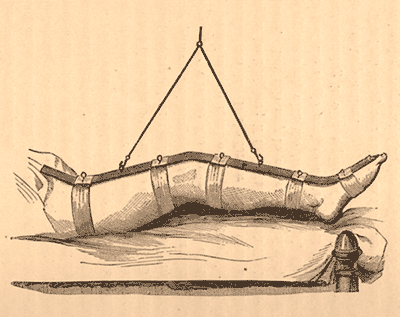
Photo: A hand-drawn image of Nathan R. Smith’s anterior splint, which stabilized a soldier’s injured leg, allowing him to be moved with less pain and risk of further injury.
William A. Hammond joined the University of Maryland School of Medicine (UMSOM) in 1860 as chair of anatomy and physiology but left just two years later to join the U.S. Army during the Civil War as surgeon general. In that role, Hammond developed a system for evacuating wounded soldiers from the battlefield and organized the military hospital and medical system. Hammond had the foresight to create and maintain detailed records, reports, and data, which led to a better understanding of military medical science and history. After the war, he created the Army Medical Museum.
This is just one example of how leaders from UMSOM helped to make advances during the Civil War.
In May 1861, professors Hammond and Nathan R. Smith, who held the surgery chair and filled Hammond’s when he left, were sent to Washington, D.C., to negotiate an agreement with the U.S. government to care for Union soldiers in the Baltimore Infirmary (the University Hospital) at $5 a week, $2 more than civilians were charged. In response to the war, the faculty also introduced new coursework on military surgery and hygiene. The faculty welcomed U.S. surgeons to attend clinical lectures in the Baltimore Infirmary, which provided them with medical knowledge to assist soldiers on the battlefield.
The Union soldiers provided important clinical training for UMSOM students and important research fodder for their medical dissertations, leading to an increase in the number of theses devoted to wartime topics such as gunshot wound care. However, the soldiers did cause some concerns in the hospital with the nurses, Roman Catholic nuns, who claimed the men were trying to convert them from Catholicism to Protestantism. The faculty consulted with the U.S. surgeon general to put these activities to an end.
Smith also had invented an anterior splint, which proved indispensable during the Civil War. The splint was introduced in The Baltimore Monthly Journal of Medicine and Surgery in 1830, and Smith continued to improve and perfect it until 1860. The splint stabilized a soldier’s injured leg, allowing him to be moved with less pain and risk of further injury. Additionally, it flexed, allowing for some movement of the leg, and made it easy to clean and dress the wounds.
Read more at CATALYST magazine.
The latest issue of "CATALYST" magazine highlights the School of Medicine's impact building safer health systems in The Gambia; the School of Nursing's work with HIV and mental health in Nigeria; a Maryland Carey Law fellowship honoring the legacy of graduate Eric Garvin; UMB's health care pipeline for students from underserved rural areas such as the Eastern Shore; UMB's innovative policing; Five Questions with VP for Research Patrick O'Shea; and much more.