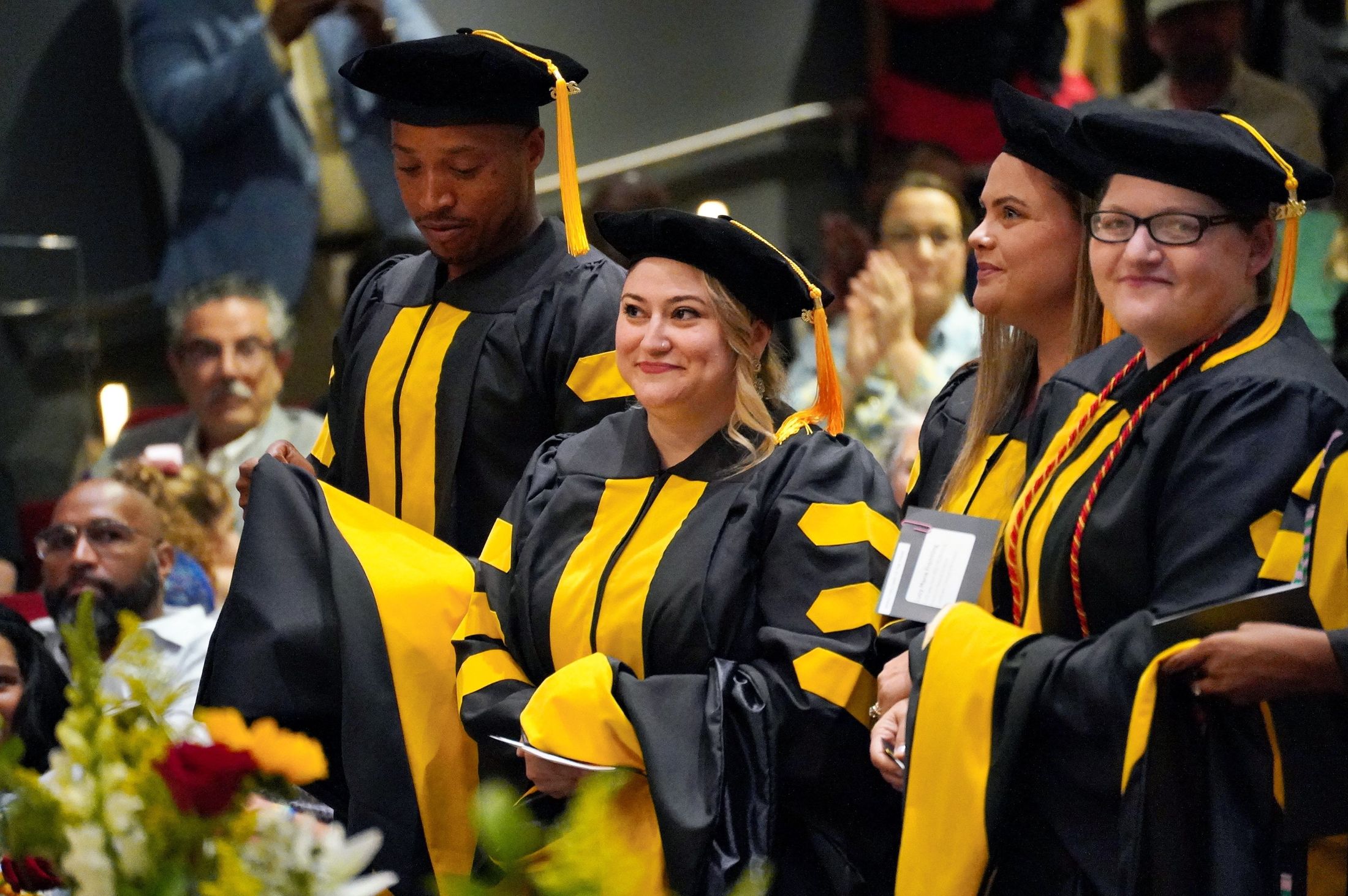
The School of Graduate Studies celebrates graduates of its first Doctor of Medical Science cohort alongside Master of Science and Post Baccalaureate Certificate programs.
On May 20, the University of Maryland School of Graduate Studies celebrated hundreds of graduates in the Class of 2026 across its Doctor of Medical Science (DMSc), Master of Science, and Post Baccalaureate Certificate programs.
Kenneth Wong, PhD, dean of the School of Graduate Studies, opened the day with heartfelt congratulations to graduates and their loved ones.
“We celebrate your drive, your scholarly passion, your desire to serve the public good, which is in alignment with the University’s mission,” he said. “Thank you for investing your time, your talent, your treasure, and your trust with us. It means a lot to us as faculty, and we have thoroughly enjoyed watching you grow and learn, and all of us are better for the diverse perspectives and the life experiences you’ve contributed to our programs.”
Roger J. Ward, JD, EdD, MSL, MPA, provost and executive vice president, University of Maryland, Baltimore, conferred the degrees. He encouraged the graduates to recognize those who supported them on their educational journey.
“I want the graduates to stand, to turn around, and give your family members, your loved ones, and the faculty members a round of applause for being here and supporting you to this point,” Ward said. “I know because of all who have poured into you that what you will be taking away from your experience here, that you are prepared to help fulfill the mission to improve the human condition, which is the University’s mission, along with serving the public good.”
The school also celebrated its first cohort of graduates from the DMSc program. These graduates represent the inaugural cohort of physician assistants who are committed to deepening their expertise in clinical practice, health care administration, and systems management.
The student address was delivered by Jamal T. Bracken, DMSc, MPAS, MSHS, PA-C, CDCES, 2026 graduate and member of the inaugural cohort of the DMSc program.
Sidelined by a basketball injury during his freshman and sophomore undergraduate seasons, he credits that injury as a turning point where academics began to take priority over athletics. Upon graduating from Frostburg State University with a Bachelor of Science in Health Science, he went on to earn a Master in Community Health and Health Education from Towson University. It was then he began to understand some of the deeper social and structural issues that shape health outcomes in underserved communities, which led to earning a second master's as a physician assistant at the University of Maryland School of Graduate Studies before earning his DMSc. He emphasized that the challenges faced during the academic journey served to strengthen resilience and purpose.
“Each of us has faced many moments that challenged us, stretched us, and forced us to grow into who we are today,” he said. “We have come to realize that success isn’t defined by how linear the path is or how it looks from the outside. It is defined by who we become by walking [the path]. The journey has sharpened our thinking and deepened our strength of purpose. Most importantly, it reminded us that we are capable of more than we thought was possible.”
Bindu Murthy, PharmD, MS, and pharmacometrics graduate, Class of 2018, was presented with the 2026 Master of Science Alumni Award. Murthy serves as vice president of clinical pharmacology within the Department of Translational Medicine & Clinical Pharmacology at Bristol Myers Squibb, where she leads a high-performing team of approximately 60 scientists supporting a diverse portfolio spanning immunology, cardiovascular, neurosciences, hematology, oncology, and cell therapy.
She advised the graduates to “First, stay hungry. Keep building skills even when you’re busy and even when you are already enrolled. Second, be willing to be the beginner. Growth often starts with the discomfort of not knowing yet. Third, practice translating technical work into decisions, because impact in drug development comes from connecting evidence to action. My path was nonlinear, and that’s an intentional modeling pun, but this program gave me the confidence to help me lead the conversation.”