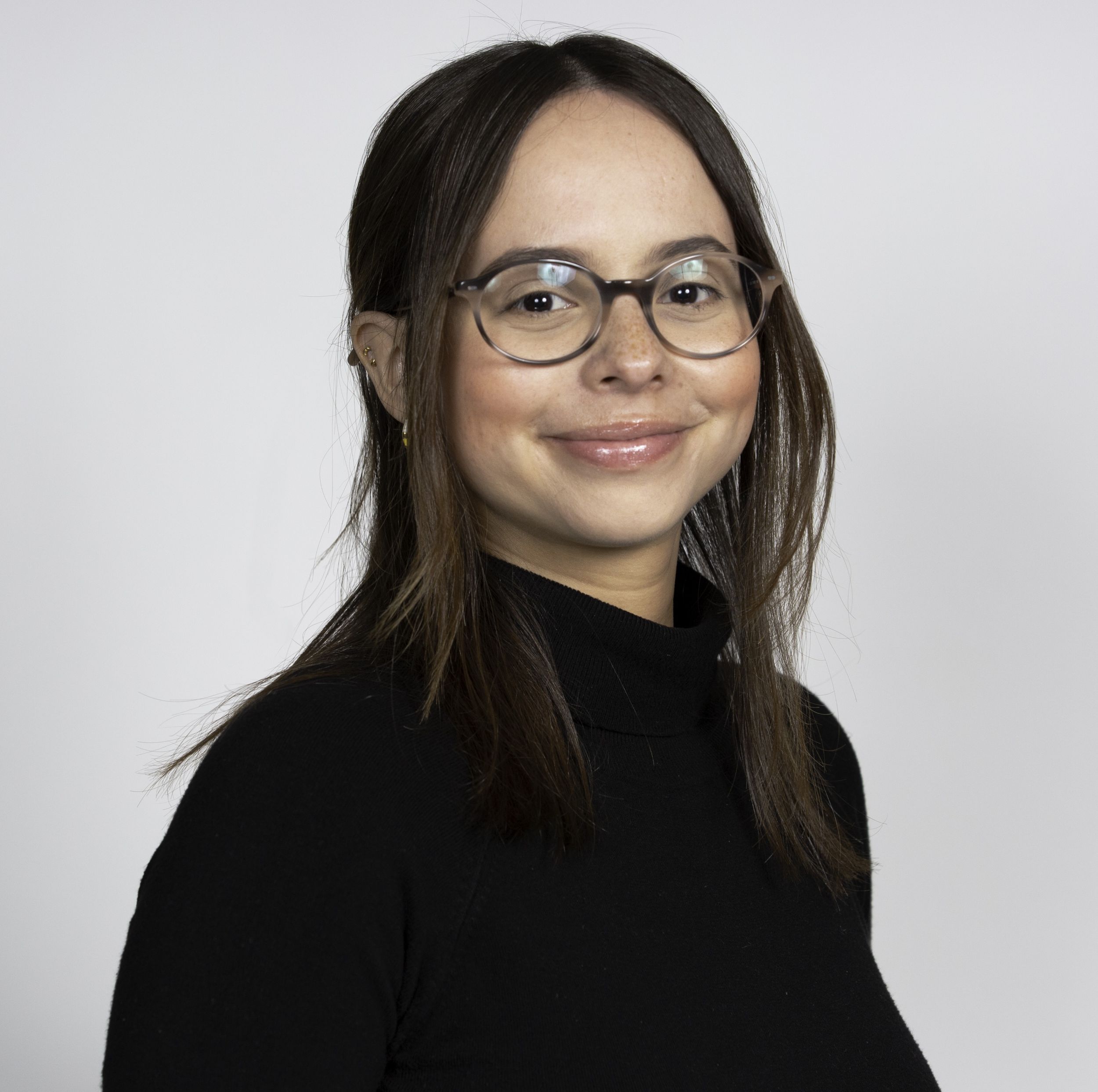
The science communication strategist answers five questions about finding her way into SciComm, communicating fundamental science, and staying curious.
How do people find their way to science communication (SciComm)? To find out, we ask a SciComm practitioner the same five questions in SciComm Voices every month. SciComm Voices is part of the Science Communication certificate program's monthly newsletter SciComm Spotlight (subscribe via our website).
This month’s SciComm Voices features Daniela Benites, MPS. Benites is a communications strategist who coordinates communications for the Chemical and Biomolecular Engineering, Fire Protection Engineering, and Materials Science and Engineering departments in the A. James Clark School of Engineering at the University of Maryland, College Park. Benites is an alumna of the University of Maryland School of Graduate Studies Science Communication certificate program (Class of 2025) and serves as the vice president of the D.C. Science Writers Association.
When did you first know that you wanted to be a science communicator?
Like many practitioners of Science Communication (SciComm), I didn’t learn about SciComm as a career path in my college days. I realized that I wanted to become a science communicator during my job search process in my last year of graduate school. I noticed a pattern in myself, about which jobs appealed to me, and after I landed my current role, the pattern became clear: I love writing about ideas that make the world a better place. Six months into the job, I started exploring new aspects about SciComm through professional development opportunities and learned about different options to pursue formal education in this field. The more that I learn, the happier I am I made this my career two years ago.
What do you consider your biggest success as a science communicator and why?
An ongoing accomplishment for me as a science communicator is being able to transform a fundamental science discovery into a digestible narrative. Thinking more like an editor, it’s easy to dismiss scientific breakthroughs that don’t clearly translate into a “product” of commercial or societal value. It’s even easier to deprioritize it when you’re presented with the option to produce storytelling coverage for inventions with tangible impact on people’s lives — and your readership would agree with that. So, producing a storytelling piece that persuades the reader to understand the value in answering fundamental questions will always be a major accomplishment for me.
Whose social media feed really speaks to you at the moment and why?
As a science communicator, it is really hard to get my eyes off a post by the Howard Hughes Medical Institute (HHMI). Their communications team has a keen eye to spot beautiful science, and so far, I have enjoyed reading short pieces about genes, cells, insects, and other subjects simply by being drawn in via captivating imagery. The HHMI feed also blends various aspects of their programming, accomplishments, research, and people into a cohesive structure that does not become monotonous. When I’m scrolling on LinkedIn, which is admittedly the only social media platform that I subscribe to, I always stop for a beautiful visual accompanied by engaging, bite-sized content.
What is your No. 1 advice to someone just starting in SciComm?
Stay curious and be patient with your goals. It may take some time to see the impact and value of your SciComm storytelling when you’re just learning the core practices. Demystifying or distilling a complex subject takes time, rounds of edits, and many stories before you become adept at translating science and capturing the attention of your readers. If you’re a SciComm practitioner who doesn’t have a formal background in science, like me, every interview is an opportunity to immerse yourself in a different subject. This makes it particularly harder if your role is to write about different disciplines, but practice allows for improvements, and the more you write about a detailed subject — such as energy storage, semiconductors, biomedical devices, among others — the easier it becomes.
What’s something you’re curious about right now that has nothing to do with your job?
Sourdough! I’ve been thinking of ways to make meal prepping more complicated for myself, and I found that to be the answer. Although not quite related to my job, the science behind baking the perfect loaf of sourdough is fascinating. I’ve been immersing myself in short video tutorials, and many of the commentators, and even experts on the matter, say that it takes multiple attempts before baking a decent loaf. Every measurement, temperature, and ingredient truly counts, and once you have a starter dough, you’ll find that it has a life of its own! It needs to be fed daily in order to rise, and neglecting it can slow down the process further or force you to start over. With six months of practice, I might be able to enjoy an avocado toast with freshly baked bread one day.