
Museums have been telling science stories for generations, and science communicators can learn a lot from them.
Read about current trends in science communication and science communication-related activities in the SciComm Close-Up, a monthly deep dive into science communication from the University of Maryland School of Graduate Studies’ Science Communication (SciComm) certificate program. The SciComm Close-up is part of the program’s monthly newsletter SciComm Spotlight. Sign up for monthly updates on SciComm.
Museums that focus on STEMM (science, technology, engineering, mathematics, and medicine) related topics share the same goal as science communicators (SciCommers): helping audiences connect with science in meaningful ways.
What makes museums distinctive is that they often begin with physical objects, using them as entry points into stories about discovery, people, and the evolution of scientific knowledge. They don’t simply preserve scientific history, they also preserve the human experience of scientific discoveries. And instead of just focusing on scientific discoveries, they communicate about what science feels like, what it changes, who carries it forward, and why people have cared enough to preserve it.
To do this job well, museums have grappled with one of the central questions that SciCommers ask themselves: How do you make science come alive for people?
Skilled museum curators know how to select the right objects and make them come alive: to tell engaging stories and to connect them to larger conversations about the role of science in our lives. Yet objects by themselves rarely communicate anything. An 18th-century botanical print, for example, is simply a colorful flower on a page until it becomes the story of the scientists, artists, explorers, and printers who worked together to document the natural world. A nursing uniform is simply fabric until it becomes connected to the person who wore it and their experiences. Museums therefore spend much of their work transforming artifacts into narratives, and in doing so have developed communications practices that science communicators can benefit from.
Living History Museum
At the Living History Museum of the University of Maryland School of Nursing (UMSON) in Baltimore, curator Kirsten Hammerstrom has recently grappled with representing the role that informatics has played in nursing to celebrate the 35th anniversary of the Summer Institute in Nursing Informatics (SINI) at UMSON. When I spoke with her at the beginning of July, she was preparing a display case and wondering if a computer would be an object to tell that story. One of her questions was: How do you make the importance of electronic health records for health care delivery and management — this “invisible idea” — visible?
Ultimately, the display dedicated to SINI’s anniversary wants to tell the story of the evolution of informatics and its role in nursing. To do so, Hammerstrom arranged programs from previous SINI conferences as well as some other books and objects related to informatics and health care in the display case. But the most interesting part of the story, namely that of the changes around patient records, came to life for me when she pointed out a patient chart from 1893, documenting a patient’s temperature over three weeks, right across from the display case. At first glance, this physical juxtaposition between the paper chart and the informatics books and pamphlets represents the evolution of electronic health records. On a more abstract level, the distance between the case and paper chart, only about five feet or so in length, represents something even more important: how science, in this case nursing, changes over time while underlying issues, here the importance of accurately documenting patient outcomes, remain the same.
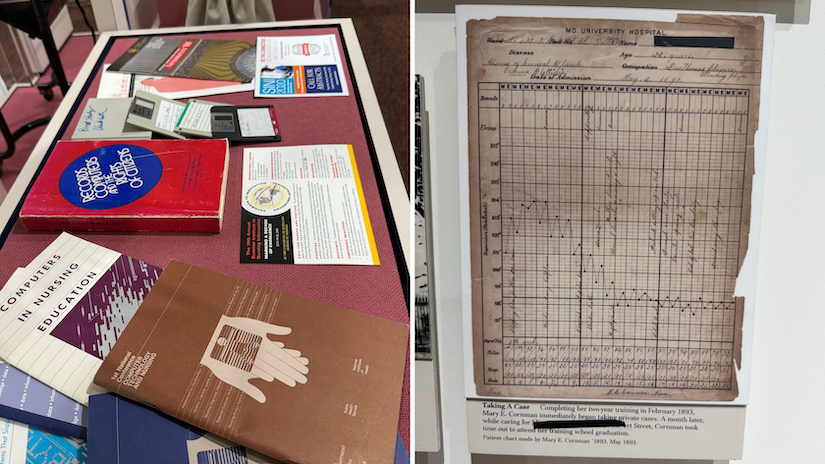
The display case on nursing informatics at the UMSON Living History Museum (left) sits across from an 1893 patient chart. (Photos by Isabell May)
The takeaway for us SciCommers is this: Including story elements that connect contemporary scientific data and information to the past allows audiences to connect with the stories we are telling from different perspectives.
Historical Collections
Tara Wink, Historical Collections librarian and archivist at the Health Sciences and Human Services Library (HSHSL) at the University of Maryland, Baltimore (UMB), says it best: “Historical objects can be moving — looking at something from 100 years ago, from 200 years ago, and recognizing they’re battling the same things we are battling today.” She talked to me about what motivates her to create displays of historical artifacts, larger exhibitions, blog posts, and other public-facing communications about the collections. This can range from celebrating national or global events or specific anniversaries, like the 2018 exhibit “Outbreak: Epidemics in a Connected World” commemorating the 100th anniversary of the devastating 1918 influenza pandemic, to current events to which artifacts in the library’s collections can connect.
One of the library’s many treasures is the extensive collection of botanical prints from the Historical Pharmacy Collection. In March 2024, the visually stunning exhibit “Groundbreaking: Spring Botanicals” opened in the HSHSL’s Frieda O. Weise Gallery. It featured enlarged and digitally enhanced botanical prints by 18th-century botanists William Woodville and William Curtis. Each wall cling of a flower was accompanied by the name of the flower on display and a short description of its medicinal use. The guidance to visitors about what was displayed was minimal, issuing an invitation to make our own connections between the flowers on display, their value to 18th-century medicine, and today’s research in pharmaceutical science on chemicals or plant-based compounds.
The illustrations on display, and many more in the library’s archives, are beautiful, but the exhibit invites us to see beauty not as their only purpose; they are also scientific documents. Each plant was carefully observed, illustrated, printed, and shared so physicians and pharmacists could identify them. While the first thing we may notice is the artistry of the illustrations, the exhibit helps us connect these illustrations to something more: centuries of collaboration among artists, botanists, physicians, printers, and pharmacists, all working to better understand the natural world.
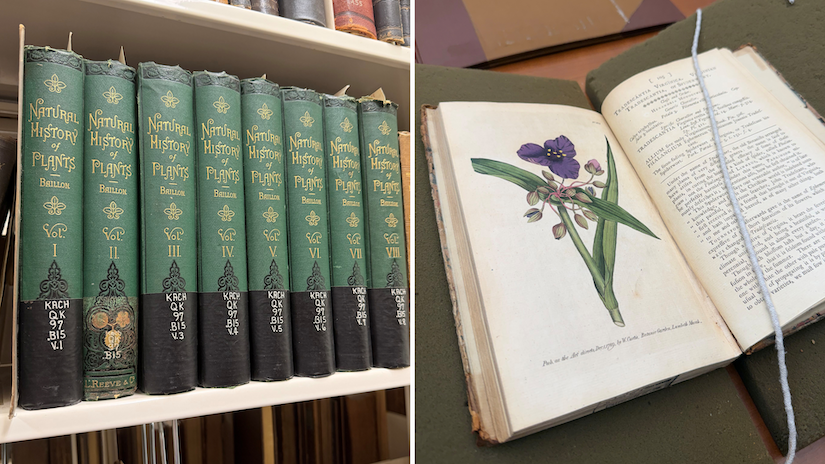
Spines of several books from Baillon’s “Natural History of Plants“ (left) and a page with an illustration of purple spiderwort by Curtis’ “The Botanical Magazine” (right) courtesy of the HSHSL Historical Collections. (Photos by Isabell May)
Museums as Science Communicators
I walked by these enlarged illustrations last spring (check out my YouTube short of that experience). As I observed how the afternoon light shining into the Weise Gallery caressed these lovely flowers, I was reminded of this insight into SciComm practice: powerful and appealing visual elements, like these enlarged prints, can draw audiences into complex stories about scientific discovery and the role of science in everyday life.
When I spent time in the Living History Museum and the Historical Collections, I expected to learn about the past. Instead, I kept being reminded of the challenges we face in the present as well as the many wonderful ways that science communication helps us make sense of the role of science in society. What if one of museums' greatest contributions to science communication is not simply that they help us understand the past, but that they help us recognize continuity and empower us to do our work? Telling stories of continuity in the way that scientists approach research questions and carry out their research demonstrates to public audiences how many of the fundamental questions that we are all asking ourselves have remained the same, and I think that presents an opportunity to forge connections and trust.
Here is my call to action to all you SciCommers out there: visit a local museum or collections to observe how museums communicate. For those of you in the Baltimore area: get in touch with either Hammerstrom or Wink — they would love visitors and are happy to connect with other passionate storytellers! Revel in the stories contained in historical objects that engage public audiences in sciences, create excitement about the many exciting things in STEMM, and build trust in the scientific enterprise with communities who are not exposed daily to the wondrous world of science. I am certain that you will find many answers to these questions. And we at the SciComm Spotlight would love to hear from you about it!
Isabell Cserno May, PhD, is an associate professor at the University of Maryland School of Graduate Studies, where she directs the Science Communication certificate program. She also leads the National Institutes of Health-funded ESCAAR program, which prepares early-career researchers in aging to integrate science communication, entrepreneurship, and age-inclusive framing into their work, and serves as director of the UMB Writing Center.