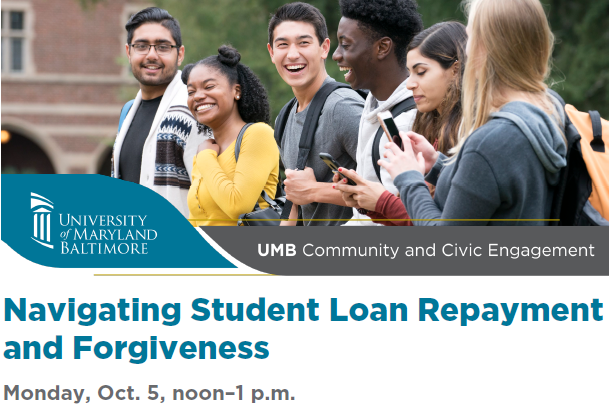
Maryland Higher Education Commission representatives will provide guidance Oct. 5 on available repayment assistance programs, eligibility requirements, and application processes at the CEC.
The University of Maryland, Baltimore's (UMB) Office of Community and Civic Engagement (OCCE) Workforce Initiatives team is partnering with the Maryland Higher Education Commission (MHEC) to provide a community information session on student loan repayment and forgiveness resources. "Navigating Student Loan Repayment and Forgiveness" is happening on Monday, Oct. 5, from noon-1 p.m. at the UMB Community Engagement Center. Virtual attendance is also available. Register for the event.
Many students, graduates, and working professionals continue to navigate changing student loan requirements and repayment options. To address these concerns, representatives from MHEC will provide guidance on available repayment assistance programs, eligibility requirements, and application processes. Participants will also learn about resources designed to support professionals in public service, health care, education, and other fields where loan assistance opportunities may be available.
The need for reliable student loan information remains significant. Maryland's Student Loan Ombudsman reported that most of the 654 borrower calls and emails its office handled in 2025 reflected confusion over the changing student loan landscape. Peer-reviewed research has also found that student loan debt can affect important financial and personal decisions long after graduation. Studies have linked higher levels of educational debt to delayed major life milestones, including homeownership, marriage, and family formation. Researchers have also found that student loan burdens can influence graduates' career choices, and higher debt has been linked to more symptoms of depression, making access to accurate repayment and forgiveness information especially important for borrowers.
By inviting MHEC and community members in an accessible setting, OCCE helps bridge information gaps that can affect educational attainment, career opportunities, and long-term financial well-being. Providing access to trusted information about repayment and forgiveness programs can help borrowers make informed decisions that support economic mobility and financial stability.
The session reflects UMB's commitment to supporting lifelong learning and economic opportunity for both University and community audiences. Through partnerships with organizations such as MHEC, Workforce Initiatives connects residents, students, faculty, and staff to resources that help them navigate financial challenges and plan for the future.
The event is open to students, faculty, staff, and community members, creating a space where participants can access reliable information and ask questions directly to subject-matter experts.
Why Student Loan Information Matters
Student debt can affect life beyond the classroom.
The stakes are high in Maryland, where about 847,400 borrowers owe a combined $37.1 billion, an average of roughly $43,781 each, according to the Maryland Student Loan Ombudsman's 2025 annual report. Nationally, about 10 percent of student loan balances were 90 or more days delinquent in early 2026, according to the Federal Reserve Bank of New York. New York Fed economists also found that borrowers who recently defaulted on their federal loans were often behind on other debts as well, including 56 percent of those with credit cards and nearly 40 percent of those with auto loans, a sign that their financial strain can extend beyond the student loan.
Peer-reviewed research shows the effects can reach well beyond the balance owed:
- Homeownership. Federal Reserve Board economists studying a national cohort found that each additional $1,000 in student debt lowered the homeownership rate by about 1.8 percentage points for public four-year college attendees in their mid-20s, roughly a four-month delay (Journal of Labor Economics, 2020).
- Marriage and family. A study of people who registered for the Graduate Management Admission Test linked each $10,000 in debt to a 3 to 4 percentage-point lower chance of first marriage over seven years for men at the median age of 24, with a slightly smaller effect for women (Economics of Education Review, 2016). A separate national study of 2007-08 bachelor's degree recipients found that four years after graduation, undergraduate debt was related to earnings, job choices, decisions to marry and have children, and net worth (Education Economics, 2019).
- Career choices. A study drawing on a natural experiment at a highly selective university, which replaced loans with grants in its financial aid packages, found that debt pushed graduates toward substantially higher-paying jobs and made them less likely to take low-paid public interest jobs (Journal of Public Economics, 2011).
- Well-being. A nationally representative study of young adults found that those with more student debt reported more depressive symptoms, even after accounting for parental wealth and childhood socioeconomic status (Social Science & Medicine, 2015). A 2024 systematic review of 46 scholarly papers found results consistent across countries and samples in showing that student loan burdens fall harder on certain vulnerable groups (Journal of Evidence-Based Social Work, 2024).
Understanding repayment and forgiveness options early can help borrowers stay ahead of these pressures. Through this partnership with MHEC, OCCE Workforce Initiatives is helping community members access trusted information and resources that support informed financial decisions and long-term economic opportunity.