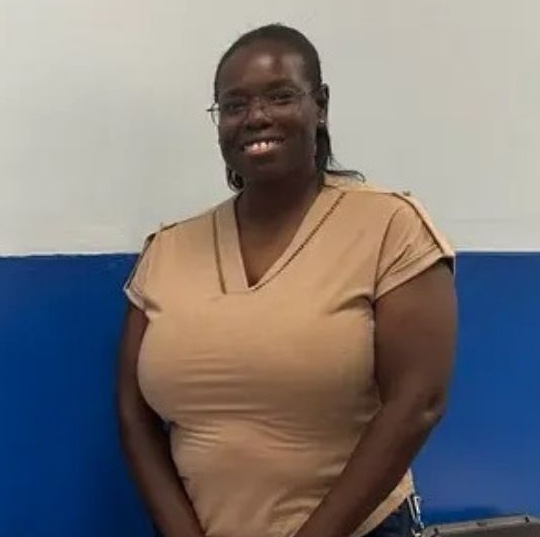
Collaboration among the School of Graduate Studies, Office of Community and Civic Engagement, and Central Maryland Area Health Education Center benefits participants and communities they serve.
Photo: Kenya Banks
When the University of Maryland, Baltimore's (UMB) Training West Baltimore in Community Health (TWICH) program was launched, its goal was to help West Baltimore residents access community health worker training and create pathways into a growing workforce. Today, graduates of the program are demonstrating how that investment continues to benefit both participants and the communities they serve.
One example is Kenya Banks, a West Baltimore resident and graduate of the TWICH Community Health Worker training program whose work is creating new connections among community organizations, schools, and food access initiatives in neighborhoods UMB seeks to serve.
Led by Iyabo Obasanjo, PhD, of the University of Maryland School of Graduate Studies in partnership with the UMB Office of Community and Civic Engagement (OCCE) and the Central Maryland Area Health Education Center (CMAHEC), TWICH provided community health worker training for residents of West Baltimore while exploring career pathways in the field through community-engaged research. Nearly 100 community members attended information sessions when the program was introduced, reflecting strong interest in careers that combine service, advocacy, and health equity.
For Banks, the opportunity arrived at just the right time.
"I was scrolling Facebook one day and an advertisement came up offering an information session on how to become a community health worker," Banks recalled. Already working for a nonprofit organization that coordinates food distribution in West Baltimore, she became interested in the role after working alongside a community health worker. Shortly after attending a TWICH information session and completing the training program, she was asked to assume additional responsibilities as her organization's community health worker.
While Banks credits her initiative and determination for helping position her for the opportunity, she says the training provided practical skills that she uses every day.
"The training helped with how to talk and manage people as far as their feelings, understanding boundaries, and learning how much support people need," Banks said. "Some people are more self-sufficient and just want information. Others need a little more hand-holding. The training helped me understand how to work with people in those different situations."
Those skills have quickly translated into tangible community impact.
Banks, who was already serving as the co-lead of the Parent Action Team, expanded her work at Morrell Park Elementary/Middle School, located in Baltimore's 21230 ZIP code, one of OCCE’s target communities. Banks has expanded outreach to school families while building new relationships with community partners and helping connect families with information, resources, and support services.
At the same time, Banks identified an opportunity to address food insecurity while reducing food waste through a new partnership she helped create between her organization's weekly food distribution program and Groundwork Kitchen, an existing UMB Workforce Initiatives partner.
After seeking ways to utilize surplus fresh produce from weekly distributions, Banks connected with the Paul's Place Culinary Training Program at Groundwork Kitchen's culinary training program. What began as a conversation about donating excess fruits and vegetables evolved into a broader collaboration designed to benefit local families.
For an upcoming Thanksgiving food distribution, Banks worked directly with Groundwork Kitchen staff to arrange for culinary students to prepare meals that will be distributed throughout the community.
"They said, 'Sure, we'll take the surplus food. We love fresh fruits and vegetables,'" Banks said. "Then when I wanted to offer hot meals for Thanksgiving, I reached out and asked whether their students would cook turkeys if we provided them. Not only did they agree, but they're also donating additional food for the event."
The collaboration will provide Thanksgiving meals, including turkey, stuffing, gravy, sweet potatoes, and vegetables, for families served through the distribution program. For Banks, successfully bringing organizations together to create new resources for the community was a defining moment.
"When I was able to take that back to my team, I was so excited," she said. "I had actually been able to pull that off."
Banks believes the training strengthened her confidence as an outreach professional and encouraged her to seek out new partnerships.
"This job has taught me to reach out more. I've put myself out there more as a community health worker. I've brought on more partners, and I'm surprised by how much has happened in such a short time after taking the program."
Her experience illustrates one of TWICH's most important outcomes: When community members gain new skills and credentials, the benefits ripple outward through neighborhoods, schools, and local organizations.
"It was a great steppingstone," Banks said. "It's amazing to see the different ways everybody took that class, internalized it, and then went and did their own thing with it."
While the community health worker training phase of TWICH has concluded, the program's impact continues through graduates like Banks who are applying their skills to strengthen their communities. The experience also highlights the value of connecting community residents with high-quality workforce training opportunities offered through the UMB Community Engagement Center.
TWICH demonstrates what is possible when faculty research, community engagement, workforce development, and community partnerships come together around a shared goal. Initiated by Obasanjo and supported by the OCCE, the project connected community-engaged research with workforce development and training. OCCE helped connect the research team with training partner CMAHEC, coordinated community recruitment efforts, and facilitated engagement of a graduate research assistant from the University of Maryland School of Social Work. Together, these partnerships transformed a faculty research project into a community-based initiative that has already produced meaningful outcomes for residents and neighborhoods across West Baltimore.
Building on the success of TWICH, OCCE is actively seeking additional collaborations, funding opportunities, and faculty partnerships that can bring workforce training, career pathways, and educational opportunities to residents through the UMB Community Engagement Center. By leveraging the center's trusted community relationships and convening power, OCCE hopes to expand access to programs that strengthen both economic mobility and community well-being for West Baltimore residents.
Contact Lisa Rawlings at workforce@umaryland.edu if you are interested in collaborating with OCCE.