Philip Mackowiak, then chief of medicine at the Baltimore VA Hospital and professor and vice chair of the Department of Medicine at UMSOM, recounts the trip in the latest issue of “CATALYST.”
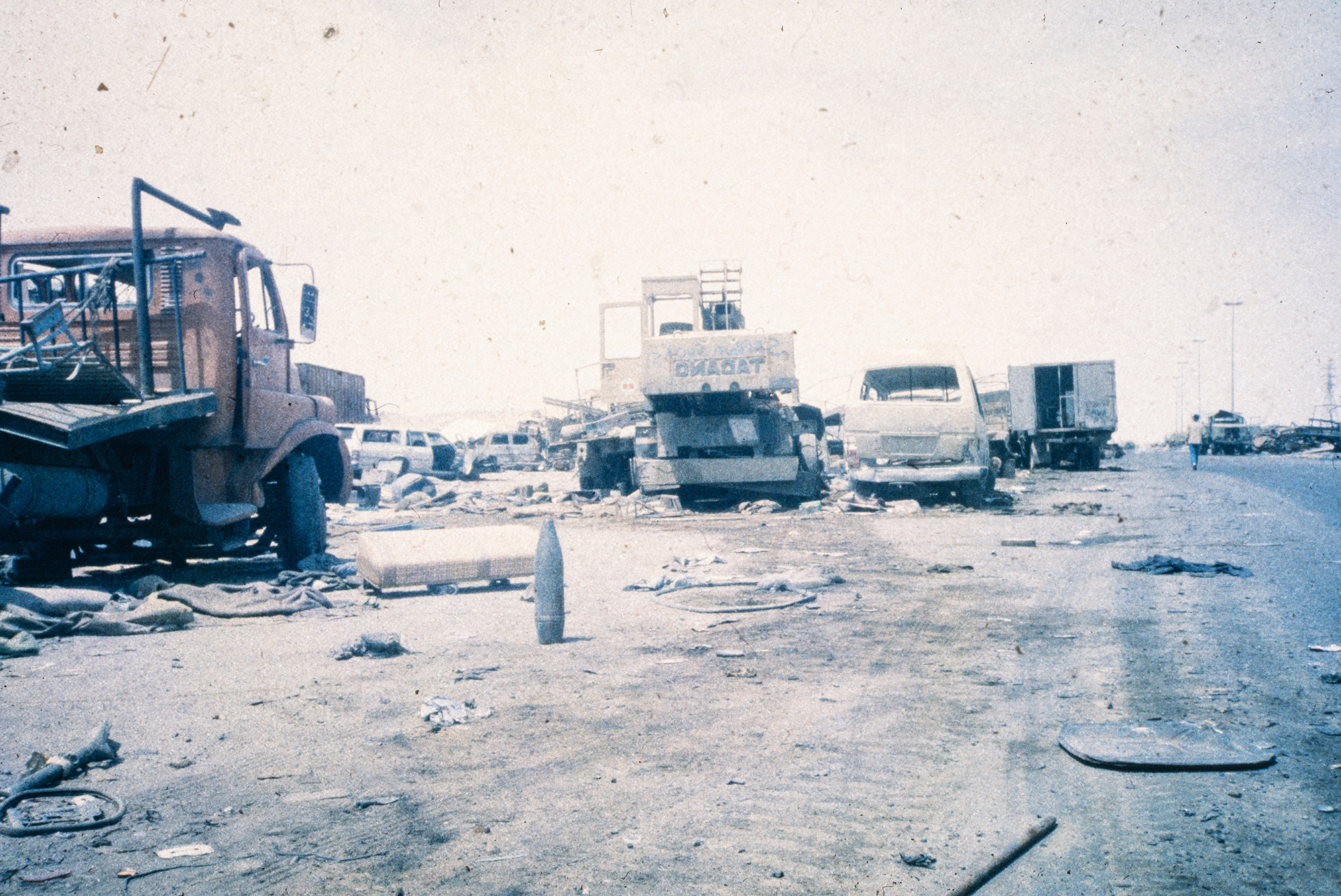
Photo: Smashed Iraqi vehicles litter the “Highway of Death” north of Kuwait City. Photo courtesy of Philip A. Mackowiak
Editor’s Note: In August 1990, Iraq invaded its small neighbor Kuwait. A coalition including the United States launched Desert Storm in January 1991, a military campaign that ended the war. Then-Maryland Gov. William Donald Schaefer visited Kuwait and signed a trade-and-aid agreement that allowed Maryland companies to compete for business in Kuwait and promised medical aid from Maryland to the war-torn country. In May 1991, a group of medical professionals — known as the Kuwait 38 — traveled to Kuwait to provide medical assistance.
Philip A. Mackowiak, MD, MBA, was the new chief of medicine at the Baltimore VA Hospital and professor and vice chair of the Department of Medicine at the University of Maryland School of Medicine (UMSOM) at the time of the trip. He is now Professor Emeritus at UMSOM.
Iraq invaded Kuwait on Aug. 2, 1990, to seize control of its vast oil reserves, stop alleged slant-drilling into its own oil fields, and abolish a $9 billion debt owed to Kuwait for financial assistance it provided during Iraq’s war with Iran. In just two days, Iraq overran Kuwait and fully occupied its tiny neighbor.
Given the importance of Kuwait’s oil to the global economy, a coalition of 42 nations headed by the United States responded immediately with a military buildup in Saudi Arabia known as “Desert Shield.” By Jan. 17, 1991, the coalition was ready to confront Iraq and launched “Desert Storm,” a campaign that, in little over a month, drove the Iraqis from Kuwait and effectively obliterated its military.
During the conflict, Maryland Gov. William Donald Schaefer was in constant contact with the emir of Kuwait trying to ensure a place for Maryland companies in the rebuilding of the country once the war was over. As part of the negotiations, a team of Maryland health care experts was formed to travel to Kuwait to attend to the medical needs of the war-ravaged country. A team of 38 Maryland physicians, nurses, social workers, and medical administrators, known as “the Kuwait 38,” of which I was a part, responded to Schaefer’s call for volunteers to go to Kuwait on a 1991 mission of mercy.
Although most of us were attracted to the mission by the prospect of using our expertise to tackle epidemic disease and care for trauma patients, only later did we learn that neither were being seen in Kuwait in the aftermath of the Iraqi occupation. The Iraqis had tortured some 1,000 Kuwaiti citizens, but because the torture mostly culminated in the death of the victim, there were few victims who required follow-up care. Moreover, the population of Kuwait had dipped well below half of its pre-invasion size, so what was left of the resident medical staff and the damaged municipal infrastructure was more than adequate to support the remaining citizens. As a result, our mission became one of fact-finding, rather than trauma care, and efforts to generate business for Maryland companies and medical schools.
Sunday, May 19
Our odyssey began in a three-minivan caravan transporting us to New York City, where we boarded a flight that took us to Frankfurt, Germany, and then on to Dhahran, Saudi Arabia.
Monday, May 20
We arrived in Dhahran at 11:15 a.m. (Saudi time) at a massive military base bristling with what seemed like an endless number of fighters, bombers, and transport planes. During the 7½-hour flight from Frankfurt, having heard nothing from our taciturn leader, the Maryland secretary of health, we spent our time speculating on what we might find when we arrived in Kuwait.
Tuesday, May 21
We spent the day shopping in Dhahran. That evening, we learned that we would be traveling to Kuwait City by bus.
Wednesday, May 22
After a slight delay, we were off to Kuwait City in two mini-buses and a Suburban loaded with our luggage. We passed through Khafji, the site of the first, and really only, standoff between the Iraqi and coalition forces. More U.S. soldiers were killed there (mostly by friendly fire) than in any other action during the war. The town was just as it had appeared on CNN, with bullet-riddled buildings and a partially destroyed tower. The Iraqis held the town only briefly before being overwhelmed by the vastly superior coalition forces.
From Khafji, we continued on to Kuwait City under the care of an Arab driver by the name of Mobarak Naser, who lived life according to the code of “inshallah” (“if Allah wills it”). He drove our bus with the accelerator pressed to the floor, no more than a few feet from the vehicle directly in front. When he passed another vehicle, white knuckles popped up throughout the bus. Because the highway between Dhahran and Kuwait City was two lanes, during the maneuver we could only hope that another car or truck was not approaching from the other direction. When this happened, which was all too frequent, the vehicle being passed had to pull over far enough onto the shoulder for the three vehicles to make the delicate maneuver. But this was not the only excitement Mobarak provided. He had a tendency to nod off while racing up the highway, so a frantic Dan Morhaim (chair of the Department of Emergency Medicine at Franklin Square Hospital), who sat immediately behind him, had to jolt him awake more than once during our trek to Kuwait City. Had it not been for Dan, our mission would surely have ended on the highway between Khafji and Kuwait City.
The sky was densely overcast that day, which we assumed was due to a rare sandstorm. However, the air tasted oily, and later we were told that the gray mist, which seemed to lighten and then intensify every few miles, was caused by raging oil fires in Kuwait that had been spewing noxious clouds of smoke over several hundred square miles for months.
As we motored on, we felt as if we were descending through Dante’s Inferno, from one circle of hell to another. Ironically, the major semicircular thoroughfare around Kuwait City was known as the 7 Ring Highways.
From the highway, we saw all the signs one would expect in the aftermath of a war of the size and ferocity of Desert Storm. There were mangled, burnt-out tanks, trucks, and other vehicles. Downed power lines, abandoned bunkers, vacant gun emplacements (mostly around highway overpasses), battered and charred buildings, and a torrent of other flotsam of war rushed by our windows as we drove on.
Kuwait City was at once both magnificent and unsettling. There was extensive damage to formerly majestic municipal structures everywhere. A playground on the waterfront, which had been senselessly and systematically vandalized, was especially moving. Only the macabre remnants of a clown’s face adorning what was left of the playground’s fence remained, a sight that echoed hauntingly in our memory when later we were shown an album containing photos of similarly battered faces of victims of Iraq’s reign of terror. Over 1,000 had died at the hands of their Muslim brothers. Thousands more had fled the country to escape the carnage, leaving the streets and shops vacant at the time of our arrival.
Eventually, we found our way to the Ibn Sina Orthopedic Hospital, which was to be our home during our brief stay in Kuwait. We were met there by our host, Dr. Mohamed al Hamadi, the hospital’s assistant medical director. A gentle, soft-spoken man, who had remained at the hospital throughout the occupation while thousands of others, including the emir, had fled, he added a personal touch to Iraq’s atrocities by recounting his own ordeal in general terms and sharing with us an album with photographs of tortured citizens and ruined buildings. He told us about the rape of Kuwaiti women and the systematic destruction of public utilities, libraries, private homes, state buildings, and the emir’s palaces. He described the devastation meted out on the telecommunication system, water purification system, and other infrastructure.
Read more about the Kuwait 38's mission in the spring issue of CATALYST.
The latest issue of "CATALYST" magazine celebrates the students and alumni who represent the future of Maryland’s health, law, and social work professions. Read about a School of Nursing alumna who turned her 2023 Grid Pitch idea into Ryan’s Place, a health care center in Gaithersburg, Md.; how Maryland Carey Law’s Law and Health Care Program prepares students to serve; a School of Dentistry graduate who studies gene therapies to prevent and treat cleft lip; a School of Social Work graduate who has been appointed to Maryland’s Commission on LGBTQIA+ Affairs; the School of Pharmacy’s newly launched, one-of-a-kind MS in Artificial Intelligence for Drug Development program; and what’s on the desk of Courtney Jones Carney, assistant vice president of student success, leadership, and engagement.