For 40 years, the University’s interdisciplinary collaboration and expansive research enterprise have sparked scientific breakthroughs, reduced stigma, and improved the lives of millions.
This story is one in a series about the University of Maryland, Baltimore’s (UMB) contributions to U.S. history as the nation celebrates its 250th birthday this year. The stories will be featured on The Elm website and in The Elm Weekly newsletter. The series also can be read at the UMB Celebrates America at 250 website.
America’s story is one of confronting challenges through innovation, collaboration, and service. Few public health challenges have tested those values more than HIV/AIDS. Over the past four decades, researchers, clinicians, educators, and community advocates at the University of Maryland, Baltimore (UMB) have helped transform the response to HIV — advancing scientific discovery, expanding access to care, reducing stigma, and improving the lives of millions of people in Maryland and around the world.
Today, UMB is home to one of the nation’s most comprehensive HIV research, treatment, education, and prevention enterprises. What makes UMB’s contribution unique is not a single laboratory or clinic, but the collective work of faculty, staff, students, and community partners across the University.
From the University of Maryland School of Medicine’s (UMSOM) Institute of Human Virology (IHV) and Institute for Genome Sciences (IGS) to the University of Maryland Schools of Nursing, Pharmacy, and Social Work and their clinical partners, UMB has built an interdisciplinary model that connects discovery directly to patient care and public health action.
The HIV epidemic emerged during a period of tremendous uncertainty. Scientists raced to understand a new virus, clinicians struggled to care for increasingly ill patients, and communities faced fear, stigma, and loss. UMB answered that challenge by investing in research, treatment, and community partnerships that continue to shape the field today.

From left, Institute of Human Virology founders Robert Redfield, Robert Gallo, and William Blattner.
At IHV, researchers have driven advances in HIV treatment, prevention, and vaccine development while leading international efforts to expand access to lifesaving care. Faculty continue to investigate some of the field’s most complex questions, including how HIV persists in the body despite effective treatment, how the immune system responds to infection, and what strategies ultimately might help achieve a cure.
Across UMSOM, investigators have contributed to landmark studies involving antiretroviral therapies, long-acting treatment options, HIV prevention strategies, and the management of co-occurring conditions that disproportionately affect people living with HIV. Their work has helped improve quality of life, extend life expectancy, and reduce transmission rates.
HIV Care in the 21st Century
UMB researchers also have led efforts to better understand the long-term effects of HIV as people live longer and healthier lives. Through studies examining aging, cognitive health, chronic disease, and quality of life, investigators have helped redefine what successful HIV care looks like in the 21st century.
The University’s impact extends beyond HIV alone. At IGS, researchers have used advanced genomic sequencing and computational biology to deepen understanding of infectious diseases and how they spread through populations. These tools have enhanced HIV research while also supporting efforts to combat tuberculosis, hepatitis, COVID-19, and other infectious diseases that often intersect with HIV in vulnerable communities.
One of UMB’s greatest contributions has been recognizing that defeating HIV requires more than scientific discovery. It also requires trust, access, education, and sustained community engagement.
That commitment is embodied by the JACQUES Initiative, which for more than two decades has provided comprehensive HIV services to Baltimore residents. Through HIV testing, prevention programs, treatment navigation, case management, behavioral health services, and support resources, the initiative has helped thousands of individuals access care and achieve better health outcomes. The program’s work reflects a simple but powerful principle: Scientific advances only matter when people can benefit from them.
Across the University, HIV care has become a truly interdisciplinary endeavor. Physicians diagnose and treat disease. Nurses support patients throughout their health journeys. Pharmacists help optimize complex medication regimens and improve adherence. Social workers address housing insecurity, transportation barriers, and other social determinants of health. Our public health professionals develop strategies to prevent transmission and improve population health outcomes. Together, these efforts create a model of care that addresses the whole person, not just the disease.
UMB’s leadership reaches far beyond Baltimore. Through partnerships led by IHV and UMSOM faculty, the University has helped strengthen health systems and expand HIV services in countries across Africa, Asia, Eastern Europe, and the Caribbean. These programs have trained health care workers, improved laboratory capacity, expanded treatment access, and helped millions of people receive lifesaving care.
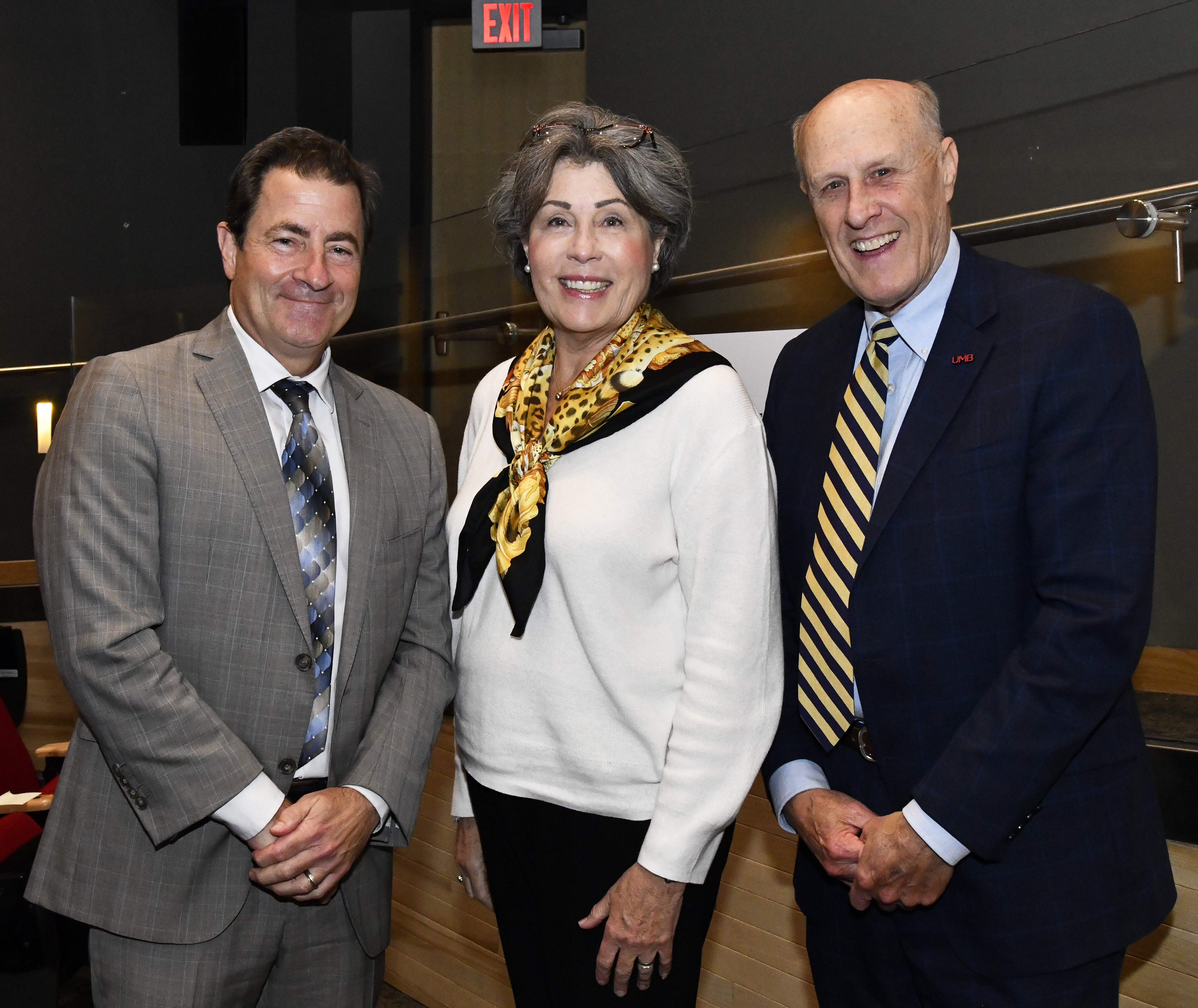
School of Medicine Dean Mark Gladwin, left, and UMB President Bruce Jarrell, right, pose with Institute for Genome Sciences founder Claire Fraser at a scientific symposium to commemorate Fraser's career in October 2024.
Next Generation Joins the Fight
Education has been another cornerstone of UMB’s HIV legacy. For decades, the University has trained physicians, nurses, pharmacists, social workers, scientists, and public health professionals who have gone on to lead HIV prevention, treatment, and research efforts throughout the United States and around the world. The impact of that workforce development can be seen in hospitals, clinics, laboratories, health departments, and community organizations across countless communities.
The results of these collective efforts have been profound. What was once considered a fatal diagnosis is now, for many people, a manageable chronic condition. Life expectancy has increased dramatically. New infections have declined. Access to treatment has expanded. And the possibility of ending the HIV epidemic is now discussed not as a distant aspiration, but as an achievable goal.
As America marks the 250th anniversary of its independence in 2026, UMB’s work in HIV reflects some of the nation’s highest ideals: the pursuit of knowledge, a commitment to public service, and the belief that complex challenges can be solved through collaboration and innovation.
The story of HIV at UMB is not the story of one discovery one individual. It is the story of an institution that brought together scientists, clinicians, educators, students, and community leaders to confront one of the defining public health challenges of modern history.
From laboratories and classrooms to clinics and neighborhoods, from Baltimore to communities around the globe, UMB continues to demonstrate how research, education, and compassionate care can improve lives and strengthen society. It is a legacy of impact that reflects the very best of America’s past 250 years and a commitment that will help shape the 250 to come.