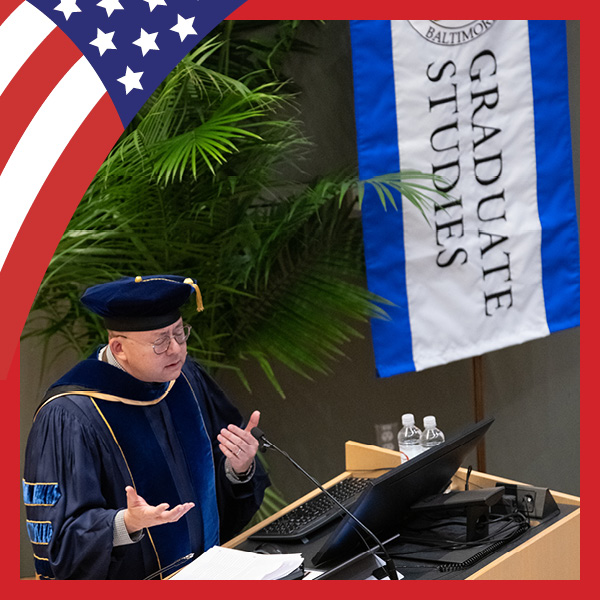
The School of Graduate Studies’ commitment to collaboration has guided it for over a century, driving innovation and discovery among interdisciplinary teams from five of UMB’s professional schools.
This story is one in a series about the University of Maryland, Baltimore’s (UMB) contributions to U.S. history as the nation celebrates its 250th birthday this year. The stories will be featured on The Elm website/Elm Weekly newsletter in the coming months. The series can be read at the UMB Celebrates America at 250 website. The July episode of “The UMB Pulse” podcast features a discussion about UMB history with Tara Wink of the Health Sciences and Human Services Library.
Innovation rarely happens in isolation.
The challenges that have shaped America for 250 years — from infectious disease outbreaks and public health crises to social inequities and emerging technologies — have never fit neatly within a single profession or discipline. Solving them requires scientists, clinicians, policymakers, educators, and community leaders working together.
Long before “interdisciplinary research” became a national buzzword, the University of Maryland School of Graduate Studies (UMSGS) was built on that very principle.
Established in 1919, just as the nation was emerging from World War I and the devastating influenza pandemic, UMSGS recognized that advancing knowledge would require more than expertise in a single field. It would require bringing together diverse perspectives, experiences, and disciplines to tackle society’s most pressing challenges.
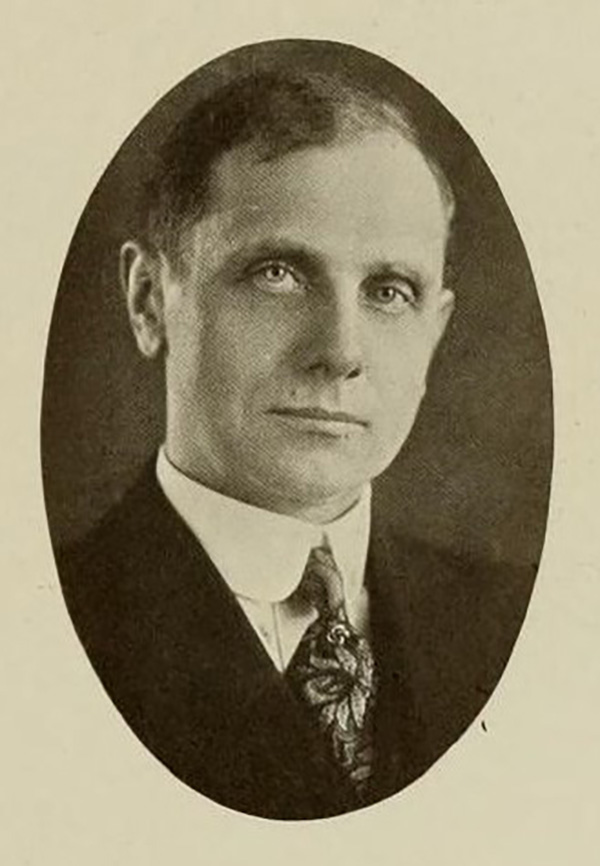
The School of Graduate Studies’ first dean, Charles O. Appleman, PhD, is shown in a photo from the 1921 “Terra Mariae” yearbook. A distinguished teacher, professor of plant physiology, and researcher, Appleman led the school until 1949.
For more than a century, UMSGS has served as the connective tissue across five of the University of Maryland, Baltimore’s (UMB) professional schools, fostering collaboration among researchers, clinicians, educators, and practitioners whose work has improved lives in Maryland, across the nation, and around the world.
At a time when most universities organized scholarship into distinct academic silos, UMB’s graduate programs encouraged students and faculty to work across traditional boundaries. Researchers in medicine collaborated with scientists in pharmacy. Dentists partnered with public health experts. Nurses worked alongside social workers. Legal scholars contributed insights to health care policy and ethics.
This model proved remarkably forward-thinking.
Teaming Up
Today’s most significant challenges rarely belong to a single profession. Developing a vaccine requires expertise in microbiology, pharmacology, clinical trials, public health, and community engagement. Addressing addiction demands collaboration among health care providers, behavioral health specialists, social workers, and policymakers. Improving health outcomes in vulnerable communities often requires coordinated efforts spanning medicine, nursing, law, public health, and social services.
The collaborative approach that has become a hallmark of modern research mirrors the philosophy that has guided UMSGS for generations.
Throughout its history, the school has helped prepare researchers whose discoveries have expanded scientific understanding, improved patient care, influenced public policy, and strengthened communities. Graduate students have contributed to breakthroughs in infectious disease research, neuroscience, cancer biology, genomics, drug development, health services research, and countless other fields that continue to shape American health care and society.
The school’s impact extends far beyond laboratories and classrooms.
Graduate education at UMB has helped cultivate leaders who serve in universities, health care systems, government agencies, nonprofit organizations, and private industry. Their work influences how diseases are treated, how health care is delivered, how communities are supported, and how future generations are educated.
Crossing Boundaries
Today, that legacy continues through innovative dual-degree programs, cross-disciplinary research initiatives, and collaborative partnerships that connect expertise from across UMB’s seven schools. Students and faculty regularly work together on projects that draw from multiple disciplines, reflecting the increasingly interconnected nature of today’s challenges.
This spirit of collaboration has become one of UMB’s defining strengths.
As the United States celebrates the 250th anniversary of its independence, the story of UMSGS offers an important reminder that progress often depends on bringing people together across boundaries. Whether those boundaries are academic disciplines, professions, institutions, or communities, meaningful innovation emerges when diverse perspectives unite around a common purpose.
For more than a century, the School of Graduate Studies has helped make those connections possible.
In doing so, it has not only advanced knowledge but also strengthened the collaborative spirit that drives discovery, fuels innovation, and helps the United States meet the challenges of each new generation.
Because some of the most important breakthroughs are not the result of a single field working alone. They are the result of people coming together to solve problems that no one discipline can solve by itself.
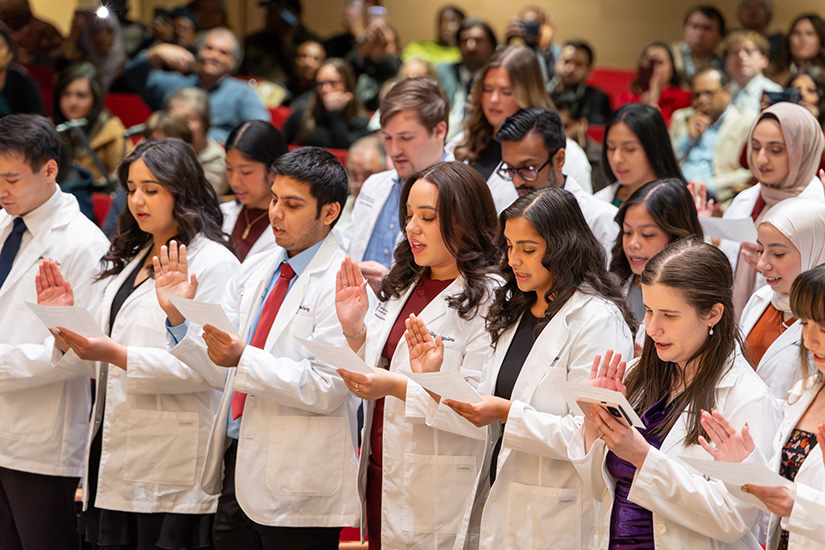
Physician assistant (PA) students recite an oath pledging to provide compassionate care after receiving their short white coats in a January 2026 ceremony that signifies their passage into the clinical phase of their postgraduate education. The PA program is housed within the School of Graduate Studies. (Photo by Angela Jackson)