
Founded in the wake of 9/11, the Center for Cyber, Health, and Hazard Strategies leverages UMB’s expertise to help governments, health systems, and communities address emerging threats and crises.
This story is one in a series about the University of Maryland, Baltimore’s (UMB) contributions to U.S. history as the nation celebrates its 250th birthday this year. The stories will be featured on The Elm website and The Elm Weekly newsletter in the coming months. The series can be read at the UMB Celebrates America at 250 website. Read more about Michael Greenberger and CHHS from the fall 2024 edition of CATALYST magazine.
As the United States celebrates the 250th anniversary of the Declaration of Independence in 2026, the University of Maryland, Baltimore (UMB) is reflecting on the people, programs, and innovations that have strengthened communities and advanced the public good throughout the nation’s history. Among those contributions is the creation of the Center for Cyber, Health, and Hazard Strategies (CHHS), a nationally recognized leader in preparedness, resilience, cybersecurity, and emergency management.
Founded in 2002 in the aftermath of the Sept. 11 terrorist attacks, CHHS was established to help governments, health systems, and communities prepare for an increasingly complex range of threats. Then known as the Center for Health and Homeland Security, the organization was the vision of the late Michael Greenberger, JD, a professor at the University of Maryland Francis King Carey School of Law whose distinguished career spanned academia, government, and private practice.
The breadth of his experiences gave Greenberger a unique perspective on risk, crisis management, and the need for organizations to prepare for emerging threats.

In the wake of one of the most consequential events in U.S. history, then-UMB President David J. Ramsay, DM, DPhil, and Greenberger (in photo, right) recognized that the challenges facing the nation demanded a new approach. Emergencies were no longer solely matters of law enforcement or public safety. They required collaboration among experts in law, public health, medicine, emergency management, cybersecurity, government, and community resilience.
At UMB, Greenberger found the ideal environment to bring that vision to life.
Facing Threats, Finding Solutions
From the beginning, CHHS was designed not only to serve communities and organizations but also to serve as an academic hub where scholarship, education, and real-world practice intersect. The center leveraged UMB’s unique strengths as Maryland’s only health, law, and human services university to create solutions grounded in research and informed by experience.
That vision proved remarkably prescient.
Over the past two decades, the threats facing communities have evolved dramatically. Natural disasters have become more frequent and severe. Cyberattacks have emerged as a major national security concern. Public health emergencies, including the COVID-19 pandemic, have tested the resilience of health systems around the world. Throughout these challenges, CHHS has helped communities prepare for, respond to, and recover from crises.
From its home at UMB, the center has advised federal agencies, state and local governments, health care organizations, educational institutions, and critical infrastructure organizations. Its experts have developed emergency response plans, conducted exercises and simulations, strengthened cybersecurity programs, assessed risks, and trained thousands of professionals responsible for protecting the public.
Interested in supporting CHHS’ efforts? Make a donation on the center’s giving page.
Equally important, CHHS has fulfilled an educational mission that reflects UMB’s commitment to public service. Faculty and staff have taught courses, mentored students, created experiential learning opportunities, and helped prepare future leaders in law, emergency management, cybersecurity, public health, and public policy. By connecting classroom learning with practical application, the center demonstrates how universities can play a direct role in strengthening the nation’s preparedness and resilience.
In 2025, the center was renamed the Center for Cyber, Health, and Hazard Strategies, reflecting its expanded mission and growing impact. The new name acknowledged the increasingly interconnected nature of modern threats and the center’s broad expertise in addressing them.
Today, CHHS stands as one of the nation’s leading preparedness and resilience organizations. Under the leadership of executive director Markus Rauschecker, JD, the center is building upon Greenberger’s foundation while charting a course for the future. A nationally recognized expert in cybersecurity law and policy, Rauschecker has been part of CHHS since 2008 and represents a new generation of leadership guiding the organization into an era in which cybersecurity, public health, emergency preparedness, and community resilience are more interconnected than ever before.
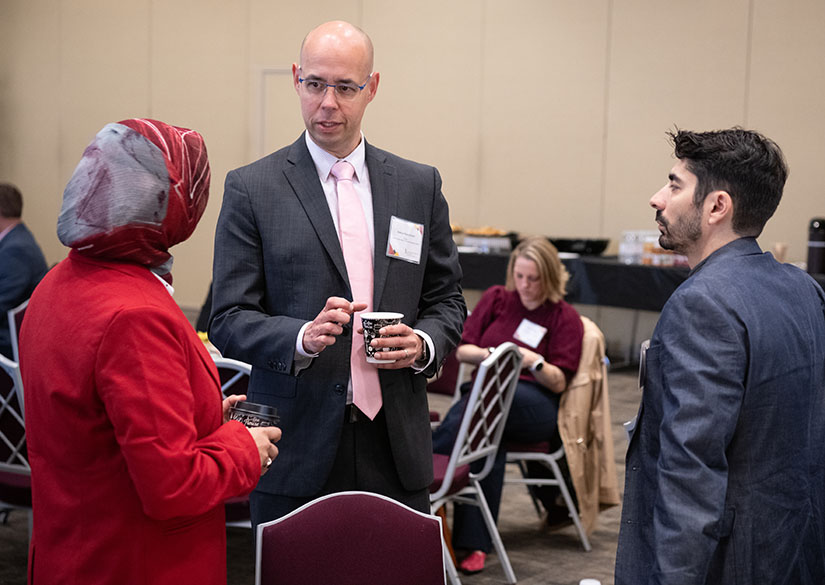
Markus Rauschecker, center, is the executive director of the Center for Cyber, Health, and Hazard Strategies. (Photo by Matthew D’Agostino)
Are We Ready?
The center’s impact can be measured in both scale and outcomes. CHHS experts support partners across the United States and around the world, helping organizations anticipate risks, strengthen capabilities, and improve their ability to respond when emergencies occur. Through planning, training, exercises, research, and thought leadership, the center continues to advance the field of preparedness while helping communities become safer and more resilient.
Yet CHHS’ most enduring contribution might be less tangible. For more than two decades, the center has helped communities ask a critical question before disaster strikes: Are we ready?
By helping organizations identify vulnerabilities, build partnerships, and prepare for the unexpected, CHHS has strengthened public health systems, protected critical infrastructure, and improved the resilience of countless communities. Its work exemplifies UMB’s broader mission to apply knowledge in service to society.
As America celebrates 250 years of innovation, progress, and civic leadership, the story of CHHS reflects the vital role universities play in helping the nation meet its greatest challenges. What began as Greenberger and UMB’s response to a changing world has evolved into a nationally respected academic center that educates future leaders, advances knowledge, and helps communities navigate an increasingly complex future.
More than two decades after its founding, CHHS continues to embody the spirit of innovation, collaboration, and public service that defines UMB’s contribution to America — ensuring that when challenges emerge, communities are better prepared to meet them.