From research to regulation, UMSOP works to influence national drug policy, improve public health, and support the Food and Drug Administration, one of the USA’s most critical scientific institutions.
This story is one in a series about the University of Maryland, Baltimore’s (UMB) contributions to U.S. history as the nation celebrates its 250th birthday in 2026. The stories will be featured on The Elm website/Elm Weekly newsletter in the coming months. The series can be read at the UMB Celebrates America at 250 website. The July episode of “The UMB Pulse” podcast features a discussion about UMB history with Tara Wink of the Health Sciences and Human Services Library.
For 250 years, the United States has relied on scientific innovation to discover new medicines and ensure that they are safe, effective, and accessible to the public. Behind every prescription is a regulatory system designed to protect patients while allowing medical advances to reach those who need them.
The University of Maryland School of Pharmacy (UMSOP) has played an important role in shaping that system.
UMSOP’s decades of research demonstrate how academic discovery can influence national policy, improve public health, and strengthen one of the country's most important scientific institutions: the U.S. Food and Drug Administration (FDA).
Developing a new medication is only part of the journey. Pharmaceutical companies also continually refine manufacturing processes, update production equipment, expand facilities, and improve formulations. For years, even relatively minor changes often required extensive regulatory review, creating significant costs and delays before medicines could reach patients.
Researchers at UMSOP helped change that.
Revamping the Review Process
In the 1990s, the school began conducting groundbreaking research examining how changes in pharmaceutical formulation and manufacturing affect the performance of drug products. This research was led by Professor Emeritus Larry Augsburger, PhD, MS, and a UMB team that included James Polli, PhD; David Young, PhD; Stephen Hoag, PhD; and Natalie Eddington, PhD, FAAPS, FCP, who went on to serve as UMSOP dean from 2007 to 2023.

Clockwise from top left: Larry Augsburger, Natalie Eddington, Stephen Hoag, and James Polli helped form the School of Pharmacy-led team that studied the way pharmaceutical formulation and manufacturing affect the performance of drug products.
Their work demonstrated that many manufacturing and formulation modifications could be made without altering the way a medication is absorbed by the body or how effectively it delivers its therapeutic benefits. This led to two sequential University of Maryland (UM)/FDA Collaborative Agreements that combined education, research, and data analysis to strengthen the scientific basis for evaluating new and amended drug applications.
Those scientific findings provided critical evidence that allowed regulators to distinguish between changes that did or did not require extensive review. The research became a cornerstone of the FDA’s Scale-Up and Post-Approval Changes (SUPAC) guidance, which established science-based standards for evaluating manufacturing changes made after a drug has been approved.
The impact extended across multiple types of medications, including immediate-release and modified-release products, and influenced guidance for manufacturing equipment and pharmaceutical processing. The SUPAC framework helped modernize the FDA’s review process while maintaining rigorous standards for drug quality and patient safety.
The benefits reached far beyond government agencies.
By creating a scientific foundation for more efficient regulatory decision-making, the school’s research helped pharmaceutical manufacturers reduce unnecessary testing, shorten review timelines, and lower the costs associated with post-approval manufacturing changes. Industry experts have credited SUPAC guidance with saving hundreds of thousands of dollars for individual post-approval submissions while preserving the FDA’s commitment to safety and effectiveness.
Hoag also did groundbreaking research on prenatal vitamins with the late Ralph F. Shangraw, PhD, MS, a former UMSOP department chair and professor emeritus. A 1997 study by Hoag and Shangraw found that many prenatal vitamin products failed to meet folic acid dissolution specifications, which raised concerns about the amount of the substance that was successfully reaching a person’s systemic circulation. The problem was made worse by testing standards of the time, Hoag said, and the study helped lead to changes in the way prenatal vitamins are tested, better ensuring their ability to meet dissolution standards.
Protecting Public Health
UMSOP’s influence continued in the 1990s and beyond through close collaboration with the FDA.
Gary Hollenbeck, PhD, then a professor of pharmaceutical sciences and associate dean for academic programs at UMSOP, served as co-principal investigator on one of two sequential UM/FDA agreements, with his role focused on coordinating education and training. The collaboration led to an award from the FDA’s Center for Drug Evaluation and Research that recognized the SUPAC Immediate Release Training Program.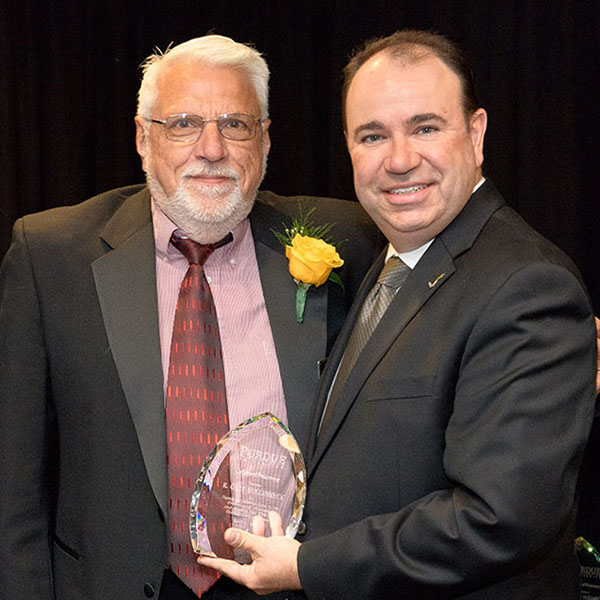
Gary Hollenbeck, at left in photo, shown receiving a Distinguished Alumni Award from Purdue University in 2018, helped expand the School of Pharmacy’s collaborations with the FDA in the 1990s.
These contributions reflect a broader tradition that has defined UMB throughout its history: translating research into real-world solutions that improve lives.
Just as UMB researchers have advanced medicine, public health, nursing, dentistry, law, and social work, faculty at UMSOP have helped shape the policies that govern how life-sustaining and lifesaving medications are developed, manufactured, and delivered across the nation.
Their work illustrates an important truth about American innovation: Scientific breakthroughs do not end in the laboratory. They achieve their greatest impact when they inform public policy, strengthen institutions, and improve the lives of millions of people.
UMSOP’s contributions to modern drug regulation stand as one of UMB’s most enduring examples of how rigorous science can shape national policy, accelerate innovation, and ensure that Americans benefit from a safer, more efficient, and more effective health care system.
From research to regulation, UMSOP and all of the UMB schools continue to demonstrate that knowledge has the power not only to advance science, but also to strengthen the institutions that protect public health.