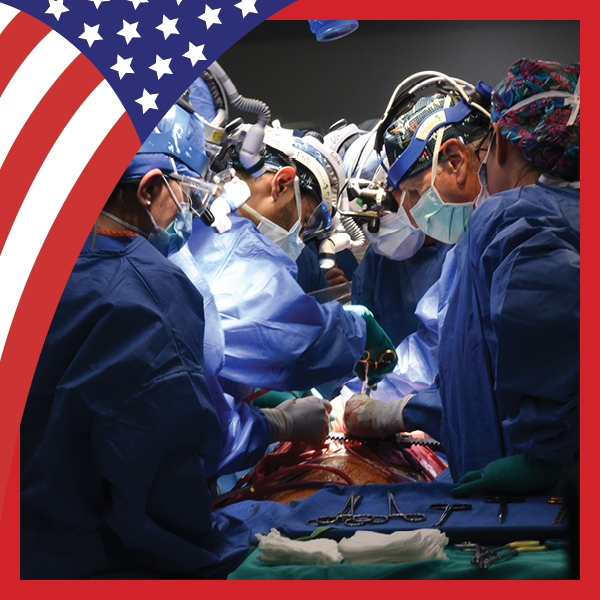
The University of Maryland School of Medicine/Medical Center partnership combines innovation, discovery, and clinical excellence to stand as a national leader in multi-organ transplantation.
This story is one in a series about the University of Maryland, Baltimore’s (UMB) contributions to U.S. history as the nation celebrates its 250th birthday this year. The stories will be featured on The Elm website and in The Elm Weekly newsletter. The series also can be read at the UMB Celebrates America at 250 website.
For more than half a century, transplantation has transformed what is possible in medicine — turning once-fatal organ failure into a new chance at life. At the University of Maryland, Baltimore (UMB), that progress is more than history. It also is a living legacy of discovery, clinical excellence, and bold innovation.
Today, the University of Maryland Medical Center (UMMC), in partnership with the University of Maryland School of Medicine, is home to one of the nation’s largest and most accomplished multi-organ transplant programs. Its teams perform hundreds of transplant procedures each year, including kidney, liver, heart, lung, pancreas, and living donor transplants. The program is especially known for kidney transplantation, with thousands of kidney transplants performed since the late 1980s and a reputation as one of the region’s leading centers for patients with kidney failure.
That work matters because the need remains urgent. Across the United States, more than 100,000 people are waiting for lifesaving organ transplants, and the majority are waiting for kidneys. For many patients, transplantation is not simply a procedure, it also is the difference between a life defined by illness and a future restored.
UMB’s role in advancing that future has included moments that captured international attention.
In 2019, University of Maryland physicians, researchers, and engineers made history when an unmanned aircraft delivered a donor kidney to UMMC for successful transplantation. The first-of-its-kind flight demonstrated how technology could help reimagine one of transplantation’s most time-sensitive challenges: moving organs safely and quickly from donor to recipient. The kidney arrived viable, the transplant was successful, and the moment signaled a new frontier in organ transport.
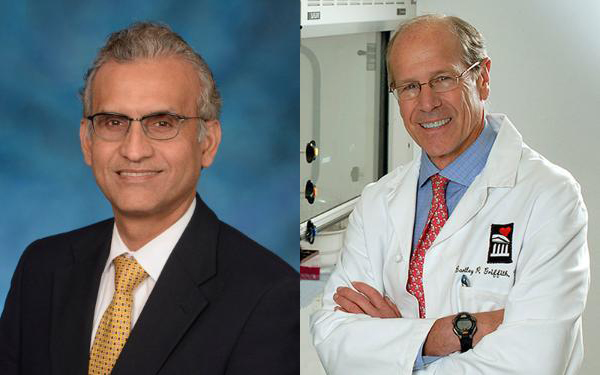
The University of Maryland School of Medicine’s Muhammad Mohiuddin, MD (left), is director of the school’s Cardiac Xenotransplantation Program, and Bartley Griffith, MD, is director of the Cardiac and Lung Transplant Program.
Xenotransplantation Breakthroughs
UMB also has helped lead the world into one of the most closely watched areas of modern medicine: xenotransplantation, the transplantation of organs or tissues from one species to another. In 2022, surgeons at UMMC performed the world’s first transplant of a genetically modified pig heart into a living human patient.
The patient, who had terminal heart disease and was not eligible for a traditional human heart transplant, lived for two months after the groundbreaking procedure. In 2023, the team performed a second genetically modified pig heart transplant in another patient with end-stage heart disease. He initially showed signs of recovery and lived for nearly six weeks before the heart failed due to immune rejection.
These cases were not cures, and they were never presented as such. They were compassionate-use procedures for critically ill patients who had no other available treatment options. But they were also scientific milestones. Each case provided invaluable knowledge about immune response, genetic modification, infection risk, organ function, and the ethical and clinical questions that must guide the future of transplantation.
That is the nature of medical progress. It is rarely simple, and it is never instant. Advances come through decades of research, clinical courage, patient participation, and the willingness to confront the hardest problems in medicine.
As the United States marks its first 250 years, UMB’s transplantation story reflects the best of America’s scientific promise: a public mission, a commitment to patients, and a belief that discovery should be used to expand what is possible for people and families. From high-volume kidney transplantation to drone-enabled organ delivery to the frontier of xenotransplantation, UMB continues to help shape the future of lifesaving care.
The work is not finished. But at UMB, the next chapter of transplantation is already being written.