
Dr. Angela Brodie’s pioneering development of aromatase inhibitors transformed the treatment of hormone-sensitive breast cancer and has helped millions of women around the world survive the disease.
This story is one in a series about the University of Maryland, Baltimore’s (UMB) contributions to U.S. history as the nation celebrates its 250th birthday this year. The stories will be featured on The Elm website and in The Elm Weekly newsletter. The series also can be read at the UMB Celebrates America at 250 website.
Some scientific breakthroughs save lives one patient at a time. Others change the course of medicine itself.
At the University of Maryland, Baltimore (UMB), few discoveries have had a greater impact on human health than the work of breast cancer researcher Angela H. Brodie, PhD. Her pioneering development of aromatase inhibitors transformed the treatment of hormone-sensitive breast cancer and helped turn what was once a frequently fatal diagnosis into a disease that millions of women can successfully treat and survive.
Brodie’s work stands as a powerful example of how university research can improve lives far beyond campus walls. Her discoveries continue to benefit women in every state and around the world decades after they first emerged from the laboratory.
When Brodie began her research in the 1970s, treatment options for postmenopausal women with estrogen-driven breast cancer were limited. Scientists knew that estrogen fueled the growth of many breast cancers, but they lacked effective ways to stop the body from producing the hormone. Patients often faced recurrence, progression of disease, and fewer options once existing therapies failed.
Brodie saw an opportunity to attack the disease at its source.
Working first with her husband and scientific collaborator, Harry Brodie, PhD, she focused on aromatase, an enzyme responsible for producing estrogen in postmenopausal women. If that enzyme could be blocked, she reasoned, the cancer’s fuel supply could be significantly reduced. It was a bold idea at the time, and one that many initially doubted.
The research eventually led to the development of aromatase inhibitors, a class of drugs that suppress estrogen production and slow or stop the growth of hormone receptor-positive breast cancers. The first generation of these therapies emerged from Brodie’s work, laying the scientific foundation for medications that are now standard treatments throughout the world.
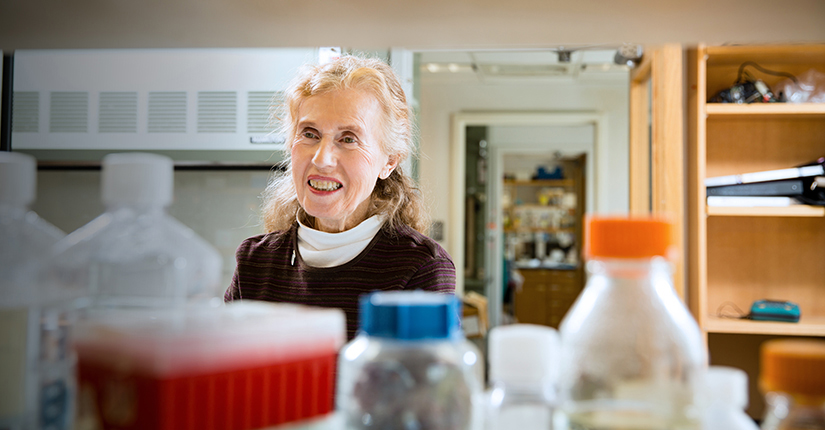
Angela Brodie joined the University of Maryland School of Medicine in 1979 and retired in 2016. A year earlier, she was featured in UMB’s Champions of Excellence campaign. Brodie died in 2017 of complications from Parkinson’s disease at age 82.
Changing Cancer Care
In 1979, Brodie joined the University of Maryland School of Medicine (UMSOM), where she continued to refine and advance the research that ultimately would change cancer care. Clinical trials demonstrated remarkable results, leading to the development and approval of aromatase inhibitor therapies that became a new standard of care for postmenopausal women with breast cancer.
Today, drugs such as anastrozole, letrozole, and exemestane are among the most widely prescribed breast cancer therapies in the world. They are used to treat active disease and reduce the risk of recurrence after surgery and other treatments. For countless patients, these medications have added years — and often decades — to their lives.
The significance of Brodie’s achievement is difficult to overstate.
UMB leaders have described aromatase inhibitors as one of the most important advances in modern breast cancer treatment. Cancer experts around the globe credit the drugs with saving countless lives worldwide and dramatically improving outcomes for women with estrogen receptor-positive breast cancer, the most common form of the disease among postmenopausal women.
What makes Brodie’s story especially fitting for UMB’s America at 250 celebration is that it embodies the University’s enduring mission: to translate discovery into public good.
Her work began as a scientific question in a laboratory. It evolved through decades of experimentation, collaboration, and clinical research. Ultimately, it became a therapy used by physicians across the globe. The journey from hypothesis to lifesaving treatment reflects the very best of American biomedical innovation — and the essential role that research universities play in advancing it.
Brodie received numerous honors throughout her career, including election as a fellow of the American Association for Cancer Research Academy and induction into the National Inventors Hall of Fame. Yet perhaps her greatest legacy cannot be measured in awards. It is found in the millions of women who have had more time with their families, more birthdays to celebrate, and more opportunities to watch their children and grandchildren grow because of therapies that trace their origins back to her work.
For 250 years, American progress has been driven by innovators willing to challenge accepted thinking and pursue solutions to society’s greatest challenges. At UMB, Angela Brodie exemplified that tradition.
Her discovery changed the landscape of breast cancer treatment. Her legacy continues to save lives every day.