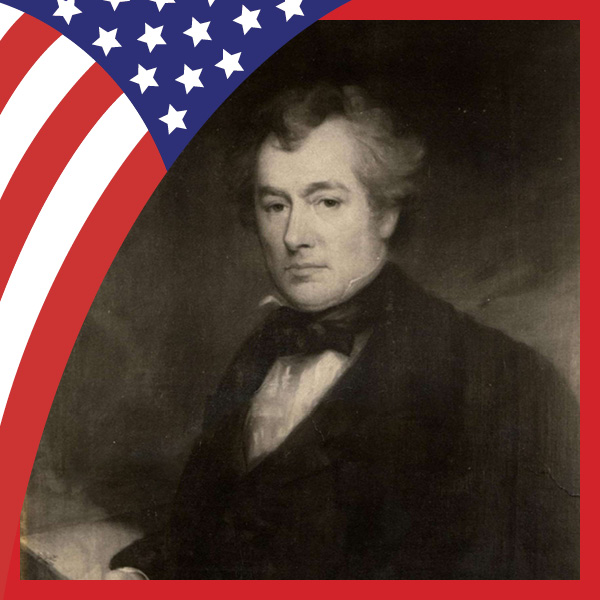
As a doctor to presidents, the dean of UMSOM, and a highly influential professor, Robley Dunglison left a mark in the halls of power and academia as well as the annals of U.S. medicine history.
This story is one in a series about the University of Maryland, Baltimore’s (UMB) contributions to U.S. history as the nation celebrates its 250th birthday this year. The stories will be featured on The Elm website/The Elm Weekly newsletter in the coming months. The series can be read at the UMB Celebrates America at 250 website.
In the early years of the American republic, there was no guidebook for becoming president.
Every decision made by the nation’s first leaders established precedents that would define the presidency for generations. At the same time, American medicine was finding its own identity. Physicians practiced without anesthesia, antibiotics, X-rays, or an understanding of germs. Epidemics swept through cities with alarming regularity, surgery remained perilous, and many diseases that are now easily treated were poorly understood.
Just as the nation was inventing its government, physicians were inventing the practice of medicine in America, and standing at the intersection of those two stories was an English doctor named Robley Dunglison.
In 1824, Thomas Jefferson faced a challenge unlike any he had encountered in public life. Having founded the University of Virginia, the former president was determined to build an institution that could rival Europe’s great universities. To do that, he needed exceptional faculty, particularly in medicine, where the United States still looked to Europe for many of its leading scholars.
Jefferson personally recruited Dunglison to cross the Atlantic and become one of the university’s founding professors of medicine. The young physician accepted, beginning a remarkable American career that would place him at the center of the nation’s political and scientific life. During the final years of Jefferson’s life, Dunglison became his personal physician. He later would care for presidents James Madison, James Monroe, and Andrew Jackson, making him the physician to four presidents and one of the most trusted doctors of the early republic, and became known as “The Father American Physiology.”
His greatest legacy, however, would not be found in the homes of presidents, it would be found in the classrooms of the University of Maryland, Baltimore (UMB).
Influence in Baltimore and Beyond
In 1833, Dunglison joined the faculty of the University of Maryland School of Medicine (UMSOM), already one of the nation’s oldest and most respected medical schools. He was named dean only a year later, bringing with him an international reputation, firsthand experience treating some of America’s most influential leaders, and an unwavering belief that medical education should be grounded in science rather than tradition.
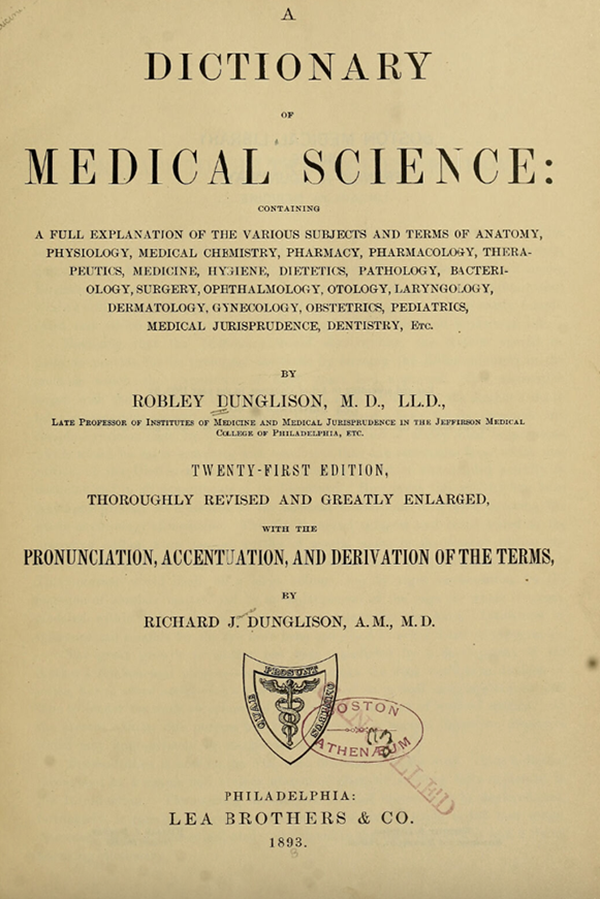
Robley Dunglison’s “A Dictionary of Medical Science” was one of the medical profession’s first standard reference books.
At the time, many physicians still learned primarily through apprenticeships. Medical schools varied enormously in quality, and scientific standards were only beginning to emerge. Dunglison thought that physicians needed something more. They needed a rigorous education in anatomy, physiology, chemistry, and pathology, supported by careful observation and a willingness to question accepted wisdom.
Those ideas helped shape the education of physicians at UMSOM during a pivotal period in U.S. history.
Dunglison’s influence extended well beyond Baltimore. He became one of the19th century’s most important medical authors, producing textbooks that educated generations of physicians across the United States. His “A Dictionary of Medical Science” became one of the profession’s standard references, while his books on physiology and hygiene introduced American physicians to emerging scientific discoveries from Europe. In an era long before electronic journals or medical databases, his writings helped standardize medical education throughout the country.
His work reflected a larger transformation taking place in the United States. As canals, railroads, and industries connected a growing nation, science was becoming more organized, more collaborative, and more evidence-based.
Medicine followed the same path. Physicians increasingly relied on observation, experimentation, and shared knowledge rather than tradition alone. UMSOM became one of the institutions leading that evolution, and Dunglison was among the educators who helped define what modern medical education should become.
Leaving a Legacy
Although history often remembers him as the physician who cared for presidents, Dunglison probably influenced far more lives through teaching than clinical practice. Every student who sat in his lectures carried his ideas into communities across the country. Those physicians treated families, established hospitals, trained future doctors, and contributed to the steady advancement of American medicine. His patients included some of the nation’s most famous men, but his students cared for countless Americans whose names would never appear in history books.
As the United States celebrates the 250th anniversary of the Declaration of Independence, co-authored by Dunglison’s most famous patient, it is worth remembering that the nation’s history has never been shaped by elected leaders alone. Behind every president stood teachers, scientists, physicians, and educators whose work quietly strengthened the country in ways that often escaped public attention.
Dr. Dunglison was one of those figures.
He stood beside presidents as the office itself was taking shape. He later stood before students at UMSOM, helping define how physicians would be educated in the United States. His belief that medicine should be rooted in scholarship, scientific inquiry, and lifelong learning continues to guide UMB more than 190 years after he arrived in Baltimore, and UMSOM commemorates his contributions each year at commencement by conferring the Robley Dunglison Award upon a graduate for excellence in preventive medicine.
Dunglison’s story reminds us that the most enduring influence is not always exercised in the halls of power. Sometimes it begins in a classroom, where physicians’ ideas are passed from generation to generation, improving the lives of people they will never meet.
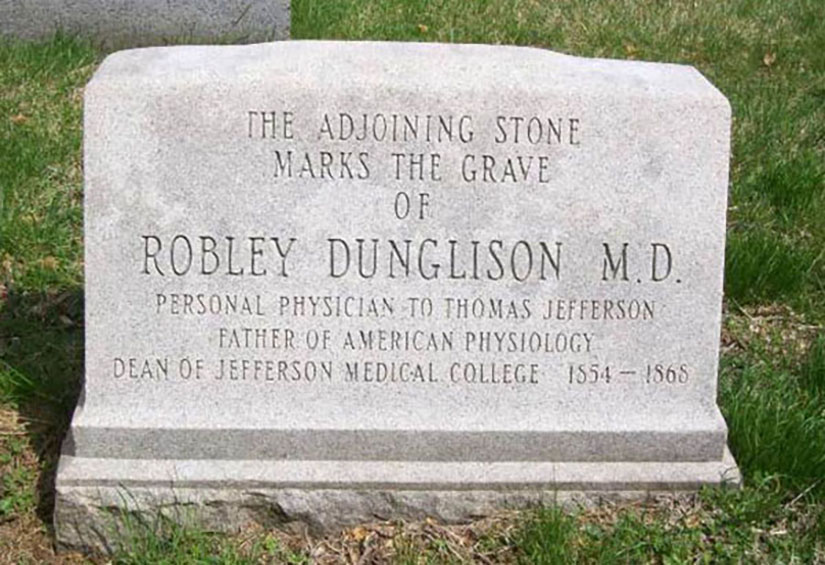
This stone marker is adjacent to Robley Dunglison’s grave at Laurel Hill East Cemetery in Philadelphia. Dunglison died in 1869 at age 71.