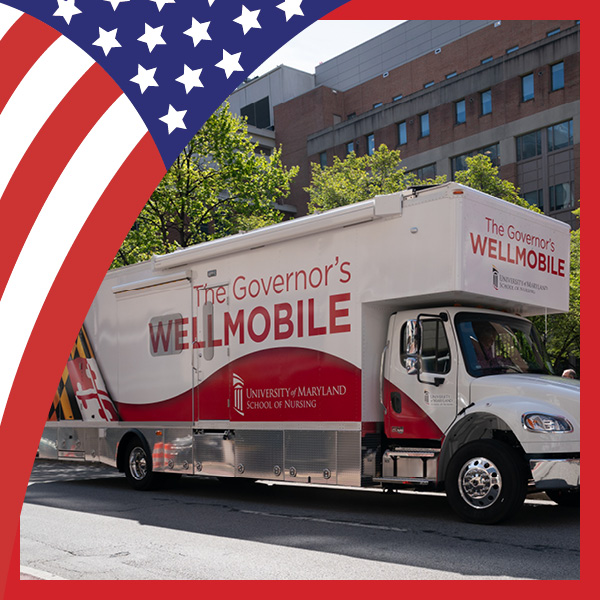
Since 1994, the program managed by the School of Nursing has been a vehicle for faculty, practitioners, and students to serve Maryland residents who face obstacles to receiving medical care.
This story is one in a series about the University of Maryland, Baltimore’s (UMB) contributions to U.S. history as the nation celebrates its 250th birthday this year. The stories will be featured on The Elm website and in The Elm Weekly newsletter. The series also can be read at the UMB Celebrates America at 250 website.
The American promise has always included a simple but powerful belief: Where you reside should not determine whether you have the opportunity to live a healthy life.
For much of the nation’s history, however, that promise has remained out of reach for millions of Americans. Rural communities, underserved urban neighborhoods, older adults, families without reliable transportation, and individuals experiencing homelessness have often faced significant barriers to accessing health care providers.
The University of Maryland, Baltimore (UMB) has spent generations working to close those gaps. Few examples embody that mission more visibly than the Governor’s Wellmobile program, the traveling health clinic managed by the University of Maryland School of Nursing (UMSON) that has delivered primary care directly to Maryland communities for more than three decades.
Instead of requiring patients to overcome barriers to reach health care, the Wellmobile removes the barriers altogether.
The program began in 1994 with a straightforward but transformative idea: If vulnerable populations cannot access health care easily, health care should come to them. The brightly colored mobile clinic has served communities in Western Maryland, the Eastern Shore, and Central Maryland, with its current area of focus being Prince George’s County, and could be found parked outside schools, senior housing communities, shelters, community centers, churches, and public housing developments.
Inside, patients find much more than a medical examination room.
They find trusted health professionals and a bilingual, Spanish-speaking outreach worker. They gain access to preventive care that helps identify health problems before they become emergencies. They receive vaccinations, health education, referrals to specialists, behavioral health support, screenings for chronic diseases such as hypertension and diabetes, and guidance for navigating an increasingly complex health care system.
For many patients, the Wellmobile represents their first consistent connection to primary care.
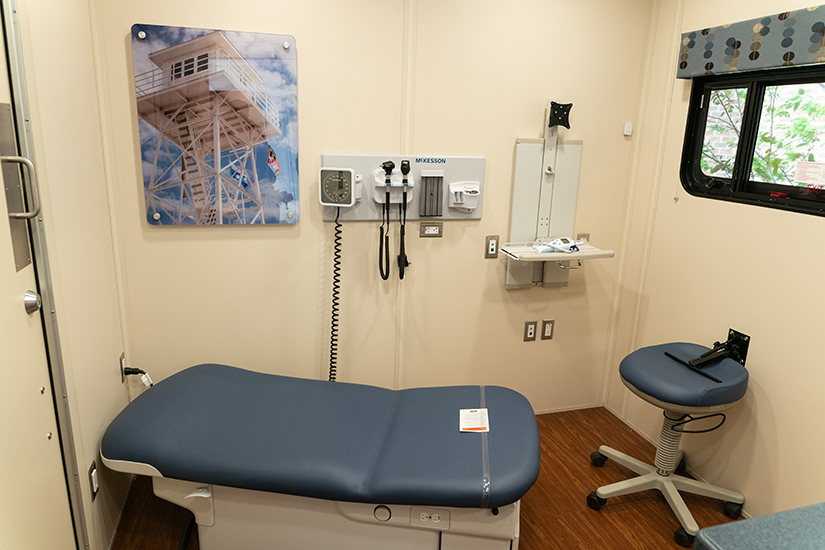
Patients can be seen by nurse practitioners in an exam room inside the Wellmobile. (Photo by Matthew D’Agostino)
Hands-On Learning
The clinic also serves another critical purpose: preparing the next generation of nurses.
Students from UMSON work alongside experienced faculty members and clinicians, learning that exceptional health care extends beyond hospital walls. They witness firsthand how social factors — including housing, transportation, food access, education, and income — influence health outcomes. They learn that listening, building trust, and meeting people where they are can be as important as any medical intervention.
These experiences shape nurses who understand both the science of health care and the realities of the communities they serve.
Over the years, the Wellmobile has cared for tens of thousands of Maryland residents, often becoming a dependable presence in neighborhoods where access to health services has long been limited. Its partnerships with local governments, nonprofits, schools, and community leaders demonstrate that improving public health is most effective when institutions work together rather than in isolation.
The program also has adapted as community needs have evolved. During public health emergencies, the Wellmobile has expanded its role to provide testing, vaccinations, education, and outreach. As chronic diseases have become increasingly prevalent, the clinic has emphasized prevention and long-term management. Throughout each challenge, its mission has remained constant: bringing compassionate, high-quality care directly to the people who need it most.
Community-Centered Care
As America commemorates its 250th anniversary of its independence in 2026, the Wellmobile reflects an enduring national ideal — that innovation should improve lives, and opportunity should extend to every community. And as UMSON celebrates the 60th anniversary of its master’s program in community/public health, the Wellmobile stands as a shiny and shining example of the school’s commitment to public health while serving as a clinical site for students in the program.
UMSON has transformed a vehicle into something much greater than a mobile clinic. It has created a model for community-centered health care that has influenced the way health systems think about access, prevention, and equity.
For UMB, the Wellmobile represents more than a successful program. It also reflects the University’s broader commitment to public service, education, and discovery — a belief that knowledge achieves its greatest value when it reaches beyond a campus to improve people’s lives.
For thousands of Marylanders, the Wellmobile has meant more than a doctor’s appointment. It has meant reassurance, prevention, connection, and hope.
And for 32 years, it has demonstrated that some of the most meaningful advances in American health care do not always happen inside a hospital. Sometimes, they arrive on four wheels, meeting communities exactly where they are.